


Ben Thompson started the Stratechery blog in 2013, covering the business strategy behind tech companies. He’d been writing it for a year before introducing a paid subscription.
Up to that point, it had been a side project while working full-time for Automattic. The company hired a globally remote workforce, which meant they had a strict policy against second jobs.
So when a consulting offer came up, Ben took it, left Automattic, and launched the paid version of the newsletter. The plan was still to run it as a side project until the revenue was sufficient to go all in.
But the consulting job fell through, and Ben had already burned the boats. He needed to make the business work immediately.
“I had a one-day goal, a one-week goal and a one-month goal. And I failed to reach all of them and failed pretty significantly, honestly.” – Ben Thompson
He’d given up a six-figure job, couldn’t pay credit card bills, had sleepless nights, worked seven days a week, and managed tech that was constantly breaking. This was spring of 2014 – there was no out-of-the-box software for subscription newsletters.
His pride wouldn’t allow him to quit before he’d begun, but come the summer, his network wasn’t exactly supportive of the move.
“No one thought I would succeed. I had lots of people reach out and be like, ‘Hey, Ben, I love you, but subscriptions are not a thing on the Internet. It’s not going to work.’” – Ben Thompson
There were, however, promising internal signals.
Though subscription numbers were in the low hundreds and not delivering a full-time salary, they were growing month-on-month from April through July. People liked the product.
“I looked at those numbers, I’m like, I think it’s going to work.” – Ben Thompson
Progress continued through word of mouth.
By November, seven months in, he hit his year one goal – $100,000 in revenue.
He celebrated with a post on his website, which he shared on Twitter:
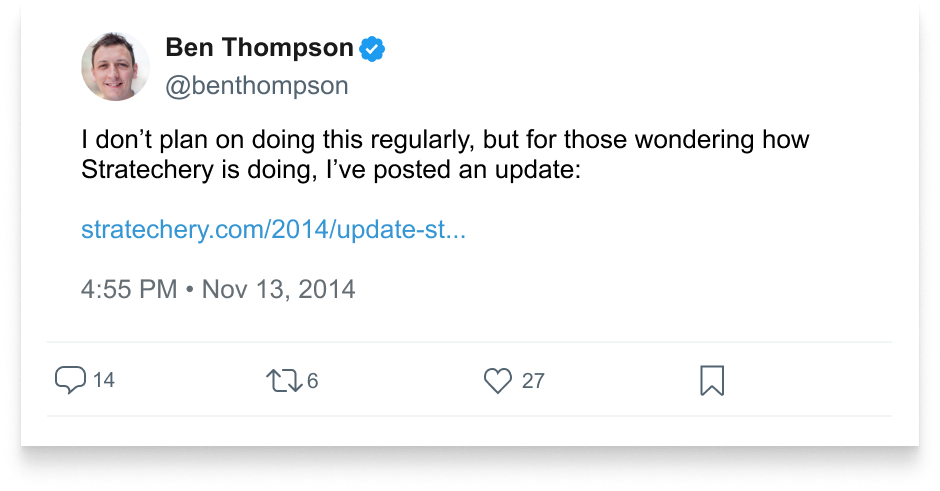
The update: he had passed 1,000 active members, and though he wasn’t getting rich, he was “making a living.” The business model worked.
“And in the next 24 hours, I got 250 new subscribers. By far the biggest step change in my subscriber growth.” – Ben Thompson
Ben had a hypothesis for this instant spike:
Many readers visited his website for the free bi-weekly articles but didn’t subscribe because they feared he would go out of business and they would lose their money. The moment the market received a signal that this newsletter was here to stay, he grew his membership by a quarter, instantly.
I also think the Legitimacy Threshold was at play.
Research shows that new ventures rely on a recognition of legitimacy to attract early investors and customers, and that aura of legitimacy comes from a range of different signals like early user traction, credible endorsements, and press coverage.
1,000 active members met the Legitimacy Threshold, unlocking the wave of early majority who’d follow the early adopters. That new wave then triggers further legitimacy signals.
By early 2015, Stratechery had passed 2,000 paying subscribers.
By 2020, Fortune cited estimates of $3m in revenue from approximately 25,000 paying members, which, according to Thompson, was still growing through word of mouth.
There are two lessons to highlight here:
One, when you have internal signals of legitimacy, share them publicly.
And two, Ben had strong, early signals of resonance, which isn’t always the case. Often, progress is slower. I wonder how many people give up, thinking they have no momentum, when really they haven't yet reached the Legitimacy Threshold that will open up the market.
P.S. This story comes from Ben Thompson’s conversation on the Acquired Podcast with Ben Gilbert and David Rosenthal.