Chapter 1 — Win Without Pitching
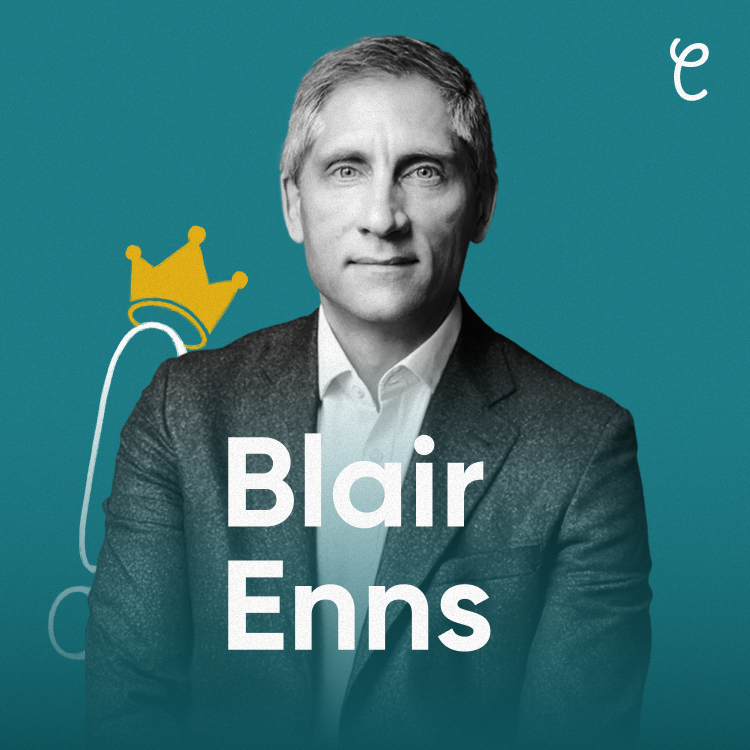
Liam Curley: Blair Enns is unquestionably an Undisputed Authority in the creative service industry. One of his books, Pricing Creativity, has generated $1 million in net revenue. Another, The Win Without Pitching Manifesto, is an evergreen bestseller with 100,000 copies sold. He also co-hosts The 2Bobs, one of the most popular podcasts in his niche.
A question I had when I started researching Blair was what seeded the success? He's not a heavyweight on any one social platform. He posts a public email once a week, co-hosts a podcast every other week and published a book every 6ish years. From the outside looking in, his production cadence appears consistent rather than prolific.
In a world where thought leaders in inverted commas pump out daily content, how did Blair build authority without being everywhere all the time? That's what I'm going to try to answer in three chapters, starting with chapter one, Win Without Pitching.
Blair studied business administration at college and worked part time organising concerts and speaking events for the Student Association. Upon completing his diploma, he sees an advert for a PR job and thinks, this is a natural progression to what I'm doing. Here's Blair on the Kamp Vuur podcast.
Blair Enns: They didn't hire me, but they called me back a few months later and said, we bought an ad agency. Would you like a job in advertising? So I went, yeah, that'll be fine.
Liam Curley: He applies for the job, doesn't get it, but then gets a call back from the PR firm who inform him, we've just bought an ad agency. Would you like a job in advertising? Early on in that job, his boss recognises something in him. He tells Blair he seems fearless and puts him in charge of new business.
Blair is 22 years old at the time. In his words, he barely knows what he's doing, but he gets some early wins and learns, as Blair says, some tricks. Over the next 10 years, Blair works in business development for ad agencies. Up to this point, he's working for large agencies in urban Canada.
But growing up in central Canada, Blair loved nature. So when he and his wife, Colette, have their first child, a seed is planted in their mind that when the opportunity arises, they'll move to a more rural village. That move isn't going to work whilst he's working for agencies. So as he's starting a new business development role, he tells his boss:
Blair Enns: I said I'd work for you for a year, then I'm going to move to the woods to do this consulting thing.
Liam Curley: Early in that role, he and his boss are in a business call together when something in Blair's posture changes. Blair had always hated being in a position where he was one in a sea of many, where the client had all the power and used it to push him around. He's in a meeting with his boss and a prospective client and the meeting is going well. But at the end, the client says, you guys seem great. Why don't you come back with some ideas of how you can help us? And Blair is fed up hearing this at this point. He's heard it so many times, he looks at the client and says, oh, no, we never pitched. Here he is talking about that call on the Agency Collective podcast.
Blair Enns: And at the same time, I said that, my boss, who was sitting next to me, said, okay, and looked at each other, and I forget how we got out of the situation. And afterwards he said, he was a great guy to work for, he said to me, hey, hey, I don't. I don't mind this approach that you're taking. I just, you know, I'd like to know in advance.
Liam Curley: That's the moment. The seed of the idea for Win Without Pitching. Blair starts pushing back on requests to submit to the pitch process. Though he has no deeply thought out methodology for how to do that, in his words, he's just fumbling his way through some early successes. Around the same time, his boss signs him up for a sales training programme.
Blair Enns: I went through the training, it was led by a woman named Pauline O'Malley. And I just thought, this is brilliant. This is like we're. We don't. This is basic sales stuff. And more than that, I don't mean to disparage her content. It was a very. It was more than that. But I thought, even just the basic sales skills procedures, we're not taught that in the agency world.
Liam Curley: Those 12 months he planned to work with the firm, turn into 20, at which point he tells his boss he's gotta go. He's got a vision of the life that he wants to live. His boss asks how he's going to earn a living, to which Blair responds, he doesn't know, but he has a vague idea of a consulting practice. So his boss offers a deal.
While you're building your consulting practice, why don't you just sell for me remotely from wherever it is you're going? That gives Blair the financial security for the next 12 months to move to Kaslo and go start his own consulting firm. Now, Blair had already validated the idea of winning agency work. Without pitching, he'd proven that you don't have to say yes to every unreasonable request the client makes in the prospecting phase, but there was little thinking to support that stance and there was no methodology.
So when he launches his consulting practice in 2002, he starts writing an approach, as he puts it. He thinks through his fingers. He has to write to know what he thinks. He also contacted Pauline O'Malley. If you remember, that's the lady who ran the sales training course he attended. And he asked her whether he could licence some of her material for a book he was writing. She agreed. So what was in the book?
Blair Enns: Just the entire system of selling. So just everything from how to position your firm right through to the sales interaction. And she had this model that she used that I had licenced, which is some specific way to think about the stages in the sale. And then on top of that, just a whole bunch of general, what you would consider to be general, somewhat obvious, but not obvious to those in the creative professions, advice on basic sales tactics. So it was, it was a system, it was a sit. How do you generate leads? Everything from positioning to lead generation, then to how to navigate the conversations, how to construct proposals.
Liam Curley: He took the basics from Pauline, translated it to agency selling and then infused his perspective on how to win without pitching. He called it the Win Without Pitching Manual. Here he is on the Design Domination podcast.
Blair Enns: I'm a writer, so I wrote everything I knew about new business from this point of view. Ended up with a book that I published on my website. It was self published, it was simply called the Win Without Pitching Manual and I sold it for $995 a copy.
Liam Curley: So the book goes on the website and Blair discovers the Second Wind Network, which had a list of agency members along with the names of their respective presidents and email addresses. He sent 30 emails promoting the book and received 15 replies. Blair acknowledges there was a large amount of luck in his timing. He was starting a business in the early days of the Internet being used commercially, where there weren't many competitors doing what he was doing and the ones who were were difficult to find. In his words, behind every successful business, there's a whole bunch of luck. And his timing was perfect. As he receives each order, he prints the book from home, binds it in a three ring binder and then ships it. And as he sold each book, he successfully upsold his consulting services.
So now the consulting business is up and running and he continues to sell that book until 2010 when he releases the Win Without Pitching Manifesto, which we'll come back to later. From a positioning perspective, I want to reflect on what Blair did here. Blair made a positioning claim before he was ready to make that claim. Here he is speaking with Chris Do from The Futur.
Blair Enns: I've made this claim and like the world's not beating a path to my door. The claim is just the starting point, right? What I would say is make the claim before you are perfectly comfortable making it. Your positioning, the claim that you make can be a little bit aspirational. And recognise that the act of making the claim will hurry you up, will sharpen your focus to build the missing skills, capabilities and processes like nothing else.
Liam Curley: Today, we all know Blair as the undisputed authority of winning work without submitting to the pitching formality. But he claimed that title of winning without pitching before he had any formal procedures and methodologies around how to win without pitching. He'd simply done it informally for a relatively short period of time. That was a bold claim in a market of clients accustomed to making unreasonable demands in the sales process.
I'm going to help you decline those demands and still win work. He makes the claim before he's ready to truly make it, which encourages him to go write the methodologies and think around his positioning. And over the 10 years that follow, he becomes the authority. But that's only possible because he made the claim before he was the expert.
Subsequently, he spends the following years between 2002, when Blair launched the Manual, and 2010, when he launched the Manifesto, successfully proving that claim of expertise.
Chapter 2 — Manifesto
Liam Curley: So Blair launches the Win Without Pitching Manifesto in 2010, and that book would propel him and his brand to another stratosphere. Now, at that point, when he published the book, he already had an audience of thousands email subscribers who loved his thinking and would spread the word about the new book. And we'll talk more about that book soon.
But before we get there, let's talk about those eight years between launching his business with the Win Without Pitching Manual and becoming an undisputed authority in 2010 with the Win Without Pitching Manifesto. How did he build that following? First, in 2002, he buys a couple of email lists of approximately 4 to 5,000 people and starts writing emails.
Blair Enns: I was always uncomfortable with purchasing lists. I don't know that you need to be uncomfortable with it. I think it depends on how you use the list and how you introduce yourself to the list and the value that you're providing to the list, which is also a function of the quality of that list.
Liam Curley: Those lists get the ball rolling, but more importantly, the act of writing develops his thinking and gives him something meaningful and interesting to share. He curates what resonates and with that material, has a foundation, something with which to approach event organisers and proactively apply for speaking opportunities.
Blair Enns: I did a lot of speaking engagements. I identified all of the organisations to whom I thought, I need to be able to. I need to get on a stage and speak to this audience. And I slowly checked them all off the list and it took years. So a speaking engagement leads to another speaking engagement.
Liam Curley: His first speaking engagement is in Nashville. A friend of his runs an office in Blair's hometown. And when Blair starts his consulting practice,
Blair Enns: the friend says, oh, there's this guy, David Baker. You really need to get to know him. And I went to his website, I thought, oh, he's. He's really smart. And then I saw that he had this conference and I thought, I need to speak at this conference. So I just sent him an introduction. I didn't ask this and just said, hey, I'm just starting out. Here's what I do, here's my website.
Liam Curley: David replies, telling Blair, that's really interesting. Do you want to speak at my conference? That's the first speaking engagement. Blair does a few more, but fast forward to 2005.
He's at his brother's wedding in his hometown when later the next day, he gets an email from David C. Baker.
Blair Enns: And I get this email from David C. Baker titled Oops. And he said, hey, two days from now, I'm doing a new business seminar for 20 agency owners in Nashville and I'm in the hospital with a kidney stone. What are the chances you could fly down here and do this for me? And I thought, well, I'm just sitting here in this other city, it's actually easier for me to get there. I can do that. So I said, sure. So I flew down there and I helped him out. He would leave the hospital for a few hours at the time to make sure I wasn't destroying his good standing with his clients. Then the next year, he said, hey, why don't we do an event? And we called it the New Business Summit. And we did it every year for 10 years. And by the time we shut it down, there was, I think maybe there were 50 people. When it first started, we had as many as 130. When we shut it down for the
Liam Curley: next 10 years, Blair co-hosts the New Business Summit, which had a fundamental impact on Blair's personal brand and exposure.
Blair Enns: David introduced me to a bunch of people. So even though my talk in that first year was pretty bad, a couple people did hire me. And then he invited me back a couple years later and then more people hired me. And that was a real community of similar firms. And I got to become well known in that community of firms and many of those firms over the years hired me.
Liam Curley: So we're in this season where Blair is frequently writing, speaking, developing interesting ideas and perspectives and frames, when in the middle of it, he releases a blog post that will further transform the trajectory of his business. In December 2008, he released a blog post with 12 proclamations for the New Year. Here he is on The 2Bobs speaking about that moment.
Blair Enns: And I'm a big fan of manifestos. Some of the inspirations for that book were Confucius and Nietzsche. I love this aphoristic writing style, these short, pithy truths, lofty tone of voice. And I thought I would try on this manifesto-ish tone of voice in this blog post. So I was the most nervous I had ever been about publishing content when I posted that to the website and hit send. And I remember thinking, oh, this is highly likely, this is a mistake, it's going to seem silly. And then slowly the feedback started to come in and people were telling me, I've printed that out and mounted it on my wall. And then it was only probably two or three months after that post went out that I realised, okay, this is the book.
Liam Curley: This pattern comes up regularly in my research of other authorities. They publish a blog post or a series of tweets. The material strikes a nerve with the market and the author subsequently recognises that they're onto something, so they expand on that short form content into a coherent, structured body of work, which is usually a book. For example, if we take Austin Kleon and Steal Like an Artist, which has sold more than 2 million copies, that book started as a series of blog posts where Kleon was collecting quotes by artists he admired who were using the word steal.
He turns that into a Twitter thread, pointing back to the blog, which goes viral. And subsequently he gets so much web traffic to that original blog post that it brings his website down. That's what he subsequently turns into a book. So Blair had already written the Win Without Pitching Manual, but with the manifesto, he wanted something more accessible and less of a how to.
Now, after six years of writing and speaking on the subject of winning without pitching, he was confident on the formulation of his thinking and the tone of his voice. But what does an ideology book do that a how to doesn't? Here he is speaking on The 2Bobs.
Blair Enns: I always say that your thought leadership people will come for the content, but they'll hire you for the ideology. You're looking for one of two reactions to the ideology or the point of view or perspective. The two possible reactions that you're looking to get are, number one, we are ideologically aligned. We think about these things the same way. You are my guy, gal, you're my person. We are ideologically aligned. And number two is I've never thought of it that way before. That's interesting, where you convert people to your ideological point of view.
So it's one of those two reactions, and I think both of them worked. I think there were a lot of people in the creative professions and still are who hoped that there was a different way that you could do this, who imagined that it might just be possible to actually show up in the sale with some integrity, exhibit some backbone, say no, stand up for yourself, and still win the business. And the manifesto was meant to be a yes, you can book. I wanted you to be able to read it in two or three hours, put it down and be convinced that you could do this.
Liam Curley: And Blair is intentional about how he wants the book to be packaged. Here he is again on The 2Bobs.
Blair Enns: I took a book that was the right thickness, then I cut it down to what I thought was the right size, and then I reverse engineered the word count from there. But luckily it arrived at somewhere around 24,000 words. With some room to move, I could have made the book a little bit longer, a little bit shorter, and it just rested at 24,000. But that really gave me the freedom to write less than the standard 50 or 60,000 word count that they talk about for a business book.
Liam Curley: He writes the book over the next couple of years, publishing it in 2010, and he writes it to be timeless. The idea was that this book would outlast him, that he was producing an asset he'd be able to leverage as long as he was in the business. It's as relevant today as it was when he wrote it. So what does the book do for his business?
First, it's an extremely effective sales tool. Here he is again on The 2Bobs.
Blair Enns: One of the ways this has really worked is because it's an ideology book. This is our point of view. It was my point of view back when it was just me when it was published, and now it's our point of view. It's become a really powerful tool in the sale. So if somebody reaches out to us for training, and previous to us being a training company, I was still a solo consultant. If somebody reached out to and they weren't aware of my ideology. I would ask, have you read my book? And if they hadn't, that was the homework. Go read the book, you will be on board and effectively I will have no competitors. From a sales advantage point of view, there's a lot to be said for having a polarising ideology and putting it out there into the world and letting the market select based on I'm either ideologically aligned or I'm not.
Liam Curley: At the time of recording, Blair has sold more than 100,000 copies of the manifesto. So it has broadened his and his business's reputation dramatically. And that number will keep rising because though this book was written with the view of getting Blair's message out into the world and bringing in clients, it's an evergreen classic in the niche.
Blair Enns: I think we net about 50,000 a year from that book. It's done its job in getting a reach out there, it's helping people, it's done its job of getting us known and driving leads. And it's unexpectedly done a bit of a job in actually generating revenue. So it's good marketing that does good work, that actually makes money rather than costs money.
Liam Curley: After the manifesto is published, Blair's notoriety increases, he gets more speaking opportunities and he's fully booked for consulting work, making around $350,000 annually from those engagements. But he's burning out. Here he is on the Consulting Success podcast.
Blair Enns: I had pushed the independent consulting model as far as I could go in 2012, the last year that I was a consultant, I got sick four times on three continents. Not serious, but just run down. And the last one in November, I was flat on my back in bed with pneumonia for two weeks. And I thought, you know what? I was thinking through all these things, and I was thinking, okay, it's time to make the shift. This business model is killing me.
Liam Curley: So he begins exploring the options of tweaking the business model. And he asks himself, how can I increase revenue as a solo consultant with a cap on the number of hours I can sell each month? In his research, he discovered Ron Baker and value-based pricing and came to the conclusion that he had been making a classic mistake. Blair realised there are customised service businesses and there are productised service businesses.
And he was stuck in this what he called mushy middle. Win Without Pitching had started as a consulting company. So in theory it should have been a customised services business. But again, in his words, he had quasi productised his services, which is something in retrospect, he noticed firms doing a lot. His insight was that you can make more money and have more impact if you commit to one end of the spectrum.
Either you embrace that yours is a customised service business, small number of clients, pricing based on the value you create, or you pursue, scale and build a company. He decides to switch from this quasi position to productised expertise, doubles down on events and seminars and gets to work building the Win Without Pitching programme, business development training and coaching on the Win Without Pitching way. That move was enormous because Blair has subsequently introduced a team and increased revenue and profit by several multiples. But it's important to add here as we wrap up this chapter that Blair has since slightly changed his perspective on customised consulting versus productised, introducing the distinction of standardised delivery and standardised pricing.
According to Blair, quote, the most lucrative business models for professional firms appears to be a combination of standardised delivery and customised pricing. End quote. So the firm or consultant develops a process or processes for consistently delivering results, but they don't stick a price label on the service. They price each client according to the value delivered.
Chapter 3 — Get Creative
Liam Curley: Up to this point, Blair hadn't advised on pricing, but after discovering Ron Baker's work, he went down the rabbit hole.
He's described falling in love with the subject of pricing, realising it's part science but a lot of art, and that the field is as big as the entire field of judgement and decision making. It encompasses behavioural economics, behavioural psychology and a whole load of other fields. So he just kept buying books and kept applying what he learned. He starts that process as a self-declared novice on pricing, but in a relatively short period of time.
A friend who owns a small agency says to him, you should write a book on pricing. Blair pushes back because there are already a lot of great books on pricing, but his friend says, your clients are never going to read those books. Blair realises he's right. The underlying theory is in textbooks that most creatives wouldn't touch.
Blair took the advice and got to work writing a book on value-based pricing for creative firms. He'd call it Pricing Creativity. It came in a three ring binder and he applied value-based pricing to the sale of the book. He gave customers three options.
The first was an ebook at $100, second was a physical copy of the three ring binder plus ebook $199 and the third was a five part video series with the three ring binder and ebook at $320. That was an unusual way to price the book. One of Blair's core values at Win Without Pitching is leading by example. And it occurred to him that he wasn't aware of any book on value-based pricing that actually used the principles in the book to price the book itself. He wanted to be the first to do that.
And he'd done some rough maths and estimated conservatively that the book would help create over $100 million a year in new excess profits for the global creative community. If he's going to help create that kind of value, what's fair compensation? Here's Blair speaking on the Modern Sales - B2B Selling podcast.
Blair Enns: And I actually think charging $25 or $40 for the book would have actually devalued what was inside the book and would have actually maybe even had a negative impact on the effect. I think the more you pay for something, the more you value it, the more you appreciate it.
Liam Curley: At the time of recording, Pricing Creativity has generated $1 million in net revenue through sales of approximately 5,000 copies at an average price of $215. And I want to hover on this point because I think it's an interesting one. I've noticed a pattern amongst authorities that the unique insights are produced from observing data. And there are three types of data.
The first is derived from experience. For Blair, that was the Win Without Pitching Manifesto. He'd spent eight years working with creative firms helping them win business without submitting to the formalities of a pitch. He did no research for that book because the insights were derived from his personal experiences and expertise on the subject, the patterns he'd noticed in the field.
The second type of data is primary. Now, as far as I'm aware, Blair hasn't created any significant thought leadership through primary research. So we'll use David C. Baker as an example. David's firm Punctuation helps agency owners sell their businesses and buyers buy them.
He's worked with over 200 firms at this point and in doing so has built a repository of unique proprietary data on the intricacies of buying and selling a firm. Hard numbers which inform unique thought leadership. The third type of data is secondary, which is what Pricing Creativity had built on. Blair conducts heavy research on pricing using secondary data.
In this case, books, then translates that data and applies it to a new field. Creative firms. Notice that none of the research for any thought leadership content involves heavy consumption of material from within its own field. There's value in knowing what peers are doing, but if you look too closely, you end up regurgitating ideas that have already been presented to your target customer, which leads to vanilla content that gets ignored. So if you're going to do research, either collect proprietary data or translate ideas and stories from other fields.
So Blair publishes Pricing Creativity in 2018. But I am aware we've skipped over a significant event that we need to touch on here. Remember the New Business Summit I mentioned earlier that Blair launched with David C. Baker? That Summit ran for 10 years and it had been a huge success, really launching Blair's career as a speaker.
But by 2015 it had become stale.
Blair Enns: My material had evolved, but because I had a co-presenter, my material couldn't evolve into his. Like we had kind of had our lanes and I couldn't evolve into his. It wasn't a horrible thing. I just, a voice said to me, you're just standing up there and saying the same thing you did last year and the year before. This is dangerous for you to get into this rut.
Liam Curley: Blair had an idea to record a podcast with David as a potential alternative to the New Business Summit. The podcast would be a space where they could speak about new topics, rather than delivering somewhat the same keynote over and over. Here's David C. Baker talking about the moment on The 2Bobs.
David C. Baker: I remember you suggesting it. Marcus had never done a podcast before and he was really excited about it. There was no learning curve for him. He knew exactly everything about audio editing, so it was pretty easy for him. And then I remember one of the first things that happened is he recommended certain audio setups for us because he was a real stickler for the quality of it. In retrospect, yeah, it was definitely your idea. And I thought, oh, I'd love to do something with you. Let's do it.
Liam Curley: They record the first episodes in 2015, but they don't release them until 2017. The podcast would subsequently become as impactful on Blair's business as the Win Without Pitching Manifesto, maybe more so. Feedback is great. Downloads have been growing since the beginning, and according to David, he can't have a new business conversation without somebody bringing it up.
Here's David C. Baker on Smart Business Revolution talking about the impact of the podcast.
David C. Baker: It was Blair's idea to do it and I kind of went along with it because I like him, we're friends. I didn't think much would come of it, but I have just been blown away at how it has impacted my business.
Liam Curley: As we close out the final chapter of this podcast, let's end on the subject of books. After the success of the manifesto, Blair would occasionally receive feedback along the lines of, I liked your book. There's not much how to in it. Well, that book wasn't designed to be a how to.
It's about ideology. But for many years, Blair had the idea of publishing a framework book. Here's Blair on The 2Bobs.
Blair Enns: So it really is the here's how to. So if you've read the manifesto, you're inspired by it, but left to wondering, well, like, how do I put this into action? This is really the here's how to.
Liam Curley: Four years after publishing the manifesto, Blair finally started on the framework book that would capture the essence of the process he taught students in his Win Without Pitching programme. It took him 10 years to write that book, which in Blair's words, is the training he delivers, but in book format. But when you sell training, don't you cannibalise that programme?
Blair Enns: Somebody is going to buy the book. And I'm not the first author, slash owner of a training programme to grapple with this question. They don't need to do the training. That's one way to look at it. And on some level it will may cannibalise training. But really when we're talking about it internally and somebody said, what's the difference between the book and the training? My answer was it's the difference between understanding and knowing.
Liam Curley: Blair told me that since the book has come out, he's rejigged the programme to be less of a download of information because all the information is in the book. So the programme's now more about the practical application of that information. Now I had one burning question for Blair on the topic of The Four Conversations. The question being, you priced The Four Conversations at $30.
If Pricing Creativity was worth $320, is your framework worth 1/10 of that?
Blair Enns: I thought about it. That could be priced at 1500, it could be priced at $2500. It could contain some videos with it. I could have turned that into a self directed course. Right. But I have learned that the method by which you try to scale your business is the method by which you will commodify your offering. Turn your IP into a course, it just commodifies it.
Liam Curley: That line captures the underlying essence behind Blair's success. Blair often talks about the three rungs of the lead generation ladder. The top rung is thought leadership. So low immediacy, high authority.
And at the very top of that rung, the number one thing you can do is publish a bestselling book or deliver a TED talk. Here's Blair speaking with Anneli Hansson.
Blair Enns: So I've done that and I'm really good at the stuff at the top and as you move down the rungs, the one in the middle is the marketing rung. I guess that's not really publishing, but if you stay at what we would call the publishing rung. So I've done the big ones and the other ones underneath that. Not so good.
Liam Curley: I'd argue that the decision to not be so good at the bottom two rungs and focus on the top is the foundation upon which his success has followed. His focus has always been to produce groundbreaking, thought provoking content. Because of this, you won't find him in many places. He doesn't post frequently on LinkedIn or X or any other social platform.
Across the span of 25 years, he's only published four books. Now for some that's a lot, but amongst his peers I'd say it isn't. He has built the ultimate luxury brand in his space. Everything he puts out is qualitatively and relatively scarce.
Cal Newport makes a compelling case for this. In a TEDx talk, he pushes back on the idea that you can't quit social media without becoming irrelevant. Newport's argument is that in a competitive 21st century economy, what the market values is the ability to produce things that are rare and valuable. And social media use is the epitome of an easy to replicate activity that doesn't directly produce a lot of value.
It's something that, in his words, any 16 year old with a smartphone can do. The market is always going to reward the deep, concentrated work required to build real skills and produce things like a craftsperson over the noise of being everywhere at once. Now, I'm not suggesting you should or shouldn't quit social media, but I am asking the question, is it in the interest of a premium brand to be in all places at once? Rolex limits the supply of its products for a reason.
Blair does the same. His books are beautiful. Those are his words. We aren't exposed to average, never mind rubbish thinking.
He has filters in place, whether those are from his inner circle or his private email list. Everything that comes out beyond those circles have been tested, so he knows it resonates before it's distributed to the wider market. Seth Godin calls this a promise. Here he is on Talk About Talk.
Seth Godin: Marketers, particularly people with a personal brand in quotation marks, hustle too much. They interrupt too much, they hassle too much. They try to get the word out. I think getting the word out is a ridiculous mantra. It's not effective and it undermines everything you're trying to do.
Liam Curley: I'm not saying you should release an essay once every six months and see how it lands. If you're using content to build your brand, you want to show up regularly, build relationships and gain momentum. As James Clear would say, you want to make a lot, publish a little, curate what resonates.
And relatively speaking, Blair does this. That exclusivity, luxury and original thinking is present in everything Blair does and priced accordingly. It's like Christopher Nolan and Bruno Mars. They don't produce as often as their peers, but when they do, the world stops to buy, applaud and acknowledge them as the greatest in their field on the back of great work. Not a lot of work.
And this same approach is how Blair Enns became an Undisputed Authority. He is to his field what Nolan and Mars are to theirs. Scarce quality that's anticipated, appreciated and applauded when it's published.
Liam Curley: Thanks for listening. I hope you enjoyed this episode and if you did, consider subscribing. In each episode I share the story of how one invisible expert became an Undisputed Authority in their niche. And one more thing. I've created a free email series called the 10 Patterns of Disruptive Wisdom.
In my research of these authorities, these are the consistent behavioural patterns I noticed amongst those who rise to the top. To get the email series, head to liamcurley.co.uk. Link in the description.