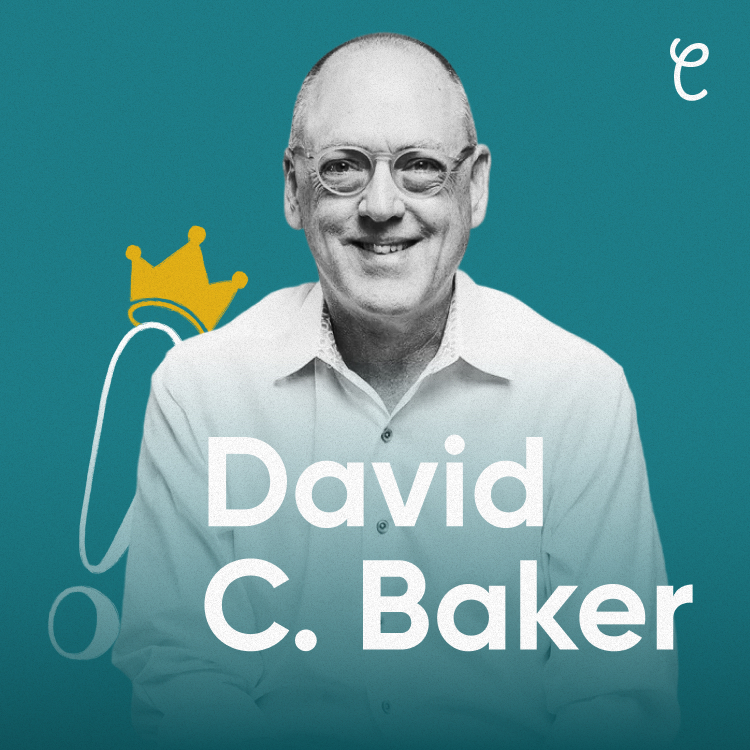
Across three decades, David C. Baker has become the leading authority on positioning and lead generation in the creative services space. That stature is driven by a phenomenal body of work. There are several books, one of which, The Business of Expertise, is, in my opinion, the best book you'll find on positioning. And his podcast with Blair Enns, 2 Bobs, is the most listened to podcast in the space. But he built that body of work at a time when there was less competing content, people were more likely to read emails, and readers determined what showed up in the feed rather than social media companies.
If David was starting today, would his deep and thoughtful content style rise to the top in a crowded marketplace of mostly shallow, easy to consume clickbait?
Chapter 1 — Borrow
Liam Curley: David was born in Michigan and his parents were medical missionaries. So as a young child his family moved to Costa Rica to learn Spanish and then to Guatemala, where he grew up in a Mayan village with no running water, no electricity and no roads. David has said he wouldn't trade that experience for anything. He moved back to the US when he was 18 and spent six years at grad school studying modern and ancient languages.
His ambition was to teach at graduate level, but that changes as he becomes disillusioned with academic life. David had worked along the guiding principle that you follow the truth no matter where that truth leads you. But he discovers, in his words, an unspoken stipulation at university that conflicted with his beliefs. We follow the truth so long as it doesn't lead to certain uncomfortable conclusions.
So part way through grad school he knew he was on the hunt for a different career to the one originally planned. And while reading a newspaper, it occurs to him that most of the ads in this newspaper were terrible and people were getting paid to make them. So maybe there's an opportunity here for him. In 1988, after completing his studies, he starts an agency and over the next five years he grew that agency to become a 16 person business.
But in his words, it was a pedestrian average agency. What kind of work were the agency offering?
David C. Baker: It was pure marketing and advertising and we didn't have a declared focus, but there was a pretty heavy emphasis on higher ed.
Liam Curley: Okay, just because the nature of you were getting higher ed clients and then referring, they're speaking to other higher ed people.
David C. Baker: Yeah, yeah.
Liam Curley: I asked David, how are you winning the work?
David C. Baker: Well, this was before the geographic moat was destroyed. So back then, you know, from 88 to 94 when I was running this thing, your clients were local. So you know, in the small town of Warsaw, Indiana, there were three notable agencies. One of them was really, really good and then there was me in the middle and then somebody else, I don't remember. And so it was simply a matter of connections and calling and networking and, you know, it was just the old that, that doesn't work anymore. I mean, that's the way some people are still trying to do it. But back then it wasn't a mystery because there was a geographic moat. You weren't serving people that were outside of your market, so you knew who they were. Yeah.
Liam Curley: David was a subscriber to Cameron Foote's Creative Business newsletter and had been since the year David had started his agency. Cameron's newsletter was described at the time as the only newsletter dedicated to the business side of providing creative services. Back in the early 90s, there wasn't a great deal of content online and this newsletter was a big deal. Cameron encouraged readers to reply with any questions or feedback, which was his way of staying in touch with the marketplace and figuring out what readers wanted.
So there's this period of regular contribution where Cameron writes a newsletter. David responds with his thoughts on the subject matter. This continues until at some point Cameron asks David to contribute a guest article. He tells David, I'm not really good in this area. Maybe you could write an article.
Was there a particular theme in your responses to the newsletter? Were there certain things you were saying or topics you were talking about?
David C. Baker: Yes, for sure. And those overlapped with the topics that he wasn't comfortable writing about. So the one topic specifically was on financial management, financial issues, accounting, taxes and so on. And it's not like that was my favourite topic, but that was the area where he let me make a contribution so I just jumped on it. Right. It wasn't. I would have chosen something else to talk about, but that was where he wasn't comfortable. So that's where he asked me to contribute at first. And all my articles were about that at the beginning and then they kind of migrated further out as he got comfortable with my perspective.
Liam Curley: So correct me if I'm wrong here, but the first responses are around financial to Cameron. Do those evolve before the point at which you offer consulting through the newsletter? Are you then talking about positioning and other topics like that with Cameron and into his audience?
David C. Baker: Yes, yes. After those initial financial topics, then he had me write about some other things as well. Yes.
Liam Curley: The first guest article happens around 1991 and David regularly contributes over the next two years. Around that two year mark, it hits David that Cameron is sitting on an untapped opportunity, a readership of agency owners interested in learning more about the business side of running a creative service firm. He asks Cameron, why don't you offer these people consulting? Cameron had his reasons for not wanting to do that, but he said to David, maybe you should.
David is still running his own agency at this point, and the idea hadn't occurred to him up to now. Cameron offers to put an ad in every publication promoting David's advisory offer in exchange for a 10% cut on everything David makes. David agrees. Do you remember what the consulting offer was that you put out?
David C. Baker: Yeah, I actually have a copy of the ad, actually. So he actually wrote it. He wrote the ad and put it in. And the idea was that if you want specific consulting from David, the author of some of these articles, then just reach out to him. And he asked me to give him 10% of everything I made, which I did. And then I later increased that for my own weird reason. And it was just a little small, sort of like about an eighth of a page ad or something like that. And I didn't think anything would happen, but people started calling right away.
Liam Curley: Yeah, what was your weird little reason for increasing 10%?
David C. Baker: Oh, because here I am talking on and on about how you need to avoid client concentration. And it hit me. It's like, oh, my goodness, I have my own client concentration issue because all of my work in the early days was referred to me from Cam. And so I needed a strong incentive to diversify and find work in other ways. So I called him up one day and I said, hey. No, actually I sent him an email and I said, hey, I need to increase this to 15% instead of 10%. And he thought I was nuts. And I explained, no, it's like this is 10% doesn't give me a strong enough incentive to find my own work. So it needs to be 15%. And I think within like five or six months. I was hardly getting any referrals from him at that point because the incentive was so strong to keep all the money. Right. So that's why.
Liam Curley: Oh, wow, that's great. That is an unusual approach, but I understand.
David C. Baker: What makes, what I understand my makeup. Yeah, it's about freedom and money.
Liam Curley: Within six months of advertising this new consulting offer via Cameron's newsletter, David's life changed entirely. He was fully booked with consulting opportunities. So he wraps up the agency and goes all in on consulting other agency owners around things like staffing, positioning, new business and service offering. The advice he's delivering gets better with each engagement, not because he was an exceptional agency leader, but because he's working with the same people on the same problem over and over. Here he is speaking on 2 Bobs.
David C. Baker: I'm not guiding agency principals because I was an amazing agency principal. I was a very pedestrian, average one. Honestly it comes more from just learning as much as I can by seeing the inside of other firms.
Liam Curley: As David mentioned previously, he jacks up the commission he pays Cameron as a way to incentivise himself to find other sources of lead generation. He starts by buying a full page ad in Communication Arts. The ad costs $5,000 per issue, eight issues per year. Here's what was in the ad.
David C. Baker: It was basically just trying to say things like, you know, your success is largely unrelated to your creativity. Creativity was big back then. It's more related to the quality of your business decisions. That was the theme of the ad. It was done by an agency down in Birmingham, Fitz Martin. It was a really great ad. And then I invited people. The call to action was a toll free number because I didn't want people to know I was in Nashville at the time. It wasn't a cool place back then. And to subscribe to the email. So those were the two CTAs in the ad.
Liam Curley: And then they subscribe and then you build a relationship, they read your material and at some point they inquire, is the idea.
David C. Baker: Yeah, exactly. I've never felt like everything I do, speaking, writing, like whatever, it's like all I care about, subscribe to my email. Is like if you get this weekly stuff and if we're a good fit to work together, it's going to happen. Like I don't, I'm not going to call you, I'm not going to put you in some sort of a drip funnel. It's like, no, you're just going to get the emails and if it resonates you're going to call me. So everything I did was designed to get somebody's email address, period.
Liam Curley: So David's advertising with Communication Arts now, which is the big publication in creative services and then he starts speaking. At this point we're still in the early days of the advisory business around 1994 and that brings in more work. Do you remember your first speaking opportunity relative to what you do now? Do you remember what that was and could you tell me about it and how it came about?
David C. Baker: It was in Sacramento. I flew there and I was the keynote speaker. I could find my notes but it was something like the 10 things you should know about such and such and I look back on that and I think, you know, four or five of those were pretty good. The rest, I don't even know why they were on that list. It was some creative organisation affiliated with AIGA, I believe, in Sacramento. That was the first speaking engagement. Yeah.
Liam Curley: Did you go out looking for that opportunity or did it come to you?
David C. Baker: It came to me. I think they'd seen my ad in Communication Arts.
Liam Curley: Okay. And then saw some material, presumably.
David C. Baker: Yeah. Right. Somebody who got my regular emails said, hey, he'd be a good speaker. So I went out there.
Liam Curley: Yeah. Did many more speaking keynote opportunities follow that? Was that then like just a trigger of a domino effect?
David C. Baker: Yeah, for sure. Yeah. Because I was also writing a column. It wasn't an every issue column, but I was regularly writing a column for Communication Arts, the business column. So I became pretty well known there. I was writing for HOW magazine and Print magazine and at one point AIGA hired me to go around to various chapters and do three days of seminars on various topics to educate their members on business issues. So I was becoming fairly well known at that point.
Liam Curley: Do you remember how you got the opportunity to write for Communication Arts for that column?
David C. Baker: Somebody, you know, there's supposed to be a wall between advertising and editorial. Right. But you know, the editorial people saw my ad and we started up a conversation and she asked, I think it was Rebecca, trying to remember her last name. She asked if I would write for Communication Arts. And I just remember that was the first time my work had ever been edited well. And she was an amazing editor. So she would question everything I said and it made really great articles and the process was very enjoyable for both of us. And so she would ask me to write regularly and in advance, say, hey, I've got this opening. What's a good topic? And I'd throw her several, four or five, and she'd pick one and then I'd write it and so on. So I still look at those, those topics, they're pretty fun. Got in trouble with one of them. Yeah.
Liam Curley: Do you want to talk about what it was or not?
David C. Baker: Yeah, it was. I was late on a deadline and just for fun, because I knew her pretty well, I threw in a line at the end of the article. I said, prostitutes are better at running their businesses than creatives because all the money's up front, there's no scope creep. And when they say full service, they mean it. And it was so out of character for me that I figured, well, she'd know I'm just having fun here. Right. But she published it, so it was pretty funny.
Liam Curley: And was there feedback?
David C. Baker: Oh, yeah, it was, you know, I was pretty nervous but people thought it was funny and of course it has a ring of truth to it too. So I still say that sometimes. Yeah.
Liam Curley: All right, fair. Communication Arts was, it may be big now, but back when you were writing, that was one of the big publications, right, in the industry.
David C. Baker: Oh yeah. I mean, if you got an award from Communication Arts, that could make your entire career. It's like you would. Yeah, not so much anymore, but, you know, it's more of a purist thing now. But back then it was like, yeah, it was the top of the heap for sure.
Liam Curley: Is there anything to speak to of what it did for your brand? Any opportunities that came to you, and maybe you've spoken to them, of being a writer in Communication Arts?
David C. Baker: Oh, it was huge, you know, and I remember when I would have a conversation with a prospect or in an email exchange, I would always throw that in and I would say something like, you know, you may have seen my ad in Communication Arts or you may have seen my article and something, you know, and I didn't know if they had or not. I didn't care. All I cared about was they knew, like to get an article in Communication Arts was really significant. To put an ad, all you had to do is pay money. Right. But you still, there was still a certain credibility that you purchased in a way by being in Communication Arts. It was sort of like being in the New York Times for the industry.
Liam Curley: As I wrap up chapter one, I want to draw your attention to a point I think is important. David borrowed audiences in the same way that Carl Richards did in a previous episode, same way Blair Enns did in a previous episode, same way Nancy Duarte did in a previous episode, and the same way Dorie Clark did in a previous episode. All of these authorities borrowed audiences at the start of their career. And David didn't just borrow an audience from someone who had a lot of readers, they were readers who were the perfect fit for the solutions that he was selling or would go on to sell.
Cameron had one of the biggest newsletters in creative services and Communication Arts was one of the biggest publishers in the market. But the reason these other authorities lent the attention they already had with an audience was because David had value to offer. Cameron recognised it in the one to one replies he was getting from David. With Communication Arts, they recognised it in the form of the ad he was delivering in the paper, the emails he was delivering from his own newsletter and the guest articles he'd been writing for Cameron Foote's newsletter.
David didn't chase opportunities to get featured. Opportunities came to him because he was consistently delivering value over a sustained period of time to the people that already had the trust of the audience he wanted to reach. And then when he borrowed that attention, he delivered more value still. The question then is, how does David create this value?
Chapter 2 — Insight, not content
Liam Curley: Let's fast forward five years after launching his advisory business. Things are going well. Client opportunities are coming from speaking and from David's email list. He has his own weekly newsletter at this stage, which wasn't easy to run in the 1990s from a tech standpoint. There were no off the shelf solutions to host and distribute email back then, like a Mailchimp. He had a server rack in the living room, an email server, a DNS server and a web server. At this point he has around 3,000 email subscribers, all of which came through a combination of guest writing for Cameron Foote, as well as the ad with Cameron, the ad in Communication Arts, the column for Communication Arts, speaking, and word of mouth. He's also doing direct mail pieces to agencies at this point. But despite all the success, something gnaws away at him. Here he is speaking on 2 Bobs.
David C. Baker: I started consulting in 94 and I remember in 99 it just hit me that I was being asked similar questions repeatedly and I didn't have a clear point of view. I was like hemming and hawing around, stumbling, you know, I just didn't have a defendable point of view on certain topics. So I just got tired of it because I just hate incompetence. Incompetence just really drives me to solve it competently. And so I just wrote down all the topics that I felt like I needed a point of view on and it came out to 55 topics.
Liam Curley: I asked David, why this sudden realisation that you didn't have a defendable point of view?
David C. Baker: I don't remember a specific event, but I've always been really motivated by trying to avoid embarrassment, not having the answer to something. So it either happened on stage or it happened in a phone call where somebody asking a question just assumed I would have the answer and it was a legitimate assumption and I didn't have, I mean, I made up something but it just didn't feel like I just, I didn't feel like I could defend it. I was just hoping like, oh, I hope the conversation just dies at this point because if we go deeper, I'm going to lose it. Like I have no idea. I just said something, appearing confident, but I'm not sure I really am. So it was probably several moments like that. But that's what that would have been the motivation for me for sure.
Liam Curley: When the several moments kind of compound and it's like, I can't bear this anymore. I don't want to feel like this again.
David C. Baker: Yeah, yeah, exactly. And part of it was that I wasn't comfortable at the point telling people if I didn't know the answer. I still felt like I had to have the answer for everything, which is such an immature perspective. Right. Nowadays, and the counter to that is now like I would stand in front of any crowd in the world. It could be live on TV with a million people listening. And there's no question that scares me because I either know the answer or I'll tell them I don't know the answer, but I didn't have that. I didn't have that black and white perspective at the time.
Liam Curley: So David takes a step back and lists all the topics that he feels are deeply relevant to the work he does and for which he should have his own well thought out opinion. He came up with 55 topics. Here he is again on 2 Bobs.
David C. Baker: So the next thought was, okay, well, how am I going to ever develop a competent point of view on these? And that's when I decided to start Persuading, that publication. So it was six pages a month and it was $360 a year. I was thinking once I solve this, I'll tweak my point of view over time, but I'll have something to think about. I will have leapt over this barrier. And so I wrote 55 issues of Persuading and then I quit the publication. Now since then I've had to develop points of view and lots of other things, but it's really helpful. Those issues were 3,400 words.
Liam Curley: David launches the Persuading newsletter in January 2000. And it took him four and a half years to cover those 55 topics. Developing a point of view on each. Here's an example of some of those topics. Constructing an appropriate retainer relationship. Good and bad reasons for having a partner. Creating compelling new business presentations.
The newsletter had a deep impact on readers and peers. Here's Blair Enns, fellow authority and co-host of their podcast 2 Bobs, speaking on 2 Bobs about the Persuading newsletter.
Blair Enns: It was a newsletter because you used to print it and send it out, right? And that may be the way I first became aware of you back in probably 2002. It was very widely read. You charged, I remember, I think you charged $360 a year for it.
David C. Baker: Right.
Blair Enns: And then I guess it was, it went out in electronic version too. But from somebody who didn't know you well and was kind of getting to know you through your thought leadership, I can say it was an impressive vehicle. It looked beautiful. Everything about it was beautifully designed. And the content, you are a good writer, but the content and the writing style, it just really communicated a level of professionalism that just wasn't there in the space at the time. So I think with that, you kind of immediately rose to the top of the heap.
Liam Curley: David's charging $360 per subscriber per year. But also in one case, he sends 19 editions that cover financial issues to a writing firm in Dallas who worked with him to turn those editions into a 65,000 word workbook that generated over $230,000 in revenue. So he's directly generating significant revenue through this process of working on one topic at a time. But it's also having a profound impact on him and the business indirectly. I'll quote David here.
The points of view that you develop will be the frequent launching pads for a myriad of opportunities in the future. And you'll sleep better at night knowing what you know and what you don't know. There are dozens of new topics on my current list and that doesn't discourage me. It excites me. End quote.
So the highly successful books that come later, particularly The Business of Expertise, David doesn't write those books if he doesn't go through this 55 topic process. Here's David speaking on 2 Bobs.
David C. Baker: I still go back to those articles all the time, even though they're outdated now because it forced me to figure out what I think about certain things. And it also, it gives me a starting place so that I can keep changing my perspective as I learn things. You have to put a stake in the ground or you don't really learn the next phase.
Liam Curley: So here's a question. How did David come up with the relevant topics that resonated with his audience to such an extent that they would pay $360 to receive them? This is where I want to talk about his writing process. Not specifically his process for the Persuading newsletter, but his broader process in general that's relevant to all of his work.
David has said he comes up with most of his topics either when he's in conversation on the phone or in person with a client. Here he is speaking to this point on 2 Bobs.
David C. Baker: I cannot remember the last time I had a good idea by myself without being in front of a client or on the phone with them, or maybe speaking with a prospect or making a presentation at a conference. Those are the only times when I seem to think really clearly. And it's so important for me anyway to capture those things, even if it's just scribbling down a sentence and then when I get back to my hotel room or back to the office or whatever, expanding that into a paragraph or two so that I remember what I'm talking about when I get back to it. I don't come up with interesting ideas to think or write about when I'm by myself. I have to be sort of on with somebody.
Liam Curley: The ideas or topics for emails come through conversations with clients. If he's spending a whole day with a client, that could be five or more ideas. He collects them in Evernote to develop later. And in most cases he'll sit with that idea. He won't write an article on it immediately. The important point to highlight here is that these questions from clients expose doubts and hesitations that occur in context. Specific, nuanced gaps that best practice advice doesn't satisfy. These questions also identify core areas that are likely to resonate with other clients and other readers who look like your clients. And just like a comedian will put material past other comedians, David puts his thinking through other peers for objective advice and counter arguments. At any one time, David can have up to 250 article ideas sitting in Evernote.
Here he is speaking on the Recognised Authority podcast.
David C. Baker: They just sit here. But that kind of makes me watch the world a little bit differently. So about a year ago, I said, I really need to understand the procurement process and how it impacts my clients. I need to understand that more carefully. So I just create a folder called Procurement. And then anytime I come across something really interesting, I will throw it in there until I have enough.
Liam Curley: When he has enough on a particular email idea, he'll digest everything that he's got and he'll start writing. Then he'll put money into the ideas. Here he is speaking on 2 Bobs.
David C. Baker: The next stage, the second stage is to find out, okay, which ones are worthy enough to go ahead and commission an illustration. So then I'll pick maybe 20 of these ideas and say, hey, here's what I have in mind. I've started to outline it. Can you do this? And I just sketch it out on my iPad and send it to the artist. Then the artist comes back with something and almost every time she comes up with something that's right on target. Then those sit in a file. Right now I think there's about, I don't know, 60 or so of those. So I have the illustration, I have the topic, and I have an outline.
Liam Curley: Then he gets to the writing stage. So when he sits down, knowing he needs to write something for next week, he goes through dozens of options that already have an illustration and outline, decides which one grabs him today and he'll write the article. That whole process often leads to insights that you might call contrarian, meaning they contrast with best practice advice. And they resonate partly because of everything I've already said, but also partly because they signal that David has a deep level of understanding of his market's particular circumstances. And as David points out, this is insight, not content.
Here he is speaking with Michael Zipursky on Consulting Success.
David C. Baker: I think they're different, but you know, that terminology can get a little bit sloppy. But you know, content development firms, they're a step above content mills for sure. That would be a pretty derogatory way to describe them, but the content just doesn't really serve a purpose except just to be content, sort of to check something off on a list. So I want the, like here's the big difference in my mind. Insight to me is something that has a clear point of view. Not a stupid point of view just because you want to have a hot take or something, but a thoughtful, based on research, point of view.
Liam Curley: I started this chapter asking the question, how does David create the value that enables him to borrow audiences from existing authorities? Really the value stems from tight positioning. Here's David speaking at an event hosted by SharpSpring.
David C. Baker: Positioning for an agency is really about carving out a tight positioning so that just a few people, prospective clients, are drawn to you because what you're solving is what's keeping them up at night, and what you're solving for them is not the same thing that's keeping other, say, CMOs up at night.
Liam Curley: David spots patterns because he's looking at the same frustrations as experienced by the same group of people at far greater length than many other consultants are. As a result, he spots patterns others have not yet noticed, or at least not yet articulated. The pattern matching leads to unique insight, and the unique insight leads to differentiated value. Here's David speaking on the Visible Expert podcast.
David C. Baker: It occurred to me that one of the reasons why so many folks in the professional services space struggle with having deep enough insight to share with clients is that they haven't made courageous focusing decisions. Patterns don't surface until you put yourself in a situation where the one you're looking at right now is fairly similar to the one that you looked at yesterday and the one you looked at the day before. And then last week and then all of a sudden the patterns emerge.
Chapter 3 — Mind Your Own Business
Liam Curley: Most of the authorities I've covered in previous episodes amplified their authority and following by speaking at events. David does that too. But after around five years of doing that, he decides to also launch his own event. His two person business, Punctuation, run by him and his son Jonathan, generates approximately 1.7 million in annual revenue.
Book sales account for between 70 and 120,000 in a year. 400,000 is events and the rest is split between advisory and mergers and acquisitions. That M&A service, I'll be speaking about that in a later episode. So there's the direct revenue from the events, but then of course there's the indirect advisory business that comes from people who inquire after attending an event.
As with advisory, his experience of running events started with Cameron Foote.
David C. Baker: He had his own events. He was hiring me. We weren't collaborating together. They were his events. And he would have the same seminar in lots of different cities and he was getting to the point where he didn't want to travel to all of them. So he picked the fun cities and I was left with, you know, whatever. St. Louis. But I was using his notes like, you know, it was his material. Some of the stuff in the material were things that I had written for him. But it was largely his notes that I was delivering and answering questions. You know, there'd be 15, 20 people there or something like that. And then he and I also did a roundtable. We did a roundtable every year together in Bermuda. Those were truly collaborative where he would bring people, I would bring people, we would split up the facilitation of it and so on. We did those every year in Bermuda for 10 or 12 years, something like that.
Liam Curley: What kind of people did you bring?
David C. Baker: So I would bring principals of firms and he would bring readers of his paid newsletter.
Liam Curley: And were yours clients or readers of your...
David C. Baker: Both. Yeah, some clients, some pre-clients.
Liam Curley: And when you stop doing that, actually at some point you stopped doing that. Why did you stop doing that?
David C. Baker: Well, I felt like I was above doing, you know, reading somebody else's notes. And so I quit doing that. And then we started doing sort of as equals. We started doing the roundtables and then I wanted to take them in another direction. And I felt like the quality of the attendees that he brought and that I brought were a mismatch. And the people that I was bringing were bored with some of the people he was bringing. And it wasn't, I don't mean this as a stain on his work at all, but his readers were sort of freelancers, maybe running a small firm. I was attracting a bigger audience and it just didn't work. So I started doing them on my own.
Liam Curley: As with the guesting on Cameron's newsletter, David was building the skill of presenting and hosting events under the banner of Cameron, who already had the trust and attention of agency owners. And he only transitions to host his own events once he's getting traction and brand recognition. A newsletter with thousands of subscribers and a sustained period of speaking on other people's stages.
David C. Baker: You can't really do events until you're pretty well known because it's so easy to overestimate how many people will come. And it's a very small fraction of the people that know about you that will actually come to an event. So it took a while for me to get to the point where I would have enough of a crowd to come from.
Liam Curley: Here he meets a significant influence and collaborator in his life. Blair Enns. Here is Blair speaking about the early days of building his own authority via speaking.
Blair Enns: I did a lot of speaking engagements. I identified all of the organisations to whom I thought I need to be able to, I need to get on a stage and speak to this audience. And I slowly checked them all off the list and it took years. So a speaking engagement leads to another speaking engagement. I spoke at one of David's early events. That's how my first speaking engagement was. David Baker hiring me in 2003 to speak at his MYOB conference. And that led to all kinds of other things. I probably have to give David some credit because he not only hired me in 2003 to speak at the event, he hired me in 2005. And then I forget what year, so much time has gone by. Now I was, it was after my brother's wedding. I was travelling for my brother's wedding. The wedding was over and I was in a friend's office and I get this email from David C. Baker titled Oops. And he said, hey, two days from now, I'm doing a new business seminar for 20 agency owners in Nashville and I'm in the hospital with a kidney stone. What are the chances you could fly down here and do this for me? And I thought, well, I'm just sitting here in this other city, it's actually easier for me to get there. I can do that. So I said, sure. So I flew down there and I helped him out. He would leave the hospital for a few hours at a time to make sure I wasn't destroying his good standing with his clients. Then the next year he said, hey, why don't we do an event? We called it the New Business Summit and we did it every year for 10 years. And by the time we shut it down, there was, I think maybe there were 50 people when it first started. We had as many as 130 when we shut it down.
Liam Curley: This period of launching and running the New Business Summit with Blair Enns, I'd argue, is the period where David firmly establishes himself as a top tier authority in the creative services space, amplified by the success of his book The Business of Expertise, which he published in 2017. When he and Blair wrap up the New Business Summit those 10 years later, they launch a podcast, 2 Bobs. That podcast gets 25,000 downloads per episode. Biggest podcast in the space. And more or less every new client references it when first making an inquiry with David.
I've covered the origins of the podcast in my episode on Blair Enns, so I won't go back over it here. If you're interested, I recommend checking out that episode. I want to get back to the concept of running an event. This may be a stupid question, but what does an event, running an event, do for you that being a keynote at someone else's event doesn't?
David C. Baker: If anything, I think I'm a pretty average speaker, but I think I'm a really good programme person. So if I'm speaking at somebody else's event, it could be about money. Sometimes I'll make really good money doing it. Other times it's really significant to be on somebody else's stage because they have a really big stage, right? So I can think about the early days of Inbound or when I'm speaking, which I have twice, at Brent's event in New York City.
Liam Curley: As a side note, I think that event in New York David's referring to is Mirren Live, founded by Brent Hodgins.
David C. Baker: What I've always felt the difference in doing your own event is there's a very different, you're at a much higher level if you're doing your own event. If it's pulled off well. And instead of just doing my own event, I wanted to leap another level, too. And I wanted to invite most of my, all of the good competitors who were good speakers as well, because that sets you apart even more. It's like, oh, he's not afraid to give a platform to other people. I never have been. I've felt like the world is really large. So there's a certain notoriety in doing your own event. And even more so when you're inviting people in the industry, it's like, oh, so he's leading this industry. That was the thinking.
Liam Curley: Does that trickle through to business opportunities? That when you've got that kind of halo or feeling that this guy isn't afraid of competition?
David C. Baker: Yeah, for sure. You know, and when somebody, when I speak with somebody on the phone, if I'm sensing that this is not a good fit, then I'm not going to end it there. I'm going to try to introduce them to somebody that I think is a good fit who will be a competitor of mine. And it's like only 1 in 20 of my competitors are assholes. The rest of them are really good people that just have a different perspective, a different way of delivering expertise. So it's fine. And also, that comes back to you, too. That's not why you do it. But they will send people to you as well. And, you know, that happened even in the early days. But now that we're doing M&A and there's so fewer people doing M&A, we get lots of referral, M&A referral stuff from people who don't do that. Whereas before, there was a lot more overlap between what I did and what they do. But now there's very little overlap, so it really helps.
Liam Curley: Now, I've mentioned books, speaking, events and podcasts, but I want to make one thing clear. In David's words, email is the lifeblood of the business. It's the central connection of all other parts. Here's David speaking with Rochelle Moulton.
David C. Baker: It's free, it comes out weekly, but that is the only way I get people to listen to the podcast or to buy a book or to come to an event. It's having tens of thousands of people. In my case, it's 14,000. So it's like it's 10,000 plus half of 10,000 of people who get this weekly email. That is the lifeblood of my business. And I couldn't do any of these things unless I had that.
Liam Curley: At the beginning of this episode I opened with the question, if David was starting today, would his deep and thoughtful content style rise to the top in a crowded marketplace of mostly shallow, easy to consume clickbait? That was a genuine question I had in the past. But the more I study how authorities become authorities, the more I realise how misguided the thinking behind that question is. If you want to build a media business where your face is the brand logo and your personality drives attention, your skill and success in generating and capturing attention on social media is key.
But of the authorities I study who sell high ticket strategic engagements, social media doesn't appear to be the route. It can act as an accelerant when an individual already has a following. But I'm not discovering a collection of authorities who built their early following and authority on the back of social media postings. What I find is much more akin to what David has done.
They create insight that has value to a specific group of people. They borrow audiences from people and organisations who already have the attention and trust of that group of people. And then with patience, they develop the disciplined habit of publishing insight. And remember, in hindsight, David's progress seems linear.
But progress is never linear, and there are years in between major moments of growth in his business. It was a couple of years of replying to Cameron before David gets invited to guest post, another couple of years of guest posting before he launches an advisory offer, five years of speaking before he launches his first event, and so on. David's approach worked 30 years ago and it works today for anyone disciplined and patient enough to play the long game. That is how David C. Baker became the undisputed authority.
Liam Curley: Thanks for listening. I'm Liam Curley and I help experts develop, package and publish unique insights. Hope you enjoyed this episode and if you did, consider subscribing. And one other thing, I've created a free email series called the 10 Patterns of Disruptive Wisdom. In my research of undisputed authorities, these are the consistent behavioural patterns I noticed among those who rise to the top. To get the email series, head to liamcurley.co.uk. Link is in the description.