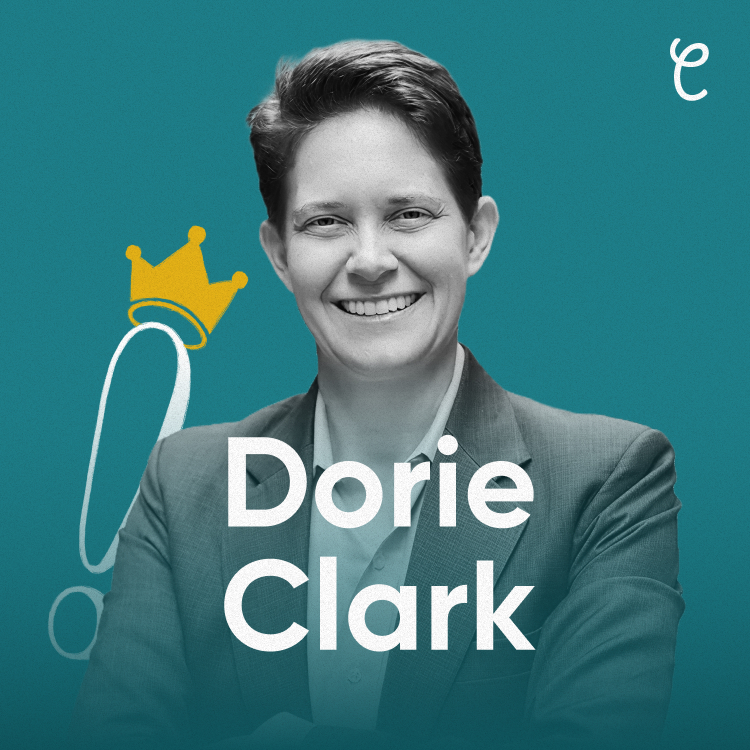
Liam Curley: Dorie Clark is an authority on personal branding and thought leadership, a best selling author for Harvard Business Review who runs a high margin seven figure business with one full time employee: herself. She's taught executive communication programmes at Duke and Columbia for over 10 years and she's spoken at companies like Google, Microsoft and IBM. She did all this starting as an unknown marketing consultant working with local clients in the Boston area. She didn't have any connections or unfair advantages.
So how did she do it? She created a map so that when she entered what Seth Godin calls the Dip — where the majority of consultants quit publishing and stop building their brand — she had a clear plan of how she'd get through to the other side. In this episode I'm going to tell the story of what that plan was and how she figured it out.
Chapter 1 — 500 Articles
Liam Curley: Dorie Clark is an authority on personal branding and thought leadership, a best selling author for Harvard Business Review who runs a high margin seven figure business with one full time employee: herself. She's taught executive communication programmes at Duke and Columbia for over 10 years and she's spoken at companies like Google, Microsoft and IBM. She did all this starting as an unknown marketing consultant working with local clients in the Boston area. She didn't have any connections or unfair advantages.
So how did she do it? She created a map so that when she entered what Seth Godin calls the Dip — where the majority of consultants quit publishing and stop building their brand — she had a clear plan of how she'd get through to the other side. In this episode I'm going to tell the story of what that plan was and how she figured it out.
After completing a master's degree in theology, Dorie briefly works as a political campaign manager before getting a job as a political reporter. She does that for about a year until she gets laid off. That was one day before 9/11. So no one's hiring. She picks up any freelance journalist work she can get at the time until an opportunity comes up in a different direction.
Dorie Clark: I had been working as a political journalist and I got laid off. And there was a gentleman that I talked to very regularly as part of my job. His name was Michael Goldman and he was a political consultant in Boston.
Liam Curley: Michael has been hired by Robert Reich, who was running for governor. They needed a press secretary and hired Dorie. Dorie spends the next two years working on a number of different political campaigns, first as that press secretary for Reich, then as a communications director and consultant. But then she takes a left turn. She leaves politics to go and run a cycling advocacy nonprofit for two years.
Dorie Clark: Which actually taught me a surprising amount about how to be an entrepreneur and then launch my business.
Liam Curley: Why did you decide to leave the nonprofit to start your own consulting business?
Dorie Clark: People who have never worked in a nonprofit will probably laugh at my answer about why I decided to leave it. But it was so incredibly stressful running this tiny nonprofit. We had three employees. We had an annual budget of about $150,000. You can do the math. We were not incredibly well compensated. I was almost entirely responsible for raising this. We had a board, but this was not exactly a fundraising board. This was a kind of roll up your sleeves and do things like lead bicycle rides kind of board. And so I felt this enormous weight and responsibility for all of these people in this organisation that was 30 years old, but still somehow it was tiny. And I thought, you know what, I would actually have less stress in my life if I ran my own business. And I was just supporting me. And I had learned how to scrap together $150,000 a year from different things for this group. And I thought, well, you know what? I bet I could probably hit six figures. I bet I could probably figure out a way to do that.
Liam Curley: So Dorie leaves the nonprofit to set up her marketing consultancy business. That's in 2006. In her books she said that she was offering marketing strategy. So I asked her what kind of marketing strategy.
Dorie Clark: So my consultancy evolved quite a bit in its first year or so as I was trying to find product market fit. So my original thought actually was that I would do political consulting, which I had done pieces of before working on political campaigns. I thought I would be an outside press strategist. But for whatever reason, I found it difficult to get political clients at first. And the people who were interested in giving me work were typically other nonprofits or government agencies because I knew a lot of people, having worked with them leading the nonprofit for the past couple of years. You always get work from your friends at first. And so those were the people that I knew. And I thought, okay, great, I'm not an idiot. I will not turn down this money that people want to give me. So I very quickly pivoted from political consultant to PR marketing consultant. But I also quickly realised that was a losing battle in 2006 because that was a place where social media was rising and the space in newspapers was rapidly declining. The so called news hole, because their ad revenue was going down, therefore the space in the newspaper was going down, therefore their headcount was going down. And so the problem that I was facing is that events that would normally in the past have gotten half a dozen reporters coming out for a press conference. All of a sudden no one wanted to come to a press conference. And I thought, all right, I'm going to go to the growth area. So I began shifting to a broader marketing strategy consultancy.
Liam Curley: Dorie builds that six figure income she hoped she would when she was dreaming up her consulting practice. She has a strong reputation locally and a great network that she's developed over the past five years in journalism, politics and the nonprofit world. But as you've probably already noticed from the story so far, Dorie is driven. Being a well respected consultant amongst local circles is not the extent of her ambitions. So at the beginning of 2009, she decided that it would be her New Year's resolution to write a book. But in her words, she went about it completely the wrong way.
Dorie Clark: I didn't know people who had written books. I mean, I had some friends who had written like mystery novels, but this was not very relevant.
Liam Curley: This was before you could go and listen to hundreds of podcasts on how to publish a book.
Dorie Clark: And so I thought I knew the parameters. I'm like, well, you write a proposal, you get an agent, you know, then that's how you do it. But I didn't understand the larger picture.
Liam Curley: The book industry was changing. Before the financial crisis in 2008, publishers were a little bit more willing to take chances on new authors, experiment a bit, see what sticks. But after the financial crisis they became more risk averse.
Dorie Clark: It's very similar to how it is today, which is that if you do not have a pre existing audience, if you do not have a pre existing platform, they are generally not very interested because they want a sure thing like everybody else in the world. In order for them to be interested in marketing you and signing you, you have to prove to them that you don't need them in order to sell books.
Liam Curley: Now Dorie was known within her local business community. She wasn't a complete nobody, but she didn't have any sort of platform that would suggest she could market a new book to a national or international audience. But Dorie didn't know how the publishing game was played. So in 2009, without that personal platform to sell books, she writes three book proposals and spends the next 6 months trying to get publishers interested. All on completely different subjects. One on millennials in the workplace, which was too generic. Another on lessons business leaders could take from politicians who were effective communicators. That was too niche for publishers. And the third was a book called How To Help Your Mom Date. Something for adults or young adults to help their mum who's been divorced or widowed to get back into the dating game, which is actually not a bad idea for a book. But it didn't matter because publishers weren't interested in Dorie, as she had no public profile.
Dorie Clark: I learned from the feedback that I was getting that okay, a platform is really essential. And if this goal is important to me of publishing a book as I claim that it is, I need to go back to the drawing board and just take some time and do this other thing so that I can emerge with a better platform.
Liam Curley: This other thing that Dorie refers to is blogging. Agents and publishers have told her that's how you build a platform, but it's something she didn't particularly want to do.
Dorie Clark: It just felt like obstacles in my path, like, oh, okay, here's this other annoying detour that I have to do that gets between me and the thing that I actually want to do.
Liam Curley: It's an obstacle that feels like it's slowing her progress, but it's what she has to do if she's going to build that platform that publishers want. All right, so you decide you're going to start blogging. What are you blogging about when you start?
Dorie Clark: So when I first started blogging, I did not really have a precisely clear vision of what I was going to specialise in or anything like that. So it's like I can do a lot of things. What things should I do? I think about it like almost like a reverse dartboard because it's like you don't know where the bullseye is and you're throwing darts. And what you have to do over time is extrapolate where the bullseye is because you can see where it's landing around. That's sort of the image that comes to me.
Liam Curley: This pattern comes up regularly in the authorities I study. They develop a writing habit, publish frequently, see what resonates and double down on that. A breakthrough book is often the result of a collection of smaller articles that resonated or one particular article expanded. Carl Richards, for example, wrote a column for the New York Times. He talks about how, even after years of doing it, he was a poor judge of what would resonate. Some days he'd send something in that he thought was incredible, but the response he'd receive from the editor, the social team and the readers would be crickets. Other times he'd send something in that he thought wasn't particularly great work but the editor would love, and readers would write back to celebrate the piece. He couldn't tell what was and what wasn't good. Same with Blair Enns and the Win Without Pitching Manifesto. Same with Austin Kleon and Steal Like an Artist. Both wrote a blog post that picked up unexpected, wild levels of positive feedback, which was validated resonance. They then expanded on to create a signature piece of work. Anyway, back to Dorie.
Dorie Clark: So I was writing about anything that I had knowledge of or an opinion about. So I was writing about social media, you know, the emerging thing of the day. I was writing about brand strategy, I was writing about delegation, I was writing about productivity, about how to have better meetings. I was writing about, you know, just like a very, very wide range of topics.
Liam Curley: Dorie started blogging in the late summer of 2009. And while she's publishing to her own website and email list, she's reaching out to publishers trying to write elsewhere to build her profile and point back to her personal platform. She was methodical about it. She made a spreadsheet of about two dozen publications that she thought were feasible. Reasonable brand names in the business world and crucially publications that accepted contributions from non staff writers. She built her list, found the contact person for each one from the website and started pitching.
This is another pattern that comes up frequently with successful authorities, intentionality and planning around borrowing audiences from the leaders or organisations that already have the trust and attention of the people they want to reach. Blair Enns did this when first building his authority in the creative services industry.
Blair Enns: I did a lot of speaking engagements. I identified all of the organisations to whom I thought I need to be able to, I need to get on a stage and speak to this audience. And I slowly checked them all off the list and it took years. So a speaking engagement leads to another speaking engagement.
Liam Curley: So Dorie has the same approach, a hit list of publications she's frequently contacting with cold pitches.
Dorie Clark: I had spent the next year really trying to wheedle my way into different publications and so I had been pitching all over the place, trying to break in somewhere, you know, Inc. and Fast Company and you know, just trying anything I could.
Liam Curley: Occasionally an editor would bite. They'd tell Dorie to send some ideas and then she'd send the ideas, follow up relentlessly and often never hear back, which was dispiriting. But the upside was that she had a list of hundreds of ideas because she'd written all these pitches that nobody ever wanted. Eventually though, Dorie catches a break.
Dorie Clark: I eventually, at the time the Huffington Post was very hot and very trendy and I found a number of friends who wrote for the Huffington Post and was trying to get an intro and it was a little bit complicated. It was sort of a strange situation because many of these people had been onboarded but they didn't have an ongoing relationship with an editor, so they couldn't really help me. But I finally found someone who wrote for Huffington Post who could get me onboarded and so I did that. So I was writing a number of things for them and that was a start.
Liam Curley: Then following more writing and more outreach, she catches another break. Forbes were just launching their contributor network. Dorie was partly making her own luck by doing the legwork, but the timing was right too. Forbes asked if she could write her first article within 10 days. She jumped on it, and over the next three years wrote 250 articles for them. She also used Forbes as a networking tool, interviewing other people, especially fellow authors. And almost everyone said yes to being interviewed for Forbes. It became her entry card to meeting the people she wanted to meet.
So now Dorie is writing for the Huffington Post and Forbes, but many other publishers were still ghosting her. And top of her hit list was Harvard Business Review. She wasn't getting anywhere with them. But that would change when she chanced upon an incredible slice of hard earned luck.
Dorie was selling her bike on Craigslist. Remember, she'd previously run a bicycle advocacy organisation and she had a really nice bike. She felt it was too nice in some respects. She kept worrying someone would steal it. The woman who bought it turned out to work at Harvard Business Review as a copy editor. Here's Dorie speaking with Terry Rice.
Dorie Clark: She told me that because she had looked me up to make sure I was legitimate and she's like, oh, I see you do business consulting. I work at the Harvard Business Review. And so at least at that point I had enough self possession to say, oh, how do you get started writing for you? And she was not the person, but she was willing. And of course I had to follow up a number of times, but she was willing to introduce me to the person.
Liam Curley: Now, despite this slice of luck, Dorie still had to persist to land the opportunity with Harvard Business Review.
Dorie Clark: There was some back and forth because I had to remind the woman several times that I had sold the bike to that she had agreed to connect me. So I did that first and then I connected with an editor and that took a little bit of time to get going.
Liam Curley: It was three or four months after Dorie sold her bike that her first article was published on HBR. And let's be clear, I've effectively condensed two years of Dorie writing hundreds of blog posts, getting probably hundreds of nos before she gets one yes followed by a load more nos. Dorie achieved everything she got up to this point and beyond because of her persistence. It took her more than a handful of blog posts to get where she eventually would end up.
At the Alan Weiss Million Dollar Consulting Convention, Dorie made the point that it's not one article that's going to get you where you want to go. It's not 10, it's 100 or even 500, which can seem painful, but you can also get empowered by it. Because if you're willing to put in that level of content creation, it builds a competitive moat because most people just won't do that. By the time Dorie had been writing for Harvard Business Review and Forbes for several years, she'd published more than 500 articles between the two. And she said it wasn't until somewhere between two and 300 articles that she started getting regular unsolicited inquiries for her business. There's value before that point. Content helps with credibility, and it can nudge prospects into clients. But in her words, in terms of that holy grail of receiving regular, unsolicited business, it takes years. But when you get there, you have a competitive advantage in the marketplace that's extremely hard to dislodge.
Chapter 2 — The Dip
Liam Curley: We ended chapter one with Dorie publishing her first article in Harvard Business Review. Her second article delivered her breakthrough moment. This article was about professional reinvention, a topic that Dorie was well placed to write on because she'd done her fair share of professional reinvention through her 20s. From reporter to political campaigner to marketing consultant. The article got popular, so popular, in fact, that HBR reached out and asked her to take the short blog piece and turn it into a longer article for the print magazine. It was a turning point. Here she is speaking with Nathan Barry.
Dorie Clark: It was actually really validating because I had had three different book proposals in the previous two years, all turned down for different reasons, but mostly because I wasn't famous. The minute, literally the minute I wrote this piece for the print edition of Harvard Business Review, three different literary agents reached out to me and said, hey, are you thinking about a book?
Liam Curley: As Dorie puts it, that was the moment she knew what it felt like when things were actually working, and she'd had enough failure to know the difference. Of the three literary agents, Dorie decides to work with Carol, who would be her agent for the next 14 years until Carol retired. But as an outsider looking in, something confused me. Post goes out, does really well. Well received, goes out in a magazine, you get inbound interest from book agents. At this point around turning that into a book, your first book is published with HBR Press.
Dorie Clark: Yes.
Liam Curley: So the stupid question is, why did you need an agent to get you a book deal with HBR when the post came out with HBR?
Dorie Clark: Yeah. Well, I wasn't necessarily the most sophisticated customer, so I probably could have sold it directly to HBR. But because I knew so little about how these things worked, I wanted to have someone representing me who knew a little bit better. I didn't know what contracts should look like or I didn't know what was a reasonable amount for somebody to pay as an advance. And I just was very deeply unfamiliar with the process because I was not in a position where I had a lot of friends doing this. I am now. I know lots of authors, but at the time I did not. And so I felt that I needed someone more experienced to guide me. And because I had these, you know, this outreach from agents after the magazine article was published, I thought, oh, okay, well, this is great. This is an opportunity for me. And it was a big dream to get published by HBR. I certainly didn't think it was a given.
Liam Curley: Dorie's first book, Reinventing You, arose out of this process. She and her agent successfully sell the book to Harvard Business Review Publishing. She writes the book over the next two years, and it becomes a fundamental pillar upon which Dorie moves into the authority speaking circuit. But all of that success is on the back of two or three years of blogging, lots of rejection, and one whole year of pushing failed book proposals.
Dorie now runs a community of hundreds of consultants that are trying to go through the same process. They want to become authorities in the same way she has, and she's noticed a pattern. Here she is speaking on The Anxious Achiever.
Dorie Clark: What I have noticed as a pattern is that for the people who are less successful, it's often that they experience some kind of rejection at a certain point. You know, they didn't get an opportunity. You know, the editor said no, or the agent turned them down, or, you know, whatever it is, the client rejected their proposal. They sort of take this view where it's almost like the universe has decided, right? Like, oh, I guess it wasn't for me, or I guess it just wasn't right, or I guess I'm just not cut out for this.
Liam Curley: Dorie's point is that we can carry this false narrative that successful people were welcomed with open arms. But that's almost never the case. Nearly everybody has gatekeepers telling them no. Some of those gatekeepers are incredibly unqualified. And the answer, in Dorie's words, is that if they don't let you in the door, you climb in the window.
With that kind of don't quit attitude, I always think the million dollar question is around, how do you know the difference between this isn't working yet and I just need to keep going until it does, versus this is never going to work and I should quit and move on to something else. This speaks to what Seth Godin calls the Dip. The Dip is the long stretch between starting something and mastering something. It's where progress slows, pain increases, and most people quit. But not all struggles are Dips. Some are cul-de-sacs, which is literally a dead end. You work and work and work, and that work never leads to meaningful progress. It's not a dip that you just need to get through. It's an endeavour that's never going to lead where you want it to go. Here's Seth speaking with Suswati Basu.
Seth Godin: Many of the people I know who are stuck are stuck either because they quit all the time and they never accomplish anything because it's a good place to hide. It's a safe place to be.
Liam Curley: Seth uses Marc Maron as an example, whose podcast made it to the point where Obama was a guest. Nobody listened to the first hundred episodes. And Seth's own blog, nobody read that for the first year and he published every day. But then Seth says there are people who are still showing up 20 years later working on the same screenplay. And his point is a blunt one. If in 20 years you can't find somebody interested enough to make a pilot, it's never going to happen. You should write something new or just do something else. Because at that point, sticking with it isn't persistence, it's hiding.
So why is it so many people quit in the middle of a Dip? Here's Dorie speaking on Free Time with Jenny Blake.
Dorie Clark: A big problem that people often have is that they have not in formulating the goal properly mapped out what it actually will take to get to the goal. And this leads to a lot of problems because, you know, it's hard to run a marathon. Not everybody does it. But if you hear, okay, well, it's 26 miles. Do you want to train for it? Are you willing to do it? A certain percentage of people will say, yes, it's worth it to me. I'm going to do it.
Liam Curley: One important point to also note here is that other people have run marathons before, which means it's possible that I could run a marathon. It's something I know I could achieve if I figure out how others did it. It's almost certainly true that the pain I'll experience represents a Dip rather than a cul-de-sac, because I know others who were in a similar starting situation as me have gone through it and achieved the outcome I want to achieve, if indeed I want to run a marathon.
The problem, as Dorie puts it, is that for a lot of the metaphorical marathons in our lives, people either don't know or haven't taken the time to find out that it's 26 miles. They think it's 13, and then halfway through, they think they're done. They're expecting to be done and they're not. They've got another 13 to go, which is the point at which they lose any enthusiasm and positive energy and quit, because they misjudged it from the beginning.
This work of becoming an authority in any field takes time, and you don't know really exactly how long it will take. That's the hard part. You don't know how long you're going to be in the Dip. But others before you have gone through the Dip and come out as authorities, which means we know it's possible. It was for Dorie. Her book, Reinventing You, comes out in 2013, four years after she'd started writing blog posts, and she'd written hundreds of blog posts in that time. In the moment, the dip feels forever because you don't know when it's going to end. But when you step back and look at the bigger picture, four years isn't actually that long. From writing her first blog post to publishing a book. That's what was possible if, like Dorie, you write every day, you take 10 nos to receive one yes, and you encounter a stroke or two of luck along the way.
Chapter 3 — The Academic Edge
Liam Curley: Since publishing her first book, Dorie has published another three. Three of those books are published by Harvard Business Review Press, and at the time of recording this podcast, Dorie has written for HBR magazine for about 15 years. Harvard is woven into her brand, but as I mentioned in the introduction, she's also tied to Duke and Columbia, where she teaches an executive communication programme. As with her writing, those teaching opportunities didn't land in her lap. Do you remember what your first opportunity was to teach?
Dorie Clark: I do, I do. It was very coveted for me because I came by it kind of accidentally, and so it was so exciting. I was working for a newspaper called the Boston Phoenix, and there was an email that went around the newsroom that somebody who was like a friend of somebody who worked there or something had been going to teach a class at Tufts University, which is a very good university outside Boston, and they suddenly took ill, or there was a problem or something, and it was going to be a class somehow related to journalism, and they couldn't do it last minute and the class was gonna start like the next week, and they were like, can anybody do this? And most of the really good opportunities come from accidents or, like, when the reliable person can't do it. And so I immediately was like, I can do it. And I mean, I had no idea how to pull together a class in a week, but I was like, I'll figure it out. Because I had very much wanted to teach and be a professor and had not, didn't think I was gonna have the opportunity. And so I got in touch and connected and they ultimately decided like, okay, you know, we can't onboard somebody in a week. This is just like too crazy. So they did push the course back, but the next semester I got to teach a course and that was sort of my introduction.
Liam Curley: Dorie teaches those undergraduate classes in Boston part time for several years. She starts at Tufts, but she also taught at Suffolk University and Emerson College, also in Boston. Come 2010, around the time when she starts writing for Harvard Business Review, she delivers her first executive education class at a business school.
Dorie Clark: I realised, okay, I have a history of teaching undergraduates. That's great, but it would be nice, now that I'm an entrepreneur, to meld it and to be able to, you know, be teaching actual professionals that maybe could hire me later or, you know, at least it would be sort of more directly relevant. So I broke into the world of executive ed.
Liam Curley: The first class she delivers is at Smith College, Western Massachusetts. That's the university she attended.
Dorie Clark: They almost strangely have an executive education programme. And I say almost strangely because they don't have a business school attached to them. And so this was an opportunity for me on two fronts. One was that they were kind of at least a little bit more likely to listen to me because I was an alumna. And the second reason is that they did not have a built in faculty because of course, most business schools, if they have an executive ed programme, they're probably going to use their own faculty for it. But Smith didn't have a business faculty. So this was actually a very good opportunity. And they gave me a shot and let me do a couple of programmes for them, which was terrific. And that was sort of all I needed to get my foot in the door. And from there I very actively pitched myself to other business schools.
Liam Curley: In 2012, a year before Dorie's first book is published, she signs a contract to teach at Duke University's Fuqua School of Business. And two years after that, she starts teaching at Columbia Business School. She didn't wait for teaching opportunities to come to her, just as was the case with the opportunities to write for Forbes and HBR. Her initiative and perseverance puts Dorie in a position to encounter opportunities. Here she is speaking on How to Be a Better Human.
Dorie Clark: So now I've spent years teaching for Duke and for Columbia and for other business schools. But in the beginning, it wasn't like anyone was coming to me and begging me to teach at their business school, like pretty far from it. I created a spreadsheet of top business schools and I reached out to everybody I knew who had a connection there.
Liam Curley: She asked for intros. She also cold pitched department heads, offering to guest lecture for free. Because guest lecturing is the first foot in the door. It builds enough connections and credibility that eventually you can get a paid teaching engagement.
She gets the first opportunity to teach at Tufts, then leverages that experience to pursue further opportunities until she's at a point where she's teaching at some of the most prestigious business schools on the planet. And this strong academic spine running through her brand, it delivers platinum level credibility. That's a significant differentiator because how many other high profile advisors in this space of personal brand building or whatever you want to call it, have academic credibility like that behind them? I can't think of any.
And this all feeds back into her speaking career. The teaching fuels the speaking, which in turn fuels the teaching. Because Dorie is one of the highest regarded speakers on the circuit and she learned to become a great speaker because of the teaching. Here she is speaking with Noah Kagan.
Dorie Clark: The way that I learned how to be a speaker, it sounds slightly banal, but I'm going to explain it. I never took classes, I never trained. It really was through practise, but it was practise in a very specific way that other people can emulate, and that is through teaching.
Liam Curley: Dorie makes the point that when you're teaching a semester long class, it's low stakes in a way that a keynote isn't. The students are with you the whole semester, so they can't leave, which means you can try things, you can experiment, you can learn how to keep people engaged and you can learn how to respond to any hiccups whilst you're up there. By doing that again and again, Dorie gets comfortable on stage.
The teaching, the writing and the speaking all form part of a flywheel that feeds annual revenue of approximately $1.7 million. Though of course that revenue can fluctuate year to year. I spoke earlier about going through dips. Dorie went through the Dip to become a recognised writer and then the Dip to become a recognised speaker and then professor. This all leads to book publishing deals, collaborations with major brands and the opportunities to teach at Duke and Columbia.
She developed this knack of going through dips by doing the upfront research to understand the markets she's going into, gathering evidence of who achieved what she wants to achieve, what they did to get there, how long it took to get there, and what she's going to need to do in order to accomplish those goals. Be it consulting, writing or teaching, that approach led to every opportunity Dorie has encountered. It's informed grit derived from the confidence that this has been done before and with the correct approach and patience, I can get to the other side just as others have. It's a personal map on how to navigate the Dip.
That is how Dorie Clark became The Undisputed Authority.
Liam Curley: Thanks for listening. I'm Liam Curley and I help experts develop, package and publish unique insights. Hope you enjoyed this episode and if you did, consider subscribing. And one other thing, I've created a free email series called the 10 Patterns of Disruptive Wisdom. In my research of undisputed authorities, these are the consistent behavioural patterns I noticed among those who rise to the top. To get the email series, head to liamcurley.co.uk — link is in the description.