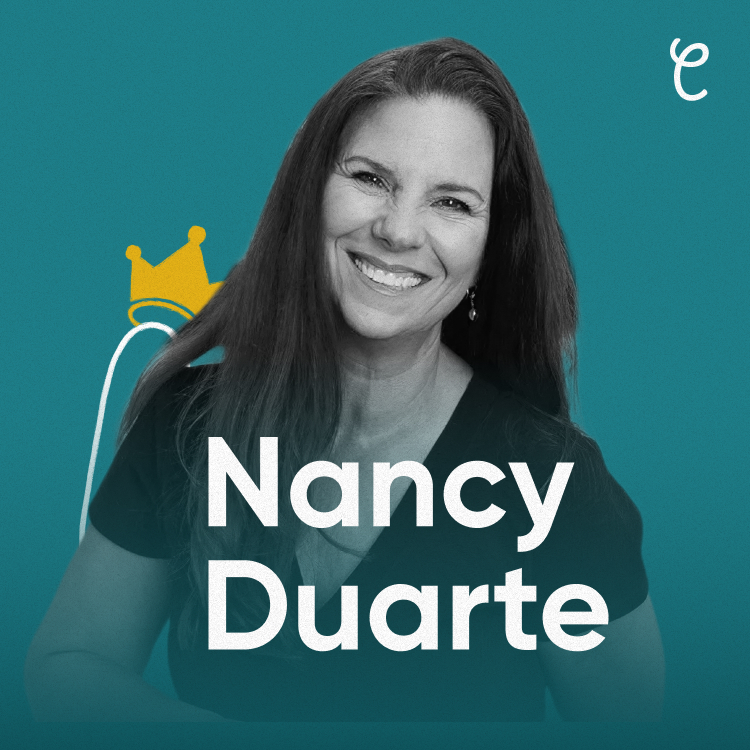
Liam Curley: Nancy and her husband Mark started their business in their apartment in 1988. They had no formal business training, no design training and no public presenting experience whatsoever. And yet together they built the world's leading firm, specialising in strategic communication, Duarte Inc. In the process, Nancy Duarte became the undisputed authority on storytelling and visual communication.
Nancy achieved all this by following a principle best articulated by Cal Newport, author of So Good They Can't Ignore You. She focused on the one thing that moved the needle, not the many that nudge it. So what was that one thing? That's the story I'll expand on in this episode.
Chapter 1 — An 18 Month Window Of Opportunity
Liam Curley: Aged 18, Nancy marries Mark in Chico, a small town in Northern California. Mark is a fine artist.
Nancy was a declared maths major at college, but she drops out and gets a job working at Longs Drugs as a cashier. She's working that job for three months when a customer walks through the line and asks, are you related to Leonard Doherty? She is. Leonard's her father in law.
He then says, you seem too smart for this. Why don't you come run my company? So she does. Primarily, Nancy was hired to call on customers, but when she wasn't doing that, she was working in all areas of the business, figuring out tax returns, doing the purchasing.
So she did that for 18 months and had a huge impact. By 19, she'd multiplied the revenue of the office supply store. She leaves the store that same year to go and work in sales for one of her clients, who was the only tech company in Chico. She's good at sales, she's scrappy and tenacious.
Here's Nancy speaking with Michael Zipursky.
Nancy Duarte: Back then you didn't put women in outside sales. The women were supposed to be manning the booth in Vegas in their little hot pants, right? I didn't want that. And so I was kind of fearless when it came to sales.
Liam Curley: She kept pushing to get into outside sales and eventually she got there, moves into outside sales and excelled. She was hungry. She and Mark had no money. But everything is about to change because whilst all this is going on, Mark is working on something in the background.
He'd been, in Nancy's words, schlepping furniture in a dying aerospace company, saving every penny until he bought one of the first Macs. They had, again, in Nancy's words, a one room house with crappy carpet and torn up linoleum. But they had a computer. People in the neighbourhood would come over just to see what it was. Mark starts doing desktop publishing — typesetting, newsletters, grants and college resumes, getting bits and pieces of money.
But he can see something Nancy can't. He tells her this could be a business. Now, Nancy isn't having any of it. She works on a mainframe at the time, which she viewed as a real computer.
Again, Nancy's words. Mark gets on his knees and begs her to read one issue of Macworld magazine cover to cover. So she reads it and her response is, okay, this might be a thing. If I can sell it, you can keep it.
And if I can't, here's your stack of resumes. Go and get a job. Specifically, the idea that Mark has is that he has illustration skills and with his Mac he could create accurate technical illustrations digitally, which no one else was doing at the time. Now this next bit, this is the crazy part.
Nancy picks up the phone, calls NASA, calls Tandem, which is now HP, and calls Apple. And they win contracts with all three at the same time. Back then the company was called Duarte Desktop Publishing and Graphic Design. How on earth does a husband and wife upstart with no formal design experience and no established business land three huge blue chip clients?
Nancy Duarte: You have to remember back then, this was long, long ago and they made charts with like X-Acto blade with black electrical tape. And then they had rub on letters. Very manual process.
Liam Curley: In NASA, HP and Apple, Nancy was identifying places where technical illustration was in high demand. She was selling Mark's illustrations — remember, he was a skilled fine artist. The opportunity that would present itself, the niche that would find Nancy rather than vice versa, was presentation design. Because though it's hard to imagine right now, other designers just refused to work on Mac.
Traditionally, presentations were created on a 35 millimetre slide on an old carousel. If you watched Mad Men and remember that scene where Don is presenting to Kodak, it's that. Here's Nancy speaking with Lenny Rachitsky.
Nancy Duarte: There's about an 18 month window in the life cycle of the Macintosh where graphic designers refused to use it. Refused. It's a toy, it's ugly, it's bitmapped. Nobody would do a font like that. We use Linotype — like it was very, the snobby kind of, we won't touch it.
Liam Curley: This is the exact moment when Nancy and Mark entered the market. They checked out books at the library on typesetting. They figured out what they could do with this tool that nobody else would touch. But although Nancy signed those early contracts, it was still a struggle to break into the industry because the old guard of traditional design firms were battling to keep her out.
When I had the chance to ask Nancy about it, here's what she had to say.
Nancy Duarte: And then the NASA process was we would literally sit around a table, four of us suppliers, and they would brief us on a project and we all literally would write our price on a piece of paper and we would have to push it to the middle. And then the person would open these little tiny pieces of paper and then they would just push the project to the lowest bidder. I never knew who was the lowest bidder or not. And I kept losing and losing and losing.
And I finally called, I called the person. I'm like, this seems so weird that I'm gonna do it digitally and fast. And he goes, oh, they're way lowballing. They were like, what's happening is they're coming anytime they're bidding against you. They're just losing to maintain and keep our business. I was like, wow, that's, that's really something. But I mean, we won the business. We got enough of it to live off of, right?
Liam Curley: So they were lowballing you. Did you then come in with a low price to win that?
Nancy Duarte: I came, I always bid our actual price. And so I think the competitors delighted, you know, in beating us. But what was weird is as a government institution, they only had to competitively bid it one out of so many times. And so when I was there in person, I lost every time.
But when they really needed something done innovatively and on a computer and pixel accurate, we would win that business. I didn't have as much competitive pressure, but it was just this, just this imagery of these people, these. And they were specifically older, they'd been in this business for a very long time, all the competitors, and watching them just reeling, I mean they were just reeling just by having me present in the room.
Liam Curley: Market demand was on her side. And in this 18 month window where other firms refused to work with the Mac, Nancy's business was taking off. Clients came through the door because Duarte were one of the only firms, if not the only, to do the work digitally. They'd even get referrals from other designers who refused to do the work.
The Mac was reviled by design firms. So when clients called around, those firms would send the business straight to Duarte. But in addition to that, because Duarte were well aware that they weren't qualified, in inverted commas, in design, they over delivered in service — running to the airport, meeting clients there, going to their house, collaborating till 2am. They were delivering exceptional service, which meant clients stuck.
And I think it's important to pause here to reflect on what Nancy and Mark are doing. Because of their lack of formal experience, they were paranoid that they didn't belong. They didn't have formal design training or a business background. But that paranoia drives them to do the work that other designers, professionals, confident in their work, don't feel compelled to do.
The long hours every day figuring out new technology, delivering unreasonable levels of customer service. Fear and imposter syndrome carved out their path to excellence. That path led to innovation because they were hell bent on doing things others couldn't or wouldn't do. It was the only way in their eyes, to grow the business. And it's a pattern common amongst undisputed authorities.
A great example of that is when they worked with Apple on a presentation at their 1992 sales conference. The head of sales at the time was, in Nancy's words, a creative savant. He wanted one slide, the whole thing covered with the word big in hot pink on a black background. When it popped up on the slide, he wanted it to light the faces of the audience.
This was at a time when slides were basically teleprompters covered in text. In Nancy's words, if you could stick a piece of clip art on one, you were lucky. Nancy and her team had no idea how to do it. They had to go through six different steps — freehand, convert, scale up — and the result was still a little pixelated.
But during the rehearsal, the production team gasped. People squealed asking, who did this? It was just one word in magenta pink. And Nancy remembers thinking, this is how it's supposed to be done.
Nancy and Mark continue to innovate and delight clients, pushing boundaries which primes them, places them in a position to earn opportunities that come from lucky breaks. There are two significant moments in the early history of Duarte where that happens. The first is in 1993 when Apple laid off many of the staff Nancy had been working with. They let a whole division go.
Here's Nancy talking with Alice Heiman.
Nancy Duarte: They scattered around the Silicon Valley like beautiful little seeds and took us with them.
Liam Curley: So Nancy's business multiplies after this layoff. All those contacts she delighted at Apple took Duarte with them to other blue chip companies across California. Then there's the next important piece of luck. This is the opportunity that, of the hundreds of thousands of presentations Duarte work on, arguably has the biggest impact on the business.
Al Gore's An Inconvenient Truth — in its original form, it was a presentation that Duarte worked on with Al Gore that he delivered more than 1,000 times around the world. It hit a moment when nobody really had an example of a truly well done presentation. It was before TED Talks were even on the web.
People had never seen someone tell a data story and stand in front of data at that scale in front of a 90 foot screen. But how did Duarte even get the chance to work with a former presidential candidate? At this point, Apple had been a client of Duarte's for 31 years. Al Gore had joined the Apple board.
And when you join that board, you're not allowed to receive goods or services from that organisation. So even though Apple's own creative services department wanted to help Gore, they couldn't. Duarte had been a partner of Apple for years. So Apple turned Gore over to Duarte.
So Duarte got the opportunity to work on An Inconvenient Truth. And the presentation was such a success that it was adapted to a feature length documentary which grossed over $50 million worldwide, making it one of the highest grossing documentaries ever. At the time, it won two Academy Awards for Best Documentary Feature and Best Original Song. It was featured on Oprah, discussed in schools globally and sparked international conversation about climate change.
It even helped Gore win the Nobel Peace Prize in 2007. Now, unfortunately, Nancy doesn't fully grasp the opportunity. She doesn't have the benefit of hindsight to see how successful this movie will become. So when the producers ask if Duarte would provide $10,000 of extra services in exchange for being named in every press release, Nancy says no.
They've already made sacrifices on the project and the people making the movie are billionaires, as she puts it. It was the dumbest thing she ever did because her thinking at the time was, who's going to go and see a movie about a slideshow? Pay me the ten grand. At this stage, Duarte Inc. is still relatively unknown beyond the clients that love them in California.
They've just had a major supporting role in a groundbreaking award winning movie. And though Al Gore is generous in mentioning Duarte at regular intervals, when the opportunity arises, Duarte don't feature in the global press coverage. So it would seem that the opportunity to expand beyond California is missed, right? Well, actually, no.
An Inconvenient Truth comes out in 2006. The year before, Nancy had become friends with Garr Reynolds. Reynolds was and is a communications and presentation consultant and an associate professor at Kansai Gaidai University in Japan. Nancy had discovered his blog the year previous.
Nancy Duarte: And I sent him a note and he and I laugh about it. The subject line was something like, where have you been all my life or something like that. And I just thanked him, congratulated him, how happy I was to know he's helping solve these problems. And he reached out right away. So he had worked at Apple long enough, I think, to know who we were already, but he reached out right away.
Liam Curley: So while Duarte didn't get picked up by the press release, Garr did publish a Q and A with Nancy on his blog around their work with Al Gore. At the time, Garr had around 20,000 followers on his blog, which was a huge number back then when blogs were new and people actually read all their emails. And it's 20,000 people who'd chosen to subscribe to a blog about presentations, which was the ideal audience for Nancy.
Nancy Duarte: So it kind of let the world know who did all that work, which was nice. So I think if it had just been a blog, I don't know, but because it was a blog attached to the people who did An Inconvenient Truth, then that's what I think triggered it to spin up. And people could find us from that.
Liam Curley: And people were finding you from that, were they?
Nancy Duarte: Yeah. And from the credits. I mean, he was very generous. He put all in the credits of the movie and everything too.
Liam Curley: All the unreasonable attention to detail, experimentation with new technology, and her relentless pursuit of delighting clients and mastering the craft of visual communication. Built to this moment where Duarte Inc. breaks out of California and makes a name for itself. Which is where we end this chapter.
Chapter 2 — Moving Upstream
Liam Curley: We ended chapter one in 2006. We're still in 2006. Duarte Inc. is now a 42 person company that's the specialist firm in visual presentation design. And she's in the middle of writing her first book, Slideology.
The initial idea for that book actually came up in conversation with Garr Reynolds. Whilst Garr is writing his own book on presentations.
Nancy Duarte: He's like, I'm writing a book and you're the real deal. So I'm going to send you my book ahead of time and you can look at what I've done and you could write a book about everything I've left out.
Liam Curley: So Nancy's writing Slideology, the art and science of creating great presentations, and will go on to publish it in 2008. But Nancy's drowning.
Nancy Duarte: I had been the hub and it was like I was the strategist. I did account, I did kind of the consulting and people would wake up and I would have drawn and they'd have on their chair what they were supposed to work on. And we were too big of a size to do that.
Liam Curley: That's not the only problem. Nancy foresees a shift in the market that's going to threaten growth.
Nancy Duarte: The kind of signs that we saw in the market were that the probability of cleaning up someone's deck or tidying up a deck, which was probably half our business at the time, that that could have a high probability of being outsourced to lower cost global resources. And the most readied for that was India. So we'd already heard murmurs that the large consulting firms were starting to build this base of work there. And we knew we needed to punch up, punch up in quality, punch up the food chain, start to work with the C-suite.
Liam Curley: I didn't really get that answer Nancy gave me because my interpretation was, weren't they already working with the C-suite of all these major brands?
Nancy Duarte: We actually already had the C-suite in our hand. Like every single major brand was using us, but they were only using us for the design. So a lot of times we weren't working directly with them. The visionary, the exec, they had their chief of staff or their executive communications expert.
That's who we'd interface with. And then we realised, wow, a lot of kind of triangulation is happening because we don't have direct access to the exec, where it's like, sometimes these, these staff underlings will be like, I don't like it yet. Well, I don't like it yet. I don't like it yet.
And we would just do rounds and rounds with them, be like, well, this is kind of pricey. Get it in front of the execs. And they would actually give us feedback that would have justified our first solution. After these other underlings, like, had us do rounds and rounds and rounds.
And so we'd pull up the original. They're like, oh, my gosh, I love that.
Liam Curley: That's when they realise they need to report directly into the C-suite. And in Nancy's mind, there was one clear way to do that.
Nancy Duarte: And I knew that to scale, to grow, to have credibility, we needed to also start to do storytelling. So I had already started to write and it was almost finished with my first book, Slideology. And I knew once I wrote it, I was like, you know what? Making more attractive slides does not solve the actual problem of presenting. The problem is the content itself.
And if you just are making the content look pretty, it's like putting lipstick on a pig. So I realised, you know what? I need to get a president in who would shift us from just being about graphic design and could help me shepherd a story practice. And so that was one of the reasons I did it, and the other was just free myself up from this beast.
Like I needed to kind of send the company off to college, like it was nice and mature and I needed to distance myself away from it enough so I could stay at this position of visionary and not being in the work.
Liam Curley: After hiring that president, Nancy goes on a trip to India to see the outsourced market for herself.
Nancy Duarte: I went on this amazing trip with all these amazing women, powerful women, like, on public boards of massive publicly traded companies. And I was kind of the token bootstrap entrepreneur. And so what I did is I peeled away a few times and met with actual agencies like the Ogilvy and the different actual agencies, specifically, with the hope of me understanding their skill set and understanding if I could find a partnership. And that was when I realised that it was at least 10 years away before they would be good enough to be outsourced to.
Because there's a cultural gap in what the US culture specifically and the Indian culture specifically considers beautiful. Like what we would consider an arresting slide, they would not consider a slide that would arrest them, you know. And so I realised I had a 10 year window to kind of punch up the food chain and kind of protect my business.
Liam Curley: So you go to India, you realise that there's a threat, but they're 10 years off.
Nancy Duarte: Yeah.
Liam Curley: However, you felt that becoming the experts at story would shield you from changes in the market.
Nancy Duarte: I mean, pretty early on I realised we needed to get into the content space and specifically story, so I wasn't an expert. So I brought in a president who had built a content practice before.
Liam Curley: Nancy goes deep into story with the obsessive rigour that she and Mark used in her approach previously with presentation design. When she analysed Steve Jobs' iPhone launch speech, she did it all by hand on quarter inch graph paper, every word mapped out. That was how she works — analogue. She needed to see it.
She discovered a book, The 100 Greatest Speeches of All Time. And she spent the next three years studying those speeches in fine detail, uncovering the patterns, rhymes and cadence of great story.
Nancy Duarte: It was three years, just three years of digging in. Because if I was going to put a shingle out on a business with my name on the door, I needed to make sure it was something we needed to not only get good at, but I need to make sure I was very comfortable owning that domain. It was very transformative for me to do that myself as a front row seat, not delegated to someone else because it became a really important kernel in the company.
Liam Curley: In that process of studying story and finding the patterns, Nancy publishes her second book, Resonate. She'd already published Slideology back in 2008. Here's Nancy speaking with Dr. Amantha Imber.
Nancy Duarte: You know, with Slideology, I was kind of codifying what was already here, getting examples off the server. With Resonate, that was a deep, rich research assignment, remember?
Liam Curley: Although they'd been restricted to design work for much of the 80s and 90s, Duarte had been working with clients on stories for years. But nonetheless, Nancy spent three years studying world class speeches. Again, another example of Nancy's mindset and absolute dedication to master any craft that she was going to sell. After this period of studying story and layering that over the learnings from client work, they now had the internal confidence to call themselves storytelling experts.
In Nancy's words, Resonate was a way to put structure around what they'd already learned by doing. And this was before storytelling had become a buzzword in business. Books like StoryBrand by Donald Miller, Storyworthy by Matthew Dicks and The Science of Storytelling by Will Storr — these books wouldn't come out for another seven plus years.
This was the book that supports the pivot, the move up the food chain. It's the book that takes Duarte Inc. to an entirely new level regards notoriety and revenue.
Chapter 3 — G-Force Growth
Liam Curley: One year after publishing Resonate, Nancy delivers a TED Talk that will trigger what she calls G-force growth to the business.
At the time of recording this podcast, 14 years on, the talk has more than 3.7 million views on TED and 1.1 million views on YouTube. I asked Nancy, how long had you been speaking on stage before that TED Talk happens?
Nancy Duarte: I wasn't a public speaker when I even wrote Slideology and I, I just put it out there thinking it would do okay, right? And then all of this inbound started to come in for me to speak, for me to train. Training was the big one with Slideology. I didn't get huge keynotes with Slideology, but I started to realise if I wrote this book on story, I would have to become a public speaker.
In the Wizard of Oz, he used to stand behind the curtain and he would pull these levers to make the, you know, Oz look so powerful. And I realised, oh my gosh, I've been behind this curtain pulling these levers to make other people seem amazing. And now I have to go and get the skills for myself — not to be amazing, but so for my message could be heard.
And that was a big transition for me to go from, like, being backstage to being on the stage. And I never was super scared of public speaking. I actually felt comfortable being a public speaker. I just never in my whole life dreamed that that would be my career trajectory whatsoever.
Liam Curley: So no public speaking career prior to delivering her now famous TED Talk? How did she get that opportunity then?
Nancy Duarte: Yeah, it was very interesting. I had been a TEDster, I'd been going to TED for quite some time, and I bumped into the gal who was running the kind of speaker training programme and I was like, hey, I have this book, why don't I come and do a little free little webinar? My goal was not to get a TED Talk.
I don't know, I'd been part of the TED community and when Slideology came out, they heavily, like, promoted. They were so generous because that was a real tipping point for how TED shows up on stage visually was Slideology. So when my next book came out, I said, hey, do you want me to work with the speakers that are going on stage? And I'm like, I'll just do a webinar for whoever's the next batch of speakers.
It'll help me work, work the kinks out of my talk, blah, blah, blah. And so I did a little micro webinar, introduced the presentation Sparkline, and the gal who was running the programme, she's like, you should do a TED Talk. And I'm like, well, I'm not invited to one. And she goes, well, I run TEDx New York.
You want to do that? I'm like, sure, do TEDx New York. And so that's how it happened. So I did my TEDx talk.
I knew if I killed it, I knew enough, because I'd seen enough TED Talks, I knew if I killed it, there was a probability of getting onto TED.com. And at that time it was very difficult. And so it was never on TED.com. It was on, like, my YouTube channel. And I posted and I tagged TED.
I was like, it was like a month later, I was like, oh, my gosh, my talk just had 50,000 views. And then boom. Like, I got an email from TED saying, we want to put it on TED.com.
And I was like, what? I was so happy. Like, I just go kind of ignorantly. And I wasn't doing that. I was doing it to celebrate TED, not to get it onto TED.com. So I don't know, I think sometimes your motives, the motives of why you're doing things. Sometimes, you know, you get rewarded just by having pure motives and not, I don't know, not trying to elbow your way in.
Liam Curley: The impact that this TED Talk has on the business is off the scale.
Nancy Duarte: When the TED Talk came out, just the requests for me to go and do gigs around the world exploded. I was an empty nester by then, so it was easy to accommodate a lot of the requests. But it was unexpected and just a real powerful moment. Like the company, when you look at the charts, I mean, the company was like, we couldn't even keep up with demand.
It was crazy town, one of my execs called it. Like, it just was like, could rip your face off kind of growth. Like, the G-forces were like real, like, you know, and so it was hard. I mean, growth is hard to manage and so is no growth. Right? They're both kind of the two extremes.
Liam Curley: When we talk in astronomical growth around this TED period, like, what are we talking as a multiple? Like, in terms of inbound opportunities, it was unbelievable.
Nancy Duarte: I mean, it was hundreds of inbound queries every week. Hundreds and hundreds and good ones. And everyone wanted to talk to me, everyone wanted me on their projects. And at this point, I had the president.
I was not involved. Or the ones where I had to be involved. So when Al Gore came in, my team's like, we got it. And I'm like, okay. And I would just wave at him and smile when he went to the restroom and went back to the conference room. I didn't even work with him. Couldn't. I could not work with everybody who was coming in.
And so real famous VCs came in. So I would go to these parties and get like, yelled at, like, I can't get past your keepers. They won't let me work with you. I'm like, I'm overwhelmed. Like, you can't be flying around the world doing speeches and be involved in projects. Because if I'm involved in the project, I'm like, you could expect a four month delay. I mean, you know, like, and who wants to give it a four month delay?
Liam Curley: The TED Talk came out in 2011, and her story doesn't end there, but that's where this chapter and podcast does. Nancy would continue to grow the business. She's released more books since, productised the service, and moved even further upstream with clients.
Nancy Duarte: Now we not only do the story and the slides and the coach on the delivery skills, speaker coaching, we actually work on the strategy now too. They'll say something like, hi, I'm in the top five Fortune 500 and we're going to remove all of our employee entitlements and we need to message this. We need a strategy for the bigger message. Because if you think about the really high stakes messages, a lot of them start with the vision of it and then how it cascades, which is what my book about epic storytelling, Illuminate, what that one's about.
So we're really punching up now and actually helping to find the strategy and not just their next big talk, which has been really gratifying work too.
Liam Curley: One other interesting thing that I do want to share that Nancy told me was around the nature of books and how they impact business inquiries. Even after a hugely successful book and TED Talk, inbound doesn't last forever, it comes in cycles.
Nancy Duarte: And my foolishness though, I thought, oh, this is norm. This is going to be our normal growth rate. Not realising that the TED Talk probably was a bell curve, right? I probably should have realised it would peak and then I would have to have put in some other massive something something to get it to do another loop up.
Liam Curley: Nancy reckons that it's a three year cycle. That's what she noticed with her books. They release a new book every three years. They catch a new wave of inbound attention as the previous book starts to drop.
I started this episode referencing Cal Newport and his counterintuitive principle that perfectly captures the way Nancy built her authority. Cal Newport is a best selling author who isn't on social media. When Ryan Hawk, host of The Learning Leader Show, asked Cal if he'd sell more books if he promoted them on Twitter, Newport's response was that social media is great for letting people talk about your book, but it doesn't actually move many copies if it's just you talking to your followers. Newport references Steve Martin's famous mantra.
In the 70s, at the height of his fame as a stand up comedian, aspiring comedians would constantly ask Martin for advice. In a conversation with Charlie Rose, Martin said nobody ever takes notice of his answer because it's not what they want to hear. What they want to hear is here's how you get an agent, here's how you write a script, here's how you do this. But I always say be so good they can't ignore you. And I just think that if somebody's thinking how can I be really good? People are going to come to you. It's much easier doing it that way than going to cocktail parties.
For Cal Newport that means writing great books rather than great tweets. His view is that it's simpler to understand but harder to execute. You want to be unambiguously good at something that's rare and valuable. Focus on the things that move the needle and don't worry about the things that nudge the needle, because if you dissipate your energy to the things that nudge the needle, you're going to end up worse off than if you had just concentrated that energy on the things that really does move it.
Nancy and Mark built a successful business in presentation design because they obsessed over the single action that moved the needle, delivering exceptional designs and exceptional service. They were so good that when Apple employees left Apple, they took Duarte with them. They were also so good that when Al Gore needed to work with presentation experts, Apple recommended Duarte Inc. Then when Nancy recognised that becoming experts at story was the answer to working more strategically with clients, she spent three years studying story.
She didn't outsource their work and she didn't skip the research, even though she could have done, having worked on presentations for the previous two decades. The TED opportunity that transforms the business comes because of that. Not because of any tactics that nudged needles, but because of this relentless pursuit in focusing on the thing that moved the needle, being so good at constructing and delivering messages that they couldn't be ignored. That is how Nancy Duarte became the undisputed authority.
Liam Curley: Thanks for listening. I hope you enjoyed this episode and if you did consider subscribing. In each episode, I share the story of how one invisible expert became an undisputed authority in their niche. And one more thing. I've created a free email series called the 10 Patterns of Disruptive Wisdom.
In my research of these authorities, these are the consistent behavioural patterns I noticed amongst those who rose to the top. To get the email series, head to liamcurley.co.uk — link in the description.