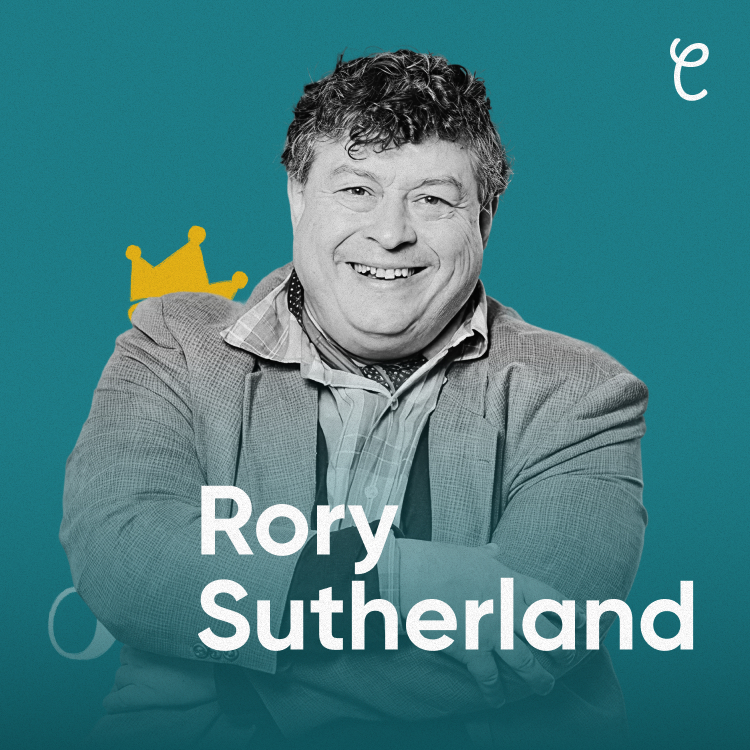
Liam Curley: For 40 years Rory Sutherland has worked at Ogilvy, one of the world's most prestigious advertising agencies, where he serves as Vice Chairman. Since the late 1980s, he's worked with some of the biggest brands on the planet, like American Express and British Airways. Described as the world's leading ad strategist by Shane Parrish and a marketing trailblazer by Steven Bartlett.
Subsequently, he's become a best selling author and keynote speaker heard by millions. You might think that personal fame and success came as a result of his work and association with Ogilvy, but I would argue it didn't. The method he used to build his own authority is available to anyone, even someone at the start of their career. In this episode, I'm going to tell the story of how Rory Sutherland became an undisputed authority.
Chapter 1 — The R&D Lab
Liam Curley: For 40 years Rory Sutherland has worked at Ogilvy, one of the world's most prestigious advertising agencies, where he serves as Vice Chairman. Since the late 1980s, he's worked with some of the biggest brands on the planet, like American Express and British Airways. Described as the world's leading ad strategist by Shane Parrish and a marketing trailblazer by Steven Bartlett.
Subsequently, he's become a best selling author and keynote speaker heard by millions. You might think that personal fame and success came as a result of his work and association with Ogilvy, but I would argue it didn't. The method he used to build his own authority is available to anyone, even someone at the start of their career. In this episode, I'm going to tell the story of how Rory Sutherland became an undisputed authority.
Rory completes his degree in Classics at Cambridge University in 1988. He briefly trains to become a teacher until the realisation hits him that he was headed for a lifetime spent entirely in educational institutions. In his view, what had made the generation of older schoolmasters impressive at his grammar school in South Wales was they'd done something before becoming teachers. They also had terrible cars.
Rory had been fascinated by advertising from about the age of seven. So when he pivots away from teaching, he applies to about six different advertising agencies to enter their graduate training schemes. He gets accepted by Ogilvy & Mather Direct, a branch of Ogilvy, and worked as a planner before becoming a junior copywriter. Here he is speaking with Jake Humphrey on The High Performance Podcast.
Rory Sutherland: I got a job in direct marketing, which is a niche area of advertising, which at the time I joined was mostly direct mail, a bit of outbound telemarketing and press ads with coupons and 0800 phone numbers.
Liam Curley: Over the next two decades, Rory rose through the creative ranks at Ogilvy, from junior copywriter in 1988 to head of copy in 1995, creative director in 1997 and eventually Vice Chairman of Ogilvy Group UK in 2005. Along the way, he worked on major accounts like American Express, Dove and IBM. Then, in 2008, an opportunity arrived. Rory is elected President of the Institute of Practitioners in Advertising, the IPA.
The IPA is the UK's trade body for advertising agencies. Its 258 member agencies handle over 85% of all UK advertising spend, making it the authoritative voice of British advertising. I asked Rory how did that opportunity come about.
Rory Sutherland: They simply suggested that I stand. I was the first creative person to do it. It was founded in 1917 and everybody beforehand had historically been an advertising account man, had later on, in a few cases become senior people from media agencies. I think my predecessor, David Patterson, was possibly the first media agency head to take the role.
And it really, really appealed to me because agencies spend ages and ages obsessing about effectively what you might call the value of the agency, what makes their agency different from other people's agencies, when in truth there isn't that much difference, if we're being honest about it. There are occasionally capability differences and there are also skill set differences, but agencies obsess about this kind of thing. In fact, what really interested me was the category problem, which is how on earth do you help advertising agencies? Because, as I said, various business decisions taken over the last 20 to 30 — well, yeah, actually a bit longer than that. 40 years have done everything that is possible to diminish their influence and stature and to some extent their earnings from client companies, because they've defined themselves by what they do, not how they think. And so my particular enthusiasm was to take behavioural science and psychology and re-inject it back into the advertising category.
Liam Curley: Notice there that Rory says re-inject behavioural sciences back into advertising.
Rory Sutherland: My activity was in fact, not an invention, but a resurrection.
Liam Curley: What Rory's talking about here is that from the 1920s through to the 1970s, large ad agencies in New York and London hired psychologists to work inside the agency. For example, John B. Watson, the man who popularised scientific theory of behaviourism, joined JWT in 1920, one of the first ad firms to apply behaviourist principles to advertising. Another example, Herta Herzog, an Austrian American social scientist with a PhD in psychology, left academia in 1943 to join McCann Erickson's market research department. But then ad agencies, as Rory puts it:
Rory Sutherland: Became fixated on their output, not on their input, if you like, which was, I think, a problem.
Liam Curley: Prior to his election as president at the IPA, Rory had made a discovery of his own which explains this fixation on behavioural science. Around 2007, Rory was off work with about 10 days with flu. After a couple of days, he's ill enough where he can't go to work, but not so ill where he's sleeping all day, doing nothing. In that time, he starts reading economics books, then behavioural economics books and then blogs.
That's how he discovers the book Nudge, which had come out in the US but not yet in the UK. He orders the book by FedEx from Amazon.com and for Rory, when he reads the book, it was an epiphany. He'd worked in direct marketing for about 15 years at this point, and he'd always been convinced that there was a scientific discipline he was missing. Here he is speaking on the Rival Scratch podcast.
Rory Sutherland: I thought, this is the discipline I've been missing all my life. I was always convinced there was this scientific discipline or area of inquiry, which I used to call the thing for which we have no name. Effectively, it was the science of human action and decision making.
Liam Curley: He finally realised he wasn't losing the plot. There were other people who found this curious and wanted to know more about it. So as a consequence of this discovery and epiphany, Rory decides he'll make behavioural psychology the central plank of his presidency at the IPA. So what I want to understand is central plank, what does that mean? What did you do?
Rory Sutherland: You have a two year presidency once you're elected as president of the IPA and it is normal to have a presidential agenda, which is what you hope to achieve or at least focus on in your two years in office. And it's a good focus. You know, you obviously do many more things than that. Obviously encouraging talented young people to enter the industry is and will always be an important part of that role.
For instance, making sure the agency has access to talent, that is an important role. But you also have your two year presidential agenda, which is something you can realistically hope to achieve or at least seed within that two year period. And mine was basically behavioural science. And there were two reasons for it, which is one, I realised that a lot of advertising made intuitive use of behavioural science, but found it very difficult to explain why, what it was doing, which often made it seem perverse or weird to the clients it served, when in fact it made perfect sense through the lens of psychology.
And secondly, I also thought there was a defensive part to this, because if all our clients had read Daniel Kahneman or Nudge or whatever, and the agency people didn't have a clue what they were talking about, we'd look stupid and further lose relevance.
Liam Curley: Rory's stint ends after two years as president of the IPA in 2011, and through those two years he's been deeply entrenched in behavioural science more than ever. It's abundantly clear that humans do not conform to rational behaviour when making decisions. We make irrational decisions. In Rory's mind, the purpose of marketing is to understand the areas where human behaviour differs significantly from what a person might logically assume versus the behaviour they will actually take irrationally.
An example of a brand that's absolutely nailed that distinction is Red Bull. Rory loves this example, and I'll quote him. There's no logic to suggest that there's a massive gap in the market for a drink that tastes worse than Coke, costs more than Coke and comes in a smaller can. End quote.
Focus groups hated it, but it's one of the most successful beverage brands in history. Here's Rory Sutherland speaking with Patrick O'Shaughnessy.
Rory Sutherland: If there were a logical solution to this problem, someone would already have found it. So the place to look if you want to have disproportionate upside in an investment, is invest in something which has an element of absurdity to it.
Liam Curley: How can you tell the difference between an absurd idea that should never see the light of day versus an equally absurd idea that focus groups will tell you is terrible, but actually contains an element of genius like Red Bull? Well, now that he's finished as president of the IPA, that's what Rory plans to do at Ogilvy. Set up an R&D department that can figure all this out. Hire psychology graduates like ad agencies used to do, with the view of taking the best of behavioural economics theory and applying it to the problems the agency encounters in its day to day work, delivering strategy and campaigns.
With that disproportionate upside at Ogilvy, Rory's in the right environment. A business with a culture of experimentation. Here's Rory speaking on the Real Famous podcast.
Rory Sutherland: We both practise and teach and our teaching informs our practise and our practise informs our teaching. So Ogilvy has always, I think, trod the line successfully. You don't want to become an agency of chin stroking intellectuals who never actually affect or execute anything. That's equally disastrous.
Ogilvy's never been anti-intellectual. It's always been fairly receptive to new ideas, new models.
Liam Curley: The problem is there's no money in the business for that kind of innovation. So how are they going to fund it?
Rory Sutherland: A very clever colleague of mine called Nicole Yershon needed to fund a laboratory in which we experimented with new tech and new ideas. It was kind of the R&D function for Ogilvy and she couldn't get funding for it. And she said, well, what if instead of giving speeches and talks for free, what if you charge for them and use the money to fund the lab? Which is how it all got started as a consequence of this.
I only realised this about a month ago. This is why intuition is so important, because often you don't know what you're really doing. While you're doing it now, as a consequence of that, I get invited to speak at things which weren't marketing or advertising conferences. I thought, well, since they're paying to fund this lab, I might as well turn up.
As a consequence of that, I didn't do what most advertising people did, which was show a lot of ads. I showed some ads, but I also talked in general, because I realised that most of the people at a compliance conference will never be in a position where they have to make an advertisement. So the advertisement isn't that interesting to them, except to the extent that it illustrates a different approach to problem solving, which is psychological rather than, let's say, technological or deterministic in some way. Anyway, as a consequence of that, and I only realised this a month or two ago, what made this different was I wasn't selling what we did, I was selling how we thought.
And in the advertising industry, what we do is quite valuable and sometimes extraordinarily valuable, sometimes not very valuable at all, sometimes probably deeply unattractive, but what is valuable from it? And, of course, people within the ad agency don't realise how distinctive and rare it is. Hence the Chinese proverb, if you want to understand water, do not ask a fish. As a consequence, I started selling how we think, not what we do.
And when you do that, you accidentally discover that what you might call the potential market for your wares is a hundred times larger than I think the conventional advertising agency has realised.
Liam Curley: Why would selling the thinking multiply the market size by 100?
Rory Sutherland: Because the way we think is something that anybody can practise.
Liam Curley: The other advantage of making this behavioural science unit self-funded is that it gave Rory a massive degree of autonomy. Within reason. He could take it in any direction. He wanted to speak about whatever he chose to on stage, because now that he's bringing speaking fees into the firm, he becomes the most cost effective vice chairman in the company.
And that title of Vice Chairman, it was, as Rory puts it, agreeably vague. And that came with advantages.
Rory Sutherland: It, to some extent, allowed me to write my own job description. I have a very good friend called JP Rangaswami. He was Chief Technology Officer, I think, at BT for a time. Variety of other very interesting jobs.
Very interesting man. He refuses to take a job with a large organisation unless the job title is new. And he argues if I step into somebody else's job title, I will automatically be judged comparatively by what my predecessor did. And that doesn't necessarily allow me to maximise the value I can bring to the organisation.
And so one of the questions I think we need to ask is that everybody is defined by what they do, not what they're for.
Liam Curley: The Rory Sutherland that we know today, the TikTok sensation, the viral TED speaker, author of Alchemy. It's this version we've just heard who talks about how advertisers think, not what they do. Up to this point he was well respected and known within advertising circles, but not particularly outside of them, but this new version whose fame and notoriety expand beyond the industry. This all came about through his creative exploration of figuring out how to launch the behavioural science lab that would act as a differentiator to Ogilvy and subsequently how he'd deliver value to the new audiences he was speaking to who were not interested in the mechanics of developing an ad.
Rory Sutherland: To some extent, I'm probably more valuable to them than part flying the nest than I am if I just stay in the nest. Because it then effectively provides what you might call early stage funding for exploration which they couldn't fund themselves.
Chapter 2 — Fat Tailed
Liam Curley: Let's go back to the time prior to Rory launching the behavioural science lab at Ogilvy, a period where he's in the thick of his career as an ad man. In the acknowledgments section of his book, Rory thanks the Dead Spiders.
I asked Rory, who or what are the Dead Spiders?
Rory Sutherland: So it's a wonderful group of people. It was founded almost, I think as a joke, as a kind of dinner club. Has met for a while. But there was a company called Red Spider and somebody misnamed it Dead Spider.
That was, I think, Charlie Robertson. The late Charlie Robertson's company was Red Spider. Very, very interesting planning company. But it's a fantastic mixture of now older advertising people.
Mark Earls belongs, I belong. The late Jeremy Bullmore belonged, Paul Feldwick and so on. Every now and then we just meet to have an incredibly agreeable dinner, typically somewhere in London.
Liam Curley: Okay, so just expanding on that then, because you referenced them in the acknowledgments of Alchemy.
Rory Sutherland: Ah, my goodness, yes. I wondered how you'd heard of them.
Liam Curley: So obviously good friends. Why did you feel the impulse, if you like, or the requirement to reference them in acknowledgments?
Rory Sutherland: Oh, because the conversations there, both with those people independently and at the dinners and occasional get togethers, were of just disproportionate value.
Liam Curley: This idea of disproportionate value, it aligns with Nassim Taleb's concept of fat tails. A fat tail means a small number of observations in a given data set will represent the bulk of statistical properties. Here's Rory speaking to that point.
Rory Sutherland: If you play poker, if you play blackjack, what you really notice is that a small proportion of your hands in the course of an evening really disproportionately contribute to your winnings. And a large number of hands, you may make a bit of money, lose a bit of money, but there are some outsize hands which complete outliers in terms of how much you win or sometimes how much you lose. And it's vitally important, I think, to understand that's also true about real life. I think it's also true about advertising, by the way, which is that what we're trying to do with life is we're trying to measure it as though value is proportionate to time, that every quantum of time has to be matched to a quantum of revenue.
For example, I worked on American Express for, you know, getting on for 10, 12 years. Looking back, I didn't realise it at the time because everything seems equally important at the time. But a small proportion of your activity or your discoveries in a way contributed absolutely outsized proportion of the value. Looking back at that time on American Express, most of the things we did were worthwhile in some shape or form, they had to be done.
But a small proportion of those pieces of activity, maybe three or four, really delivered nearly all of the long term economic value from what we were doing. And I think that's also true of conversations and events. It's particularly true that every now and then you'll have a conversation or you'll read a sentence, or you'll have an insight, which is just a thousand times. You might read five sentences in a book and those five sentences are literally a thousand times more valuable than all the other sentences in the book.
And I think just accepting that and getting away from this idea that we have to optimise the parts to optimise the whole and the idea that life is proportionate, it fundamentally changes your philosophy because you argue that actually what I'm really here for is to try and get lucky as often as I possibly can.
Liam Curley: And that was the point Rory was making about the Dead Spiders.
Rory Sutherland: Jeremy Bullmore undoubtedly among them. Still, I think the best writer on advertising in the 20th century. And every now and then you understood something which you didn't understand before. And those moments of kind of enlightenment or epiphany are really, really important.
Liam Curley: If you've listened to other episodes of Undisputed Authority, you might be noticing a thread here. The game is to get lucky, to increase your surface area of luck. You can't predict which work will get you that lucky break. Which podcast episode gets tweeted to millions, which blog post gets forwarded to the right editor?
Or which client introduces you to the opportunity that changes your business. So you do excellent work, excellent as defined by the clients you seek to serve, ship it where those clients can find it, and stay in the game long enough for that disproportionate moment to arrive. That was a game Rory played in advertising for decades, and it's the game he plays now as an authority.
Rory Sutherland: The main purpose of advertising is in fact to stay alive long enough to get lucky, to have one of those outlier effects where you have an idea which is worth £50 million, a billion dollars. In some cases, that won't happen every day of your working week. So judging people's productivity by how billable they are on Wednesday is simply moronic.
Liam Curley: I've already shared some of the fat-tailed events that shaped Rory's path to becoming an undisputed authority, but follow this thread with me. First, I ask Rory where did the seeds come from for the idea behind his best selling book, Alchemy?
Rory Sutherland: Oh, bloody hell. I mean, I needed to write a book. I think the title only emerged. The title only emerged, I think halfway through writing it.
Where the first seeds arose was really the accidental discovery that came about through doing public speaking. So as I mentioned in my last interview, I was doing public speaking for free. I ended up speaking to audiences who weren't marketers. And I realised very quickly there's no point in just talking about what we do here because 99% of these people will never be asked to make a TV commercial or run a poster campaign or even a direct mail campaign, whatever it may be.
So of necessity, if you like, it was a bit like stand up comedy in that you had a set and you continually, you had a kind of modular set and you continually experimented with it.
Liam Curley: To see what resonated. That reference on comedians tracks. That is how the very best stand up comedians write their Netflix specials. In the same way Rory wrote a best selling book through iteration, here's comedian Jimmy Carr speaking with Louis Theroux on his writing process: At the end of the show, I'll get a piece of paper out at the very end and I'll try like 10 new jokes, really. And some of them will work and some of them won't. And then you're constantly kind of building the next show. So you've got these kind of little building blocks, of Lego. Of like, oh, that's a joke that works. And that's a joke that works. And what would go well together and what's a good sequence.
And okay, now back to Rory and his process for uncovering the ideas behind his book.
Rory Sutherland: What I noticed was that when you talked about what — it was very good to talk about what we did. Because showing two or three TV commercials can be highly illuminating and illustrative of a point. But if I just stood up and talked to 40 compliance officers about making TV ads, they'd think, nice divertissement, but not much use in my everyday life.
Whereas when I started talking about how we think rather than what we do, hence the title of the next book, Mad Think, when you start talking about how we think rather than what we do, the target audience becomes much, much bigger. And then, to my joy, I discovered that the target audience for the book and the effective customer base for the book was 20 times broader than I'd anticipated.
Liam Curley: You said you had to write a book. Why did you have to write a book?
Rory Sutherland: Because I'd received an advance to write a bloody book. And I'd have to pay it back if I didn't write the bloody book. Okay? That's how it works to some extent.
The other reason was if you look at it purely from a commercial point of view, there's a whole kind of flywheel effect. If you do speaking, writing, you know, coaching, talking. The book is part of the flywheel. And having written a book, you can do the other things with a degree of extra credibility.
But also because I felt I had something worth saying. And so it didn't seem a total waste of my time to commit that to paper rather than merely committing it to YouTube or whatever.
Liam Curley: That book deal Rory gets is with Penguin Random House. So deal with a major publisher, which opens all sorts of other doors. How does he get the deal with Penguin Random House? It's the fat tail again.
How did you get the deal? How did that come in through?
Rory Sutherland: Wonderful. Again, this is what I mean about things being fat tailed. I can't remember how I first met Max and John Brockman, but they were US literary agents in the world of what you might call science writing. And I would like to say intelligent nonfiction. So John Brockman, for many, many decades, had been a kind of — how would I describe it? Almost an impresario, I think, is the right description among, you know, all manner of extraordinarily interesting people. You know, whether it be the sort of, you know, the Dawkinses or the Pinkerites.
It may well have been through Nassim Taleb.
Liam Curley: Are you friends with Nassim?
Rory Sutherland: Yeah, but not only that, friends is not doing it justice, because he's been an absolutely enormous influence on how I think about the world. Because, interestingly, at its best, statistics, when well practised, is a kind of art form. It's a form of high creativity because it involves seeing what everybody else sees, but concluding something totally different.
Liam Curley: But you were a fan of his work before you were friends?
Rory Sutherland: Yeah, that's right, yes. Before I even met him. I think I first met him at a Spectator dinner.
Liam Curley: Rory mentions the Spectator here. If you're not based in the UK, you may not be aware of the Spectator. It's a 200-year-old British weekly magazine covering politics and culture with witty, often contrarian commentary in the UK, similar in prestige to the New Yorker or The Atlantic. Rory's at a Spectator dinner because he writes for the Spectator.
So, again, how did he get that opportunity, the fat tail? How did you get the opportunity with the Spectator?
Rory Sutherland: This is, you know, I hate to say this because it's kind of depressing, but it's true that nearly all the significant things that happen to you are actually lucky. I knew someone very brilliant at Ogilvy, whose wife was also very brilliant, who was brought in by Matthew d'Ancona, then the editor, to assemble an interesting group of people around the table. Matthew then said, I'd like you to write, because I've been a lifetime Spectator fan. My father had the Spectator.
There were copies of the Spectator in my home when I was sort of 11 or whatever. And this was in the late 60s and late 70s. I wasn't reading in the 60s. I was four years old, you know, weird.
But this was the time when very few people subscribed and subscription dipped very, very low for a time. And so I was lifetime longest. And Matthew said, I'd like you to write an occasional column on technology. Happy to oblige.
And then, by a glorious accident, they wanted a sports writer, which was Roger Alton. And Roger, who I think recently had been the editor of the Observer, said, I'm happy to write a sports column, but I'm only happy to do it fortnightly, not weekly. And so Matthew then said, would you be happy to do the other fortnight? Which, by the way, was probably the luckiest accident, because had I been asked to write a column weekly to begin with, it might have driven me insane, or I might simply have lacked the necessary material to keep it interesting.
And so, you know, all shit happens this way. We just spend our time reverse engineering lives to pretend that it didn't. You know, Mick and Keith. I'm not, by the way, I'm not suggesting equivalence.
Okay. You know, but Mick and Keith met by accident on a train. And there's a great book by Brian Klaas called Fluke, which effectively makes the point that most of the world — there's a wonderfully banal sounding phrase in evolutionary biology which is things are the way they are because they got that way, which sounds completely banal until you realise it's quite profound.
And this is really important. The only thing you can do is you can't control luck, but you can control to some degree the odds of being exposed to its upside.
Liam Curley: And all those lucky breaks, they increase Rory's fame amongst widening circles of people. And that fame compounds bringing with it greater and greater opportunities. Here's Rory speaking with Darren Lee.
Rory Sutherland: If you're at the point where you are not famous, you have to find your customers. When you become famous, customers whose existence you never even envisaged will come and find you. That's a kind of escape velocity. That's a step change.
Chapter 3 — Noticing What Others Only See
Liam Curley: We've established that life and business is fat tailed and that the name of the game is increasing your surface area of luck. All undoubtedly true, all factors in Rory's success. But there's one other key ingredient at play here.
It's not all down to luck. Rory has craft in delivering messages and insights that resonate. What exactly does Rory's craft look like? First, I want to share with you an example of Rory's genius.
This is what audiences both online and in person go crazy for. The power of irrational thinking. In his TED talk, Life Lessons from an Ad Man, Rory tells a story about the Eurostar train from London to Paris. A group of engineers were asked, how do we make this journey better?
Their solution was to spend six billion pounds building new tracks to reduce the three and a half hour journey. Rory's counter proposal is, and I'll quote him, employ all of the world's top male and female supermodels.
Here is Rory delivering that talk for TED.
Rory Sutherland: Pay them to walk the length of the train, handing out free Château Pétrus for the entire duration of the journey.
Liam Curley: Now —
Rory Sutherland: You'll still have about 3 billion pounds left in change and people will ask for the trains to be slowed down.
Liam Curley: His point is that engineers, scientists and medical people are obsessed with solving problems of reality. But most problems, once you reach a basic level of wealth in society are actually problems of perception. That's brilliant, right? Here's another example of Rory's material.
Five Guys, again quoting Rory. The price you pay for a burger there is insane. You spend a huge amount on the thing where you believe money makes a big difference, the quality of the burger, but then everything around it flips. The toppings are all free, the peanuts are free, the drink refills are unlimited, and they give you a free scoop of fries on top of whatever size you ordered.
What Five Guys is doing, in Rory's words, is getting you to pay willingly for something you care about, while being generous with everything else. You walk out feeling like you got a deal even though you paid premium for a burger. Rory is masterful at simultaneously noticing things that are both obvious and overlooked. You hear the Five Guys analogy and immediately you think, yeah, of course.
That makes so much sense. Never thought about it before then. He often supports these real world observations with science, solidifying them and making them credible. That's the pattern.
Spot something both obvious and overlooked, then reference the underlying science of why it works. He doesn't invent anything. He gives language and arguments to things we've seen, we just haven't noticed. That pattern runs through many authorities.
Here's Rory speaking on the Infinite Loops podcast.
Rory Sutherland: Innovation is mostly a backwards process where practitioners make the progress which is later codified by scientists and academics. As with Darwin, in many ways, pigeon breeders and dog breeders already understood, as far as it was necessary for application, the principles of selection. But what they didn't do is codify it. And the process quite often happens backwards.
Liam Curley: Rory walks through the world with his eyes open, certainly in the context of marketing and human decision making. That's the data, right? Real human and business activity. He's always picking up signals, but then he's also reading widely.
He even speaks to this when delivering career advice on the One to One podcast series.
Rory Sutherland: The idea that the modern employee, in truth, has to be good at more than one thing, or at least you have to be very good with depth in one thing, but you need to have breadth in a variety of related fields.
Liam Curley: He uses reading from fields outside of marketing and advertising to explain the data inside of marketing and advertising. It's what I call broad perspective, narrowly applied. In other words, he notices the strange way that Five Guys price their burgers, and he uses behavioural science literature to explain why that works. But then he takes it further.
Rory's argument is that behavioural science isn't about laws, but rather it's about spotting recurring patterns. Complex systems don't have laws, they have patterns. And the power of a pattern is that it's transferable. You can notice one in burger pricing and apply it to national policy. He's made this exact point.
What if a government structured its tax system the way Five Guys structure its menus, direct the taxes people feel most keenly towards the things that they care most about and fund everything else through taxes they barely notice. Same psychology, radically different scale. Rory calls this fractal. Same principle works whether you're pricing fries or designing fiscal policy.
So whilst the points Rory makes about fat tails and surface area of luck are absolutely true, his genius for developing a broad perspective and applying it narrowly, that is his magic, intentionally or otherwise. That, I believe, is the method Rory has used to become an authority inside and outside of his industry. And that method has nothing to do with the prestigious name of Ogilvy on his CV. In fact, this broad perspective on behavioural science and using it to explain advertising, I think he could have used this to build his authority in advertising, even if he had no background in advertising whatsoever.
How do I know this? Because somebody already did. Harry Dry is the founder of Marketing Examples, a website and newsletter with over 130,000 subscribers. It's adored amongst many in the marketing communities.
Marketing Examples breaks down real campaigns from companies like Airbnb and Stripe into simple visual side by side comparisons, showing what works, what doesn't and why. And he built this with no formal marketing background. He'd only finished studying economics two years before launching Marketing Examples. Here is Harry speaking with Content UK.
I didn't have a design background and I took a design — I looked at this, someone called Steve Schoger. If you Google him, he's made some really good design tips. And actually Marketing Examples is a complete clone of what he did for design.
He made these kind of incredibly detailed design tips and I thought, I'm going to do the same thing for marketing. Harry collects hundreds of ads and examples of copywriting each week. That's the observing and collecting data part. Then, where Rory Sutherland takes his broad perspective from behavioural sciences, that's his outside source to explain the data.
Harry Dry gets his broad perspective from UX design. He uses UX design principles or other UX design techniques and applies that technique to a specific field, ads and marketing. And just as Rory found his luck through the fat tail, so did Harry. One particular example, on a piece of marketing by Kanye West's Yeezy dating app, got him his first break.
And that was followed by a landing page guide that went viral. Like Rory, Harry's walking through the world with his eyes open, curious, making connections between disparate fields. And that really is what Rory is a master of. Now, the extent of Rory's success, maybe we could put some of that down to his craft and almost 40 years of experience in the ad industry, plus any connections he made along the way.
But the method behind his success, that's available to anyone. Developing the craft of articulating observations that are simultaneously obvious and overlooked, then supporting them with explanations from behavioural science. This combination — consistent presence with genuine insight — is what separates Rory from every other advertising executive at every other prestigious agency. That is how Rory Sutherland became the undisputed authority.
Liam Curley: Thanks for listening. I'm Liam Curley and I help experts develop, package and publish unique insights. I hope you enjoyed this episode and if you did, consider subscribing. And one other thing, I've created a free email series called the 10 Patterns of Disruptive Wisdom.
In my research of undisputed authorities, these are the consistent behavioural patterns I noticed among those who rise to the top. To get the email series, head to liamcurley.co.uk. Link is in the description.