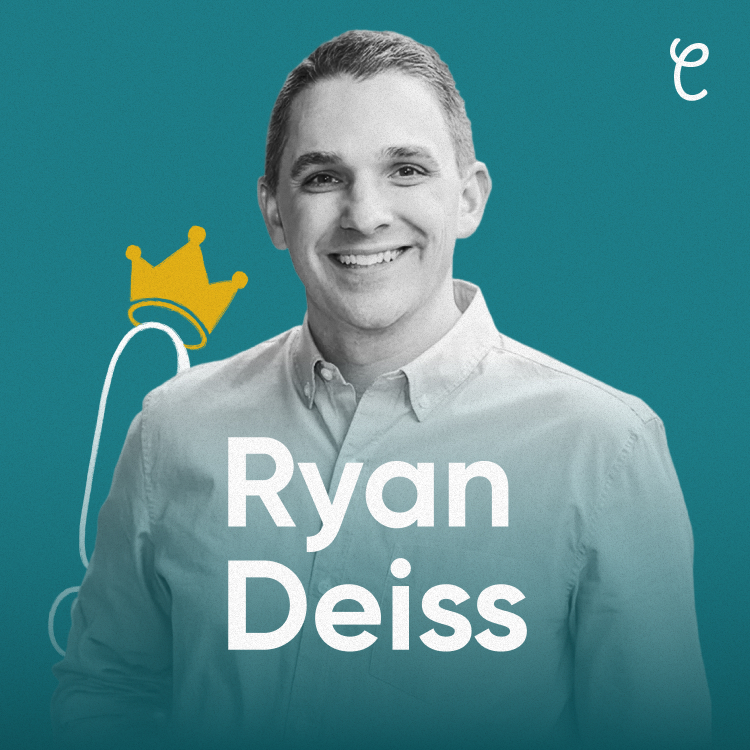
Liam Curley: Ryan Deiss is one of the godfathers of internet marketing. In 1999, fresh out of high school, he started writing and selling ebooks online. By the time he graduated from college in 2003, he had built 200 individual websites generating revenue. He would go on to co-found DigitalMarketer, one of the first and largest marketing education platforms in the world.
In 2009, he co-founded the Traffic and Conversion Summit, an events business, which in 2018 he would then sell to Clarion Events, the largest privately owned events company in the world. All of that led to the business that I want to talk about today in this episode, the Scalable Company. It's a business that developed a solution to a validated problem as experienced by a group of people who already trusted them. And the business almost failed because the way you deliver a solution is as important as the solution itself.
Here is the story of Ryan Deiss and the Scalable Company.
Chapter 1: Good marketing is everything, until it's not
Liam Curley: Ryan Deiss is one of the godfathers of internet marketing. In 1999, fresh out of high school, he started writing and selling ebooks online. By the time he graduated from college in 2003, he had built 200 individual websites generating revenue. He would go on to co-found DigitalMarketer, one of the first and largest marketing education platforms in the world.
In 2009, he co-founded the Traffic and Conversion Summit, an events business, which in 2018 he would then sell to Clarion Events, the largest privately owned events company in the world. All of that led to the business that I want to talk about today in this episode, the Scalable Company. It's a business that developed a solution to a validated problem as experienced by a group of people who already trusted them. And the business almost failed because the way you deliver a solution is as important as the solution itself.
Here is the story of Ryan Deiss and the Scalable Company.
When Ryan and his partner sold Traffic and Conversion Summit in 2018, simultaneously they decided to sell several other businesses from the portfolio. They had a collection of businesses across consumer e-commerce, consumer media and events. So they began exiting a lot of these in 2018 and 2019. Subsequently, Ryan and his partners are sitting on a lot of capital. So they're thinking, what should we do with this? He considers becoming a VC investor.
Ryan Deiss: I talked to some other people who were in that area and they're like, no, it's a very different thing. Like, just because you're good at starting companies and running companies doesn't mean you're going to be a good investor.
Liam Curley: So Ryan decides against investing because he's good at building companies. And that's where his interests and expertise lie. Here's where he and his co-founders decide to go next. They'd strategically simplify the organisation, focus on the one thing they were exceptional at and sell everything else.
So they choose to double down on DigitalMarketer as a platform business. What is a platform business? In this case, it's essentially a media company that holds the knowledge and expertise in launching and marketing new businesses. It's like a solar system.
Here's Ryan speaking on the Self-Publishing School podcast.
Ryan Deiss: So let me give you an example of DigitalMarketer. So DigitalMarketer was a planet and orbiting around DigitalMarketer was a moon called Traffic and Conversion Summit. There are also certifications, which is a separate thing. And there's a licensed practitioner. Any one of these moons could get, if they got big enough, eventually spin out and kind of become their own planet.
Liam Curley: Ryan and his team wanted to do something similar in the B2B space, which they would call the Scalable Company. I'll just call it Scalable from here on. Scalable would help entrepreneurs scale their businesses, and in the process, Ryan would effectively get paid to do due diligence on exciting B2B opportunities that they could later invest in. So what exactly would Scalable offer to these entrepreneurs?
It would solve a problem Ryan had experienced himself. He'd assumed that what it took to go from zero to a million was you just do more of that to go from a million to 10 million. But it's not. They're fundamentally different games with a fundamentally different playbook.
Ryan had been a master at building businesses from nothing, but he'd experienced a string of failures in scaling those businesses. For example, two companies in the DigitalMarketer portfolio hit the Inc. 5000 list, but one ended up being sold for scraps, in Ryan's words, and the other lost $2 million and laid off 180 people because they'd hired the wrong CEO. Again, in Ryan's words. Ryan was exceptional at marketing, but that brought with it its own problems, and Ryan has talked openly about this period.
Good marketing, he says, is everything until it's not. Really good marketing without understanding operations and systems and scale will, if you're good at it, lead to chaos. It's a machine that's going to fall apart as it's rattling, moving so fast. Again, in Ryan's words, you can only have your business held together with duct tape, bubble gum, and hope.
For so long, Ryan was hanging on, but at the cost of his personal health, his sanity, and his family. Again, this is, in his words, everything hit in a bad way in 2016. From the outside looking in. He's doing interviews, speaking on stages, making good money.
Everyone thinks he's doing great. But he was miserable. Leaving for work before his kids were awake, getting home after everyone was in bed, missing his kids' soccer games and dance recitals. Even on weekends, when he was supposedly not working, he wasn't really present.
And this is when he's successful, when he has everything that he supposedly wanted. He's described a moment that became the breaking point, which is he comes home late one night after midnight, which wasn't unusual, comes around the corner to his bedroom, and he sees the light on from under the door. His wife's sitting up in bed, and she'd been crying. Here's Ryan on the Rise Up Kings podcast.
Ryan Deiss: And she just said, look, you can keep doing what you're doing. I know I married an entrepreneur. I knew who you were when I married you. You can keep doing what you're doing. You just can't pretend like you're doing it for us anymore. And that was just crushing to me.
Liam Curley: Driven by those painful failures and personal experiences, Ryan and his team did subsequently build the systems that would mean the business didn't revolve around his expertise in marketing and they'd have systems in place that would scale. Here he is speaking with Ryan Hawk on The Learning Leader Show.
Ryan Deiss: I've got to stop being the racehorse. I don't even want to be the jockey. How do I do that? And so what I realised is that I needed to productize myself. And so if what we're selling is some type of knowledge or service, I thought about, okay, when I do, when I talk, like, what is my process that I go through? And if I weren't doing it, how would I? And so the first thing that you have to do is you have to build an asset. You've got to have your version of the Ten Commandments, right?
What is kind of that artefact for you that distils your knowledge, ideally, into a single sheet of paper that can be handed off? I could pull from me and I could imbue it into this artefact.
Liam Curley: In building a business that scales, though it may seem counterintuitive, the founder enjoys far greater freedom. Here's Ryan with Billy Broas.
Ryan Deiss: If you build a business that has great systems and that has great people, you will have far more freedom than if you have a solo business with no employees. The reality is, is if you have customers and you have clients, and if you have a business that actually is generating revenue, then they're going to expect to be served. Like they're going to expect you to do stuff for them. And if you're on the beach, kicking on, you know, on vacation, a client's hitting you up and there's nobody there to help them out, you know, you got to make a decision, basically, am I going to totally disappoint this client, potentially lose them, or am I going to, you know, blow up my vacation and potentially disappoint the people I'm with?
Liam Curley: In building a business that scales, though it may seem counterintuitive, the founder enjoys greater freedom. Ryan's made the point that if you build a business with great systems and great people, you have more freedom than a solo business with no employees. Because if you have customers and clients generating revenue, they're going to expect to be served. If you're on holiday and a client makes contact and nobody's there to help them, you've got to make the decision, am I going to disappoint this client and potentially lose them, or am I going to interrupt my holiday and disappoint the people I'm with?
Ryan had experienced this challenge of scaling for more than a decade and in recent years developed a solution to it. With Scalable, Ryan would try and solve this problem for others. But where would he find customers?
Chapter 2: The idea resonates, the offer does not
Liam Curley: Ryan started with some advantages. For one, he had an existing list of B2B business owners with DigitalMarketer.
Ryan Deiss: What had started to happen when I started DigitalMarketer, it was mostly entrepreneurs. It was mostly people who wanted to start a business online or they had a business and they wanted to take it online. The change that happened at DigitalMarketer is that as marketing became more professionalised, the main avatar, the main client or customer of DigitalMarketer was now the professional marketer. So it was marketers very often at companies.
We did have a fair number of marketing agencies, you know, agency owners and marketing consultants in there as well, who they are technically small business owners. But the ideal client for Scalable is an owner operator generating, you know, doing between 2 and 20 million dollars a year. Right? That really is kind of that sweet spot. And really that 4 to 6 million is the absolute bullseye. 10 to 40 employees, that's kind of that bullseye. We didn't actually have that market massively at DigitalMarketer.
Liam Curley: When you consider the specific nature of the businesses Scalable would target, the revenue and employee count, it represented a fraction of members in the existing DigitalMarketer community. Nonetheless, he did have a captive audience, which was why, in Ryan's words, Scalable wasn't a conventional startup.
Ryan Deiss: When it's a pure startup, what you are doing is you're trying to determine product market fit, you're trying to figure out does anybody want what it is that you're selling. And so there's two unknowns at that point, the product itself and the audience. So you don't know if anybody wants this product. And then let's say that the product itself is desired.
You don't really know exactly who desires it. In this case, I had the audience. I didn't yet know exactly what they wanted to buy, but I at least had a captive audience and that's more than half of the battle.
Liam Curley: So Ryan has an audience who like him and view him as an authority, but he didn't know exactly what to sell.
Ryan Deiss: Originally, the offer was just a mastermind because we had offered that before, we had sold that before, and I knew that high performance business owners like to be around other high performance business owners.
Liam Curley: Scalable launched at the end of 2019 with these in-person masterminds. When the pandemic started in 2020, the idea of in-person meetings turned into a virtual mastermind where once per month you hang out with Ryan and a bunch of smart entrepreneurs all working on this challenge of scaling their company. Ryan knew that this wasn't the long term offer, but it was enough to seed the business.
Ryan Deiss: We sold some variation of that for the first like 18 months. Then the thing that I rolled out to that community was our operating system framework. Like this is how we actually go in and systemize businesses. And that really took hold.
Liam Curley: Let's talk about that operating system. The day before one of their mastermind events in 2020, Ryan was trying to figure out how to connect a collection of disparate tools. Ryan and his team had figured out the scaling conundrum. They had models helping you make good decisions at every stage of business growth.
Things like value engine mapping, goal settings, and how to hold a meeting. Several of these tools were essential to building a business that successfully scaled. But the sequence of how they fit together was unclear until before one of their events in 2020. In a state of panic, Ryan figures out how to bring them together.
Ryan Deiss: I'd come up with so many different ways to try to teach this that every time I tried to explain it, it was more confusing and convoluted than the next. And literally I went back to just what the heck is an operating system? What is the definition of an operating system?
Liam Curley: Ryan Googles, what is an operating system? The definition of a computer operating system, as I quote Ryan's book, is made up of three components. One, a set of algorithms. Two, a common language which enables different components to communicate with one another in support of three, the desired outputs of a machine.
Ryan Deiss: And I was like, holy crap. These six tools that make up our operating system slot really well into those three categories. Like these three slot into the set of algorithms, these two slot into that, this one slots into that. And then in my head I was like, well, that kind of makes a pyramid. And now that I think about it, the foundation of it, we absolutely should start with these three. And when it's worked the best, we did start with these three. And then you should do these, and then you should do these.
Liam Curley: Clients loved the framework. The people who—
Ryan Deiss: —we shared that with, they were like, this is a game changer, this is really good. So I knew that I had something. And so in 2021 we started selling that separately.
Liam Curley: Ryan and his team break this operating system out as a product and deliver it as a classic two to three thousand dollar cohort course. This was the product they'd been looking for, the one that could scale. DigitalMarketer had successfully sold this type of course for years. This time, however, it didn't work as they'd hoped.
During the early months of the COVID pandemic, the market was flooded with these cohort learning products. It was saturated and it worked for—
Ryan Deiss: —about six months until everybody was sick of those. But we still continued to try to go that route and nobody wanted to buy it as a course and frankly people weren't having much success with it as a course from an implementation standpoint. Then we shifted back to let's try to sell a mastermind with the course bundled with it. So now when you join the mastermind, we're going to encourage you to go through the course and it was essentially like a group coaching type programme.
So come on in and there's going to be this group coaching element, weekly calls, but then we'll meet four times a year. You know, hard to sell, not a ton of success. What everybody said that they wanted was just one on one help building and installing the operating system.
Liam Curley: Everybody wanted one-to-one help implementing the operating system, but it was exactly the opposite of what Ryan wanted to sell. Remember, a non-negotiable was to build something genuinely scalable.
Ryan Deiss: It's harder, especially on the services side for two reasons. One, people are involved. There's things that you can automate with software and AI, but at the end of the day it's still people. And so anytime you've got humans, there's levels of uncertainty that you just can't systemize your way out of. You're just going to deal with the messiness that is humans. That is one of the challenges of service based businesses that any service based company has that software companies don't.
The second though with service businesses is you don't really get the same economies of scale that you do with products and software companies. So as they grow, you're going to need to add people at about the same rate as you add clients. The only real economies of scale that you get are on the retention and the ascension side. So if you're not getting clients to stay with you longer and to ascend, then there's really no additional margin gains as you scale. So if you sell to the same client a second time, you didn't have to re-incur that cost of acquisition.
Liam Curley: So despite the market telling him exactly what it wanted, one-to-one support, Ryan resisted and as a result, traction was an uphill battle. As appetite for cohorts waned, the business struggled. Come October 2023, they're losing money. They've had a bad month on the back of a bad month and they're fresh out of ideas.
Ryan Deiss: I realised if we didn't figure out something by the end of that year, I was probably going to have to start laying people off and essentially wind Scalable down to sort of let it be a small media company. That was sort of the face of kind of my media stuff. But it wasn't really going to sell much in the way of products. It was just kind of going to be the face of investment type efforts.
Liam Curley: As a last gasp attempt, Ryan's business partner Richard tells Ryan, if we can sell one-to-one, I'll support the first 10 clients myself. They decide to give it a shot.
Ryan Deiss: I remember the first phone call we told our salesperson because our salesperson was begging. They're like, I know if you would just let me make this offer that I could sell it because this is what everybody wants, it's what everybody's asking for. So we finally said, okay, green light, you can sell it. The very first call closed. The second call closed.
Liam Curley: Before they could even hire someone else to help with delivering the one-to-one, they'd already sold to 20 clients. So Richard, Ryan's partner, services the 20 instead of the original 10 planned.
Ryan Deiss: His kind of full time job was implementing these things for the next three months. I think he did like 25 of them while also training other people.
Liam Curley: Ryan wasn't necessarily surprised by the success. He'd just been resisting. He knew it'd be hard and it was. But the business had turned a sharp corner.
It was suddenly easy to make a sale, which is a telltale sign of product market fit. They were no longer losing money. Ryan always had a solution to the problem the market was eager to solve. But he wasn't delivering it in the way they were asking.
He heard them, he just wasn't listening. And it wasn't until he listened that the business had a chance of succeeding. So how did Scalable evolve to become a business that could grow beyond the point where the founders were delivering one-to-one coaching?
Chapter 3: Building the machine
Liam Curley: To scale to a point where the co-founders are no longer delivering the product, there are two things Ryan and his co-founder needed to achieve.
First, they needed to build out a consistent, repeatable delivery to help clients implement the Scalable Operating System and it needed to be delivered by staff they could hire. Second, they needed to build a follow-up offer beyond the initial implementation so that clients keep working with Scalable. As Ryan previously mentioned, the way to scale a business is through client ascension and retention. This all supported the process Ryan recommends on building a company from zero to one million dollars in revenue.
Here he is speaking with Billy Broas.
Ryan Deiss: But in the early days when you launch, it's all you, man. Do everything that doesn't scale. Your first 10 clients, I don't care how you get them, I don't care how hard it is to serve them. Just go and get 10 people to give you money and do that until you have at least 10 people who are absolutely over the moon thrilled, such that they have a measurable result and they're willing to let you talk about it. Until you have sold and served 10 — and served meaning just by that standard they got a measurable result, they're willing to let you talk about it — but until you have 10 of those, don't worry about scaling squat. But once you have that and you're ready to scale, okay, now we can get into systemizing.
Liam Curley: So in helping founders build their operating system over a 16-week process, Ryan and his team map out their own process of how they do that, document it, productize it and train team members to deliver it. After those first 16 weeks of helping the customer install an operating system, they offered to install the marketing and sales system required to grow the business, which was pulled from their expertise at DigitalMarketer. So now Scalable has product market fit. Ryan takes the next step to firmly establish the brand.
As experts in helping entrepreneurs scale their companies, he starts writing a book. The objective of the book was to generate leads for Scalable's services, which is pretty typical. It would share the story behind launching the business and the Scalable Operating System to grow the business successfully. Like April Dunford did when she wrote Obviously Awesome.
Ryan taught the material in live settings before writing the book. It essentially came out of the original course, those early cohorts and masterminds where he taught the implementation of the operating system.
Ryan Deiss: Even if it's virtual over Zoom, you can see people's reactions, you can see where they're really getting in. Their eyes get big and they get excited. You can see when you're losing people and they get confused. And so I had taught it a number of times and it felt like I'd really sort of honed it in.
And so the book was essentially, I got the different modules transcribed and then I rewrote it from scratch based on the transcriptions. So there was no AI used or anything like that. And it's not transcription, because the transcriptions of me talking makes for a terrible book, like a really awful book, because I tried. And then kind of the front chapters were really setting up the core principles, injecting a story into it that I don't tell in the course and things like that, but that I felt were important for people to understand the context of why these kinds of things matter. But, yeah, it started with teaching it and I wish more people did that.
I wish more people subjected their book material to real time, in-person instruction to get feedback on it. Because there's just so much stuff in books that is either bland, boring or confusing. And if they actually went and taught it, they'd realise, like, this isn't ready yet. This is very half baked.
Liam Curley: He had gold on his hands and he knew it. The feedback was great. And don't forget, Ryan had mastered the methods he was sharing. Here he is speaking with Ryan Hawk on The Learning Leader Show.
Ryan Deiss: A lot of people say, I want to write a book or I want to start teaching stuff. It's like, you haven't done it yet, you need to get out there and do it. Like step one is be really, really good at the thing that you do. Have you done it for you? Have you done it for somebody else? Have you done anything before you go out and before you go out and teach?
Liam Curley: It took Ryan years of doing, getting results, good or bad, and then stepping outside that process of figuring out how he'd achieved the same results for someone else. The years at DigitalMarketer were the doing. The time at Scalable was him stepping outside to figure out how he'd done it and how he'd help others achieve the same results. So Ryan writes and publishes the book Get Scalable, but he doesn't launch the book, not in a traditional sense. Ryan had done the big book launch before.
His first book sold over 30,000 copies in the first 30 days. But this time he took a different approach. Around the time of this new book, he'd been talking to Alex Hormozi, who was planning a massive launch for his next book, $100M Leads. And it got Ryan thinking about the books that had actually had the biggest impact on him, the ones that owned a category. Almost none of them had done the big book launch.
They started slowly, found a pocket of the right readers and spread from there. Tim Ferriss's The 4-Hour Workweek was pretty much like that. So Ryan decided to give himself 12 months to launch the book instead of 12 days, which took the pressure off. And it also made more practical sense because Scalable can only take on about 20 to 30 new clients a month.
So a massive surge of attention with nowhere to send those people would have been a waste. He launches the book to their email list, sells 12,000 copies in the first few weeks, and from there on consistently sells between 500 and 1,000 books per month. Here he is speaking on Smart Author with Chris Benetti.
Ryan Deiss: And really my goal from the beginning was to give away 10,000 copies of the book. I just wanted to get 10,000 copies of that book in the right hands because I don't need everybody in the world to read it, I just need our ideal person to read it.
Liam Curley: So how does he sell those books? At the time of recording this podcast, 15 to 20% of their ad budget runs straight to the book. And half the sales are coming from those ads. The rest is organic.
They also have a lead magnet. The Scalable Operating System is made up of six specific tools. So Ryan and his team pulled one, the CEO Scorecard template, to give away as a lead magnet. Initially, the funnel worked like this.
Someone opts in for the lead magnet, fills out some qualifying information and if they meet the criteria, Scalable sends them straight to a booking call. They don't qualify, which is generally anyone doing less than a million dollars a year in revenue, they get directed towards a self-serve product like a course instead. Ryan subsequently discovered two things. Qualified doesn't mean ready to buy.
A person downloads a PDF and runs a business turning over one million dollars. But that person has never heard of Scalable. Are they really ready to buy an $18,000 programme to implement an operating system from, until landing on this PDF, a company they'd never heard of? They're not ready to buy. That may have worked in the past, which we'll come back to, but it doesn't work anymore.
So Ryan and his team changed things. For anyone who wasn't immediately qualified, instead of offering them courses, they offered them the book and subsequently the conversion rates rose significantly. Because turns out people would rather buy a book than a course. Especially after this post-2020 period when markets fatigued with courses, the downstream impact on sales was remarkable.
Ryan's sales reps know that when a meeting gets booked and lead source is the book funnel, that lead is highly likely to close because by the time someone has read the book, they've already bought into Scalable's operating system as the solution. They're not calling to be convinced of it. They're calling because they've been given all the tools to execute themselves and they don't want to. They want help implementing it.
So those are the highest converting leads in the business. Which is all in stark contrast to the way Ryan used to market. Remember those 200 websites Ryan built earlier in his career? Much of the marketing he used to generate revenue was through the ascension model, which you might know as a marketing funnel.
Generate traffic, send it to a landing page, capture a lead. Once someone opts in, make a small offer, often called a tripwire or an entry point offer. So lead magnet to tripwire, then immediately offer them something else. That's the old school digital marketing approach to building revenue.
And Ryan was one of the most successful at it. But in his words, that model no longer works. Customers don't buy the way they used to.
Ryan Deiss: Well, two big things changed. Number one, the consumer's access to information. So they can now go and learn anything that they want to learn about a brand without having to go straight to the source. So this idea that if I want to learn about a product, that I have to endure somebody's sales funnel, I have to endure their particular sales motion, that's just not the case for anybody.
You can just go to YouTube videos, review sites, you can go anywhere to learn about anything. And so they don't have to stay in your funnel. And so they're not. We just have to accept that as a reality.
So this idea that they're going to come in and they're not going to be very well informed, but then you're going to inform them, which means that you as the marketer and salesperson get to dictate their rate of awareness and that you're knowledgeable at each stage of awareness. Not only are you knowledgeable, but you actually get to dictate it. That's just not the case anymore. It was. It's just not anymore.
Availability of information is the first reason. The second big reason is I hesitate to say that consumer tastes and trends have changed because I just don't think that people change that much. But what has definitely changed are options. We just have more options today than we did before. Name any category in any market. Consumer, B2B. And where there might have only been like one or two, there's now 20 or 30 options out there.
And so when there's that many different options out there. And pretty much everything has been so commoditized. If you think that you can control people through a funnel, that's fine. That's adorable. The store down the street is not doing that. And so if you provide any of that kind of nonsense friction, they're just going to pick somebody else.
People now have the ability to do the things that they've always wanted to do. People have always wanted to do that. It's like nothing happened to consumers that made them all of a sudden decide to want to skip commercials. When TiVo came along, like once you gave them the ability to skip commercials, they instantly did it universally across the board. Like, instantly, everybody did it.
And it's not like people changed overnight. Where it's like before they liked commercials and now they don't. It's like, no, they just now have the ability to do it. And that's the same thing that's happening in the funnel.
Liam Curley: Here's what B2B buying actually looks like today. People bounce around the internet. They're watching YouTube tutorials, then scrolling LinkedIn on the train, listening to podcast episodes, and quietly following the people they might one day buy from. By the time someone finally sends you that email, they may know more about you than some of your friends do.
These seemingly out of nowhere leads have actually been watching you for months. The sale happened ages ago. You just didn't know it yet.
Ryan Deiss: So the name of the game now is not who has the best funnel. The name of the game in marketing really is about who is the best at determining those people who are ready, willing, and able to buy now without pissing everybody else off. That's kind of the game of marketing today. Not how do we control people through the funnel and optimise at every single stage.
It's okay, we got this swath of people swirling about our brand. They're all just everywhere around us at any given point in time. Some of them are brand new. Some of them have been here forever. 3 to 6% are ready to buy now. We have no idea who it is, but 3 to 6% are absolutely, positively going to buy from someone. How do we identify those people without alienating or pissing off the rest of them?
That's the great game of marketing today. So that ain't a funnel. I don't know what it is, but it's not a funnel.
Liam Curley: The pivot that Ryan made away from the traditional marketing funnel is pretty significant when you think about it. He was an early proponent of that model, and it worked beautifully for him for so long. A lot of people in that position wouldn't have the predisposition to pivot. They would cling to the principle that had previously worked for them until the bitter end.
But Ryan has this ability to recognise when something feels harder than it should, which is exactly what happened when he was trying to deliver a solution with Scalable in a way that customers didn't want. Ryan always had the solution to a problem the market was eager to solve, but he wasn't delivering it in the way they were asking. He heard them. He just wasn't listening.
And it wasn't until he listened that Scalable started to take off. The way you deliver a solution is as important as the solution itself.
Thanks for listening. I hope you enjoyed this episode and if you did, consider subscribing. In each episode I share the story of how one invisible expert became an undisputed authority in their niche.
And one more thing, I've created a free email series called the 10 Patterns of Disruptive Wisdom. In my research of these authorities, these are the consistent behavioural patterns I noticed amongst those who rise to the top. To get the email series, head to liamcurley.co.uk. Link in the description.