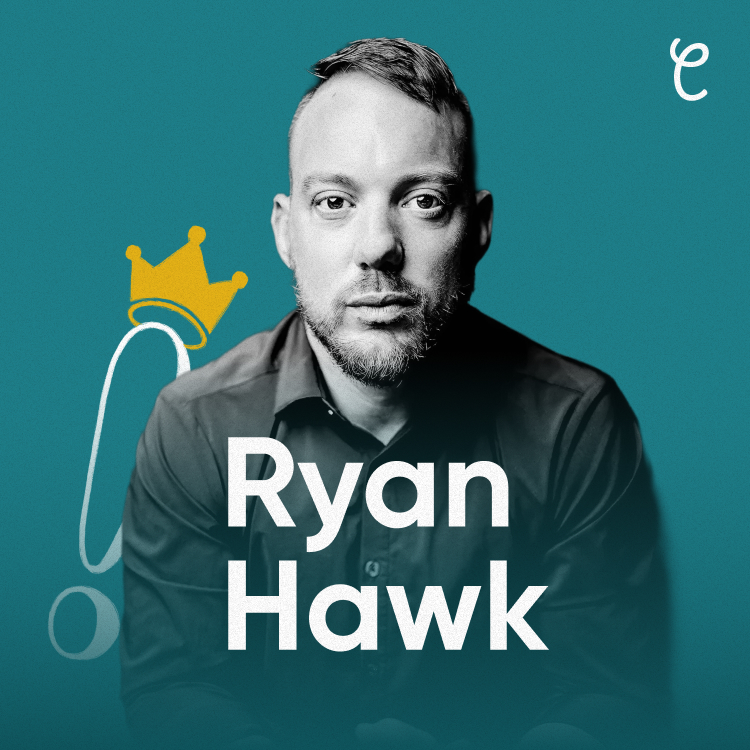
Ryan Hawk launched a podcast, The Learning Leader Show, in 2015. It's an interview podcast, so nothing particularly innovative there. He had no social media presence or email list and he had no prior experience podcasting. And yet, organically, Ryan has built a phenomenal business on the back of it.
When he launched the podcast, he did so whilst working a day job in sales. Today he's a bestselling author and runs a business made up of mastermind products, events, speaking, and he delivers leadership development programmes to Fortune 500 companies. What exactly did Ryan do so differently that led to these outcomes? He didn't do any marketing, he simply conducted his own professional development in public.
Here's Ryan's story.
Chapter One — Cold Start
Liam Curley: Ryan's dream from a young age was to become a professional American football player. He plays at the highest level of football at high school in Ohio, then earns a full scholarship that pays for his college education to go and play quarterback for Miami University. He plays college football and he's good. But when college is over, the key decision makers decide he's not good enough to play in the NFL.
He has to figure out what to do. Now, with the help of a family friend, he lands a job in telesales. Cold calling new business, 60 or 70 calls a day. This wasn't his dream, but Ryan excels.
He applies the same work ethic and self discipline that helped him excel at football, finishes consistently at the top of the sales rankings, and after a few years at that level, he interviews for a management role and gets it. Now, instead of an individual sales contributor, he's leading a team of 15. And as he writes in his first book, Welcome to Management, the idea was to take the leadership skills he'd learned as a Division 1 quarterback and apply them in sales. But sitting in his new office, he has a conversation that makes him realise the experience of leading a college football team didn't fully prepare him for management at a Fortune 500 company.
He's the youngest manager in the company, mid-20s, feeling good about himself, new office, expensive chair, great view out the window. When one of his direct reports, a woman in her mid-40s walks in to his office. Here's Ryan speaking on Game Changers with Molly Fletcher.
Ryan Hawk: I see that she's crying, her lips are quivering and she's trying to tell me something. And she said, Ryan, my husband, he cheated on me and he wants a divorce. And I remember thinking, what is happening? Why are you telling me this? What is going on? It was a stark reminder that you're in over your head. You don't know what this job fully entails.
Liam Curley: He calls his dad, who'd held leadership positions in sales throughout his career. His dad tells him that's the way this goes, man. People are going to share these things with you. You're their boss, you better get ready for this.
Ryan wants to become a better leader, so subsequently he pursues his Masters in Business to help him become one. It takes him six years and his company pays for that MBA. And then he starts thinking about a PhD. Here he is on The Learning Leader Show.
Ryan Hawk: LexisNexis paid 5,250 a year, 5,250 a year to go back to school. So I felt like it was a crime not to use that money. I said I can't not use this money but I'm done with my master's degree so I'm gonna go back and get my PhD. I started looking into those programmes in like a management or leadership or something and there's a number of programmes. University of Chicago was one of them I was looking at and there were some others where I started the process of applying.
Liam Curley: Next is the moment of fate. In 2014, on a flight to Lake Tahoe, Ryan found himself sitting next to a friend of Todd Wagner. Wagner was Mark Cuban's co-founder of Broadcast.com, a company Wagner and Cuban sold to Yahoo for $5.7 billion. That's the business Cuban sold before he bought the Dallas Mavericks and featured on Shark Tank.
Here's what Ryan says about that flight in his book, Welcome to Management. Quote, over the course of this flight out west, I told my new friend about my desire to learn more and to create my own cast of teachers in the form of people who have lived lives of excellent leadership. By the time we landed, he had agreed to connect me with someone on Todd's team, end quote. So Ryan gets connected to Todd and here he is talking about the experience on The Learning Leader Show.
Ryan Hawk: So I flew to him, I had this dinner and we both actually got there early to the hotel where the dinner was going to take place. And so it was just him and I, one on one. The dinner was a little bit bigger group. Him and I one on one were talking at the bar and man, I was just blown away. Like I was asking, I was just peppering him with questions. I said, you know, what was it like when you sold it? Like what'd you do? And he goes, well look, you know, we're sitting there face to face with the leaders at Yahoo and he's kind of getting like dramatic. And he's pausing and I said, listen, you're either going to have to buy us or compete with us. You choose. And you know, him and Mark sell for 5.7 billion and they cash out. And, you know, Mark does his stuff with the Mavericks and Shark Tank, and Todd's more philanthropic with what he does.
I was blown away, man. And I said, you know what? I would. Instead of going to get my PhD and going back through the process of them choosing my course load and them choosing my professors, and when I say them, I mean the college, them choosing kind of what I would learn. I want to choose what I want to learn, and I want to choose, more importantly, who I'm going to learn it from. I want to choose all of my professors, like Todd and others. So then I thought of, well, how can I do that?
Liam Curley: He asked friends who tell him he should start a podcast. One friend in particular, Greg Meredith, tells him he'd be great at it, right? He has the combination of interviewing experience and the ability to sell.
Ryan Hawk: I could record these conversations and share it. The scary part is, and other people get to judge me and kind of the questions I ask and how stupid I sound, but maybe people could benefit from it. Maybe people could kind of learn alongside me. And so that was the impetus, that was the combination of things that were happening at the time. That all was this perfect storm which then led to me saying, you know what, I'm gonna do it. And then I just studied deeply, you know, why did shows rate high in iTunes and what did they do? And then the mechanics of recording and microphone, like all that stuff, I did all that.
Liam Curley: So Ryan decides to launch The Learning Leader Show. Now, the conversation with Todd Wagner landed in his lap somewhat fortuitously, but how would he access other high performers consistently? This is where Ryan's sales background pays off. That first job at LexisNexis, sitting in a cubicle, smile and dial, low base salary, uncapped commission, taught him how to deal with rejection, how to write cold emails, how to make cold calls, and how not to negatively react to when people ignored him or told him to stop.
So Ryan starts cold outreach. He has no podcast and no website to speak of yet, but he still manages to book conversations with some pretty high profile guests. There was no way to find the show, but people were still giving him their time. People like Dorie Clark, Pat Flynn and Jordan Harbinger agreed to join him on the podcast.
So how does he do it? Here he is on How to Be Awesome at Your Job podcast.
Ryan Hawk: I like to name in specifics why I look up to that person or why they impress me or what I like about them, or the value they've added to my life. But it has to be very specific and it needs to be honest. Then I like to try to find some form of uncommon commonality, a way to connect us, me and that person.
Liam Curley: After that, in the same email, he shares whatever credibility he has about the show. In the early days, that was almost nothing. His only credibility was that he was curious and he'd be prepared. That's the outreach formula he uses to get early guests, and it's pretty similar today, though he obviously has a lot more social proof.
Ryan records 22 episodes before he launches, publishing three per week. In those first eight weeks, he set goals from the start. He wanted to be the number one show in iTunes New and Noteworthy, and he wanted 100 people to contact him saying the show had helped or inspired them in some way. This all sounds like smart business talk, setting goals and objectives. But how do you build a community around a podcast when you have no existing audience? I know that Ryan mentions iTunes New and Noteworthy, but as he also says,
Ryan Hawk: For the most part, podcasts don't go viral, so it's got to be kind of one at a time. Word of mouth.
Liam Curley: Ryan's download numbers steadily increase week on week. People are telling their friends, but when you start with zero, you do need a seed. And that seed started the way it does for many authorities. They borrow audiences, and usually one particular borrowed audience represents a trigger event.
That's what happened with Ryan. It's what happened for Nancy Duarte when Garr Reynolds shared her work with the world. It's what happened for Blair Enns when David C. Baker invited him to speak at his event. And it's what happened when Cameron Foote invited David C. Baker to guest write on his newsletter.
Ryan has Gary Vaynerchuk on the podcast. On episode 31, Gary tweets the episode out to millions of people and downloads spike.
Ryan Hawk: I remember that was one of the first moments, early early days, when a bunch of random people from all over the world listened and sent me emails and commented on social media when I had zero social media presence. For the most part.
Liam Curley: I know that seems like an obvious opportunity, interviewees sharing podcasts. But many of these people he's interviewing are on hundreds of podcasts a year. They don't share them all. They hardly share any of them, particularly those from low profile podcasts like Ryan's was at the time. They only share them when the host produces a standout episode. And that is what Ryan produces. The clip I'm about to share with you is evidence of that. Firstly, he's speaking with Jim Collins, legendary business book authority. Jim Collins does very few podcasts, so it's testament to Ryan that he agreed to go on in the first place. Jim asks Ryan, how does he prepare for an episode? How does he make a great episode? One, he's thoughtful about who he asks. Here he is speaking on The Learning Leader Show.
Ryan Hawk: So I only pick people that I'm interested to learn more about and I feel like they have a good message to share with my audience. People who understand how to tell their story and share their information.
Liam Curley: Then he prepares thoroughly. Again, here's Ryan on The Learning Leader Show.
Ryan Hawk: I dive deep. I watch every speech, read their books, watch TED talks, read articles written about them, read articles written by them, see conversations maybe they've had with other people, try to learn as much about the people I'm speaking with. Their message. I always come into the talks with like, for you especially, obviously I probably have enough material for us to speak for about 20 hours and I know we'll have to figure out how to distil that down to much shorter than that, but I think that's for me. I'm typically have more information than needed and it's like, what's the best way to be a great listener?
Liam Curley: And finally, he won't release the episode if it's not good enough.
Ryan Hawk: I don't want to release an episode if I don't think it's good enough. And so that happens sometimes too.
Liam Curley: He speaks more to that point on another Learning Leader episode.
Ryan Hawk: Unfortunately, I have a number of episodes that I've recorded that nobody will ever hear because they don't live up to the standard of excellence that I hold myself to for this show. If you're going to decide to click listen, that means that I think it's good. I think it's really good. So I've learned through making the mistake of accepting a guest even if they have a big name. And there's been some of those that if I'm not fully ready to go and I'm not really curious, the episode will just be average and average is not good enough.
Liam Curley: Ryan launched The Learning Leader Show in 2015, and on the back of his success, he gets his first book deal with McGraw Hill in 2018. Those three years in between, he published more than 250 episodes. All episodes were created according to those standards listed previously, but none were made with an external outcome in mind. Ryan gets asked a lot to help people launch podcasts. His first question to those people is always, why are you doing it? And most of the time, people are thinking about the business outcomes. Speaking gigs, book deals, consulting clients. The podcast is the marketing for that.
Ryan Hawk: If you're going for some outcome for whatever the thing is you're doing, I don't think that's the right reason to do it. If you're going for some outcome and you're going to have a podcast because you want to get speaking gigs or you want to, I don't know, get famous for something, I don't think that's the right reason. I think the right reason to do anything is because you want to do that thing. You want to write that book. You want to learn through the process of getting those messy thoughts out of your head onto the page. You want to learn through the process of interviewing people and putting together these narratives as you're working to do. I think that's the right reasons to do things is because the work is the reward. The actual win is doing the thing, not some potential outcome that you may get.
Chapter Two — Doors Open
Liam Curley: When Ryan launched a podcast in 2015, it was on the side. He was running it whilst doing his job full time. Come 2017, he's left that job and the podcast provides the platform for the business he's building.
As Ryan writes in Welcome to Management, he built a business, created products and services, became a keynote speaker and an author with a McGraw Hill book deal. Every opportunity came out of the podcast. Ryan didn't build offers and then promote them. Listeners told him what they wanted from him.
Ryan Hawk: So part of what started happening as the podcast grew and as the books got out, there was people were saying, hey, we don't have the right leadership development within our company or for our leadership teams. Could you work with us? And so that came out of the demand from the marketplace essentially saying, will you come in? Well, I needed help. I couldn't do that by myself.
Liam Curley: Opportunities were regularly coming out of the blue. One in particular I want to share is from a guy called Sam Kaufman, Chief Revenue Officer from Insight Global. So you worked with Sam as an executive coach at first, which led to, my understanding, led to the work that you're doing today with Insight Global. How did that opportunity come about to work with Sam?
Ryan Hawk: It's pretty cool. So Sam sent me an email out of the blue. I'd never heard of him and was a listener of the show. Bert was too, the CEO, and he said, hey, I just got promoted and part of the promotion is I have like an allowance for an executive coach. Do you want to do it? And I said, yeah.
Liam Curley: To be clear here, Ryan didn't offer executive coaching. There was nothing on his website to suggest as such. Sam was a listener of the podcast and when the budget became available to hire an executive coach he knew from dozens of episodes he listened to, he wanted to work with Ryan.
Ryan Hawk: Our first meeting was supposed to be St. Patrick's Day of 2020. I was getting ready to fly down there and we ended up cancelling the in person because that's when Covid hit. But we kept it going and God was it a year later. I don't want to share his name publicly, but there was a CEO who came on my podcast and he, after we got done, he really liked it and he asked me if I would work at his company similar to like the Morgan Housel thing and publish all my stuff with their stuff and whatever.
Liam Curley: The Morgan Housel thing that Ryan references. Let's expand on that a bit. Morgan Housel is the New York Times bestselling author of The Psychology of Money. The thing that Ryan's talking about is Morgan's relationship with Collaborative Fund. Collaborative Fund is a VC and Morgan is a partner there. His role there is as a writer and a speaker. Here's Morgan Housel speaking with Tim Ferriss.
Morgan Housel: And my whole job is to write and speak and not even write about venture capital or not even to write about our portfolio. Just write about things that I see, where the world's going, things that I think are important for investing, investing history and investing behaviour.
Liam Curley: The logic is this. If you're a venture capitalist, money is fungible. Every firm can write a cheque. So it's not a differentiator. What sets you apart is a point of view. Values, a way of seeing the world that others don't have. But values only matter if people know about them. So you hire someone like Housel to show the world how he and subsequently you think. Okay, let's get back to Ryan speaking about his own opportunity to work on that, as he calls it, Morgan Housel thing.
Remember, he gets approached by a CEO who he'd interviewed for the podcast and the CEO wants him to work with his firm in the same way Morgan Housel works with Collaborative Fund.
Ryan Hawk: Sam and I had become such close friends after we worked together for a little bit because we just, we have a lot in common and I just love the way he operates and I think he values what I was trying to do for him, too. And I said, hey, man, as a friend, you know, as a colleague, I just got presented this opportunity. That seems amazing. What do you think? And he was like, wow, that does. I kind of shared all the details. And he's like, yeah, you should. You should do it.
And then that was a Friday. And then on Monday, Sam was like, hey, forget all that. You're not doing that with them, you're going to do that with us. And so that's kind of how that deal worked out, where they became kind of the presenting sponsor. And I've expanded kind of the work that I do. And our agreement has just been one of the coolest partnerships that I could have imagined, because they are. We're just so aligned in our values and the way we try to get after it and work.
And so, yeah, that stemmed again, increasing your surface area for luck. Put out good work that's useful, they'll call you, you work together, and then, who knows, something else might come of it like that. So it's kind of crazy when you actually think back, because I haven't really told that story that much, but when you think back, it's pretty wild to see how these things come together.
Liam Curley: Opportunities like this keep popping up for Ryan as they do for many other undisputed authorities. He didn't go looking for them, they came looking for him. And that happens because of the points that we referenced in chapter one. Obsession with process combined with showing up.
Ryan Hawk: You got to be in the game. You have no chance to win the game if you're not playing. And that's, I think, a version of increasing your surface area for luck is you got to keep going, you got to push through. Like, you're going to have these moments, Liam. I think that will come up. We're like, oh, my God, this is hard and it's draining. But you also are energised because it's so much fun and it's cool to see you putting these things together.
And so you keep going and you keep at it because the work is the win. But if you stop, then you completely turn off that area for potential luck to happen, for someone to experience your work, for someone to understand what you're doing and potentially want to meet you. Because really, all opportunities, they come through people. And if you're putting out excellent work that could help other people, that, again, increases your opportunities of people coming to you, asking you to do something, like speaking at a place or paying you a book advance to write a book or anything like that.
Liam Curley: You get famous with a certain group of people when you keep showing up in their life with value and relevance. As Carl Richards said in a previous episode, relevance means solving one problem as experienced by a particular group of people, delivered in a way that's interesting and useful to that group. When you do that, you attract opportunities you didn't know existed. You don't need to go looking for them.
Fame has tremendous value. Rory Sutherland, author of Alchemy, has described fame as a luck multiplier. In a conversation on Uncensored CMO, he makes the point it's not that being famous helps you necessarily achieve something you've intended to achieve. It makes it much more likely you become lucky in ways you didn't expect.
Chapter Three — Optimising for Cool Things
Liam Curley: Opportunities are flowing to Ryan because of the compounding effect of the great work he'd been publishing for years. I want to talk now about another of those opportunities.
Ryan Hawk: I was just getting emails from a lot of listeners who were curious to kind of meet one another because there are people who do meetups and stuff, and I hadn't done anything like that.
Liam Curley: Ryan's friend Greg, one of the people who pushed Ryan to start the podcast in the first place, said to Ryan,
Ryan Hawk: Hey, you should do this, you should kind of create these circles. I think Greg even was the person who had that name as the idea of like Learning Leader Circles.
Liam Curley: Ryan's getting this interest in organising a community and his initial instinct is to get some fans of the show together, first come, first serve, take on as many as he could.
Ryan Hawk: Greg suggests otherwise, and his big thing was you gotta make it application based though, because you want to have a curation process, you don't just open it up and let anybody in. And so then we made the application, we opened it up, I did reads on the podcast and, you know, I had no idea what would happen.
Liam Curley: The idea made sense because Ryan didn't really want to organise a get together. He wanted to build a mastermind, which is way more than just a get together. Here's author Mo Bunnell in conversation with Ryan on The Learning Leader Show on this subject.
Mo Bunnell: So here's what a mastermind does. A mastermind, that old saw of you become the five people that you spend the most time around. I don't know that number's right, but the normative nature of the people we interact with the most does become normal. What do the people around us do? And as you reach a certain level of performance, you're not going to find folks, maybe even in your organisation or your community, and you got to reach outside of that if you really want to go to next level performance. That's what a mastermind can do.
Liam Curley: So Ryan announces the Learning Leader Circle and receives applications. Applicants go through a series of questions. Ryan reads through them and he personally chooses who to interview. Before saying yes or no, he's curating the group and after seven years of doing this, the feedback is consistent. People appreciate the high level of curation because once they're in, they know that every person in the group is worthy of being in their network. Once a group starts, there's a heavy getting to know you process, personality profiles, things like that. Ryan shares all of this with the whole group. They meet monthly for 75 minutes and use Slack in between.
The first group was built to be a one year programme, but towards the end of that year, members heard ads running for the next year's intake. Here's Ryan speaking with Jay Clouse on Creator Science.
Ryan Hawk: And a number of them said, can we just renew and take their place? Like, we don't want you to have another group. We just want to keep our group together. And so every member of that first group renewed, which was very telling because I didn't even offer that.
Liam Curley: Every year since this first group, he starts a new group and keeps the old ones going for people who want to stick together. At any one time, Ryan is now running three groups. Price for membership at time of recording this podcast is $12,000 a year. So I asked Ryan, was that the price when you launched?
Ryan Hawk: It was three grand.
Liam Curley: Do you remember how you first developed that first iteration of the curriculum?
Ryan Hawk: I was trying to be very transparent up front about the fact that I was building it as we went. So I did lean on some of my friends and then I was just like making stuff up as we went and some of it hit and some of it didn't. Again, that group, I'm very grateful for them because of the fact that like, not everything was great. There wasn't like a perfectly sequential order. Like now we have the entire, like all 12 months. We have it mapped perfectly of what we're doing in January and why that's then what we do in February and why that's then it all builds to this crescendo by December. So it's like very specific, very methodical. Everything happens for a reason.
Now then there was none of that. It was just like figuring it out as we go. And I think, you know, if you're honest with people and transparent, like, people are down with that.
Liam Curley: Ryan launched the first Learning Leader Circle in 2017. In 2024, he brings on board a team of coaches to support him, not just with the circle, but with other consulting engagements. Here's Ryan with his new team members, Brooke Cupps, Garen Stokes, Sherry Cole and Eli Leiker on The Learning Leader Show.
Ryan Hawk: So a few years ago, this amazing leader who now we've all become friends with, named Rob Kimball, was in one of my leadership circles and he's only in it for like three or four months and it was going well. I like to think that those go pretty well. And he just sent me a text, hey, can we do this for my whole team? Just that simple. That one text out of the blue. And I was like, I'm sure we could figure out how to do that, Rob. And the more and more we talked, you know, we got to hang out together in person a few times. And I said, hey, Rob, I think to be able to do this though, and he had brought this as an idea as well. I'm gonna need a team, I'm gonna need more people. I'm not going to be able to do this on my own because at the time I was basically doing it by my own. Brooke and I have done some things, one off here and there, but we hadn't established a team. And at that point my thinking was, who can I surround myself with that are. And this is not like a fake humility thing, but it's just a real thing. Who can I surround myself with that will be far, far, far better at this stuff than I am? I remember this quote. Dave Matthews said years ago that when he was forming his band, one of my favourite bands or my favourite band, that he wanted to have every person at every single instrument be far better than he is at singing and playing the guitar.
So Carter Beauford's the best drummer in the world. I'm gonna try to convince him to be my drummer, right? LeRoi Moore is one of the best saxophone players in the world. I'm going to try to convince him to be my saxophone player. Stefan Lessard's a 16 year old crazy prodigy at playing the bass guitar. I'm going to try to convince, right, all down the line. So I want to be the worst member in the band because it will lift me up. And I think that's why, that's why I kind of wanted to be with each of you because I think you each bring those unique qualities to what we do. And it's made me a lot better.
Liam Curley: The other element of these groups that I haven't mentioned is an event that was critical getting people together in person. And in the same way that he approaches his podcast, Ryan focused on the fine details and preparation to ensure that the event was an unforgettable experience. He hired an event producer to help. But Ryan's obsession with detail was next level.
He spent 10 hours in meetings about the lighting in the room. Because he hates standard hotel meeting room lighting. They bought their own uplighting, their own table lights. In the past, those events used to have a guest speaker, but at the time of recording this episode, they don't anymore.
Ryan Hawk: And now when we run our once a year event in May, it's cool to see because we own it all now. Like, we don't really have guest speakers. It's just either me or it's Coach Cole, Sherry Cole or Brooke or Garen. And I think since we've shifted to that, it's gotten really good. So I'm very proud of that event too, that we kind of just take full ownership over it from start to finish. And it's a lot of fun. A lot of fun.
Liam Curley: Was that the same event when you had Donald Miller?
Ryan Hawk: In Nashville? Yeah, we. I do like to do, like, surprise live podcasts at those sometimes, if I can figure it out. Like, we went to Nashville, I had Don Miller in Columbus, I had James Clear, and this past year in Scottsdale, I had Ed Latimore. So it's. If I can work it out to have a surprise guest, I'm already thinking about next year, so I don't know if we're going to be able to make it work, but that's a fun thing to sprinkle into those events.
Liam Curley: Why did you make the decision to no longer have outside speakers for the event?
Ryan Hawk: I mean, it just makes it a little bit more of us. I got kind of pushed on it. I remember from Garen of like, we got this, man. Like, we got. We can kill this. Like, we can make this so, so good. And if you invite someone else to speak, they're going to kind of do their thing. And when someone invites me to speak, you know, I expect them to, like, want me to come do what I do. Not them say, hey, you can speak. But you got to say these things. Like, I don't think that's what you should do. So if you invite someone to speak, they could be the right person and it could fit or you can guarantee that it's the right fit by just doing it with your team.
So I think you still get a little outside voices too, when you do the surprise podcast. Because I don't know what the guest is going to say. I'm just going to ask them questions. But outside of that, us just kind of running it, I think has been really good.
Liam Curley: You said it ends in December with the crescendo. What does the crescendo look like?
Ryan Hawk: It's kind of a surprise.
Liam Curley: Oh, sorry, we're not. Fair enough.
Ryan Hawk: We'll see. No, we do this. You've probably read about it because I know you're super prepped, but I like. I just made a new one actually that I'll put out in probably a month or so, but it's called This I Believe, and it's a video. You write the essay first, then you narrate a video which basically states everything that you believe. And then that video is a series of pictures and videos of your. You can decide how detailed and how professional you want that video to be. Some people do it all on their phone, others get help from my team to put these together. But yeah, the crescendo for that first year is that This I Believe kind of capstone. And I think the reason for it is you could show it's like a two and a half to three minute video that you make about yourself and what you believe. You can show that video to someone, to anyone, and they'll have a very good idea of who you are, what you're about and what you believe in just like three minutes.
And I think anytime you can get that clear in that short amount of time, one, it helps you get more clear as a learner and as a leader. And then it helps others get to know you in under five minutes of okay, I got an idea of what Liam's all about. I saw his This I Believe video. So that's what we close with in December.
Liam Curley: As we draw to close in this episode, I want to end on this point. The natural instinct when studying authorities is to measure the external markers of success. How much money have they made? How many subscribers do they have? How many books have they published? Those are relevant measures of success, but they're not the only measures. As Ryan shared with me, authority has opened up opportunities to create experiences for him and others that wouldn't have been available to him if he hadn't built the platform he has with The Learning Leader Show.
Ryan Hawk: The first event we did with James was before Atomic Habits came out. I was just a. I was and still am, was a huge fan of jamesclear.com. He wrote blogs, essays, two a week for years and I was just a big, big. I didn't know James even lived in Ohio when I was reading those. But I was a big fan of his work prior to. I mean, the Dave Brailsford essay was written on jamesclear.com before it was published in Atomic Habits. That was one of the killer stories. I remember that because I printed it out and passed it out in one of my team meetings and like, God, 2016 maybe, maybe even earlier than that.
Anyway, I was a big fan of James. Nobody. Everyone was like, how, you're in a live podcast with a guy we've never heard of. And I'm like, trust me, he's so good. You should read his blog. It's amazing because I wasn't even sure when Atomic Habits was coming out. When we did that first event. I just thought it would be cool to do a live show. I mean like, let's get people together, let's kind of have good food and drinks and let's learn together. And you know, I had no idea if it would work. I was hopeful. We did it in Columbus to make it easy because that's where James lives and you know, I don't know if we had like 100 people maybe show up. I just think you try to optimise for cool things. I mean, I've done random events.
I had a. I just booked Marc Roberge, the lead singer of O.A.R., one of my favourite bands, just as a Learning Leader appreciation night. We didn't sell anything, we didn't raise money for charity. We did nothing except say thank you for being a fan of The Learning Leader Show and all. Me and a bunch of my friends and all these listeners, we just hung out and watched Marc play music and had a big party and like that was a very expensive night because he's a big time musician, but it was the best. I would do stuff like that all the time. So to me it's like you should try to optimise for amazing experiences with people you love. And I'm trying to do that all the time as best I can.
You know, I want to turn some of the financial security that we've grown to into fun tokens. I want to have fun and enjoy times with people I love, friends, family, all that. And so live shows with like a James Clear or others we've done them with. I just did another one with James at my alma mater, Ohio University, recently. Like, whatever it is, I'm trying to think of fun, cool ways to connect with people, to have a good time, to build relationships, to bump shoulders with really cool people, right? Collision of curious people. That's like, that's what this is all about, man. Like, what's the point if we're not going to try to enjoy it as we go?
Liam Curley: That opportunity to host incredible events, to build the life and business Ryan has. It came because Ryan is what Charlie Munger, Warren Buffett's longtime business partner at Berkshire Hathaway, calls a learning machine. In his USC Law commencement speech, Munger made the point that the skill that got Berkshire Hathaway through one decade would not have been enough to get through the next. Without Buffett being a continuous learning machine, the record would have been impossible.
Here's Charlie Munger delivering his USC Law commencement speech.
Charlie Munger: I constantly see people rise in life who were not the smartest, sometimes not even the most diligent. But they are learning machines. They go to bed every night a little wiser than they were when they got up. And, boy, does that habit help, particularly when you have a long run ahead of you.
Liam Curley: Ryan is smart and diligent, but above all, he's a learning machine, conducting his own professional development in public. Being a learning machine has always been valuable. It's how you get good at anything worth doing. But today there's a second benefit.
Because when you share your learning in public, consistently and thoughtfully, like Ryan did, and when you work on the craft of how you share it, you attract a community of people, some of whom present opportunities you didn't even know existed. That is how Ryan Hawk became an undisputed authority.
Thanks for listening. I'm Liam Curley and I help experts develop, package and publish unique insights.
I hope you enjoyed this episode and if you did, consider subscribing. And one other thing. I've created a free email series called the 10 Patterns of Disruptive Wisdom. In my research of undisputed authorities, these are the consistent behavioural patterns I noticed among those who rise to the top.
To get the email series, head to liamcurley.co.uk. Link is in the description.