Nigel Green is a sales operator turned advisor. Equity-backed CEOs and investors bring him in to fix or optimise sales teams, hit revenue growth targets, and increase the valuation multiple of their company.
He’s led sales teams to three successful exits as an operator, and participated in four more as an advisor. He tripled one company’s revenue from $94m to $350m and built a $1m solo advisory practice.
Nigel solves one very expensive problem well, which he has done on repeat for several years.
He knew he was an expert, but he didn’t have market recognition.
Before meeting me, he’d already published a book that captured his approach to improving sales performance. That book fed into 1:1 coaching engagements with leaders and workshops with teams. Now, in his words, he wanted to better productise his offer:
Become recognised as the authority for one high value piece of the sales puzzle
Increase margin and repeatability
Reduce the requirement of his own time in the execution
Further leverage his intellectual capital
He’d built a course on hiring salespeople, but it hadn’t landed the way he wanted. For Nigel, it was a failed bet that cost him tens of thousands of dollars. It was an enterprise-level offering, packaged as a direct-to-consumer “influencer” product. Nigel wanted to turn that expertise into a more appropriate artefact for the people he was trying to reach: a book.
We mapped out who the book was for and what it would help the reader achieve: help equity-backed sales leaders learn how to identify and hire elite salespeople.
I asked Nigel how he’d describe the way we worked together.
Here’s what he had to say:
“The headline would be, we sparred. In the world of contact sports, sparring is done with someone of equal calibre. Iron sharpens iron. They may be better at one specific skill within the context of the sport, but you push each other.
You are better than me at distilling what I do and how I do it into accessible language.
We went about this exercise where we took what seemed muddy, then organised it into a concise process on hiring elite salespeople. Discrete insights and tactics that improved your hiring, meaning you’d outperform the market.
You were able to take my ramblings and perspective, then shape it. You forced me to make decisions on what I believe and go deeper on perspectives that I felt were strong anecdotes or opinions, but in fact were not.”
I asked Nigel, how did I force you to go deeper?
“You challenged it, not in a combative sense, but in a sense of, ‘Hey, you know this so well than some of these things seem obvious to you, but they’re not obvious to your customer or other smart people who haven’t mastered the subject.’ You forced me to simplify my thinking in a way that would eliminate all intellectual assumptions I had made about the framing of my ideas.
In a way, you made my expertise on hiring less mysterious and more applicable to the average sales leader.”
“You made a recommendation along the way that I publish each chapter as I wrote and incorporate feedback into the final version of the book.
So I did that. I had about 50 sales leaders say, send it to me and I’ll tell you what I think. Every time we finished a chapter, I posted it as an article, sent it to my list, and collected feedback on what they liked, what they didn’t like, and what was unclear.”

Part of the value I bring is asking the questions that surface the reasoning Nigel would skip over without realising. When you’ve done something long enough, some logical steps become so automatic you can’t see them as steps anymore. It’s just common knowledge, but it’s not common knowledge to your audience. The reader doesn’t have the context running in the background like you do, and that’s exactly where they get lost.
The Elite Salesperson Matrix came out of exactly this.
In one of our conversations, I asked Nigel, “How do you identify a good salesperson?” To him, the it was a silly question: “If a reader needs to ask that question, they probably shouldn’t be reading the book.” But it exposed a belief he’d never had to defend, one a lot of HR people and even some sales leaders hold: that if you’re good at sales, you can sell anything. But selling processes differ, and once we’d pulled that apart, the next question was, “If sales isn’t sales, what are the different sales processes?” Nigel started listing them, and as he did, two dimensions crossed on the page. He looked at it and asked, “Is that a matrix?”
“That’s something I knew but didn’t have the language or the framework for. I just knew it. It’s the curse of knowledge. It took a series of calls. We distilled it into a framework that disputes ‘salespeople are salespeople,’ and then, once you’ve bought that, shows you exactly what type of salesperson you need to hire.”
We named the framework and named each sales type in the framework.

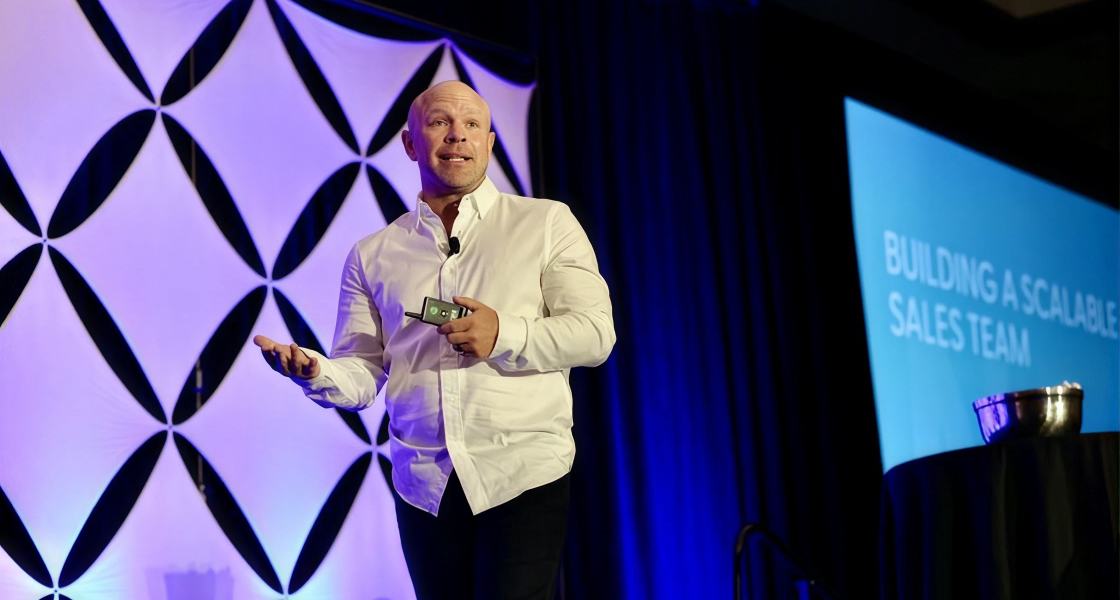
Towards the end of writing the book, Nigel was asked to speak at Get Scalable Live, a three-day conference for founders scaling past founder-led growth, hosted by Ryan Deiss.
“It’s an audience of around 700 CEOs that were mostly owner operators who had a business in the seven plus figures trying to scale it to eight figures. All obsessed with growth, and most of them already have a sales team.
This is the first time I had talked about the elite salesperson matrix in a public audience.
I said, you think that all salespeople are the same, but let me show you why you’re wrong about that. Most of these companies grew through founder-led sales. They believe that the selling should be easy at this point. They’ve got customers that they’ve already sold. The founder had some role in selling them. And so they’re trying to replicate their selling capacity with a salesperson.
Why it was particularly profound for this demographic is they were mostly hiring what we called Killers. That’s the stereotypical salesperson. And they failed to understand that most of them actually sold like a Connector or a Visionary, meaning that because they were experts of the market in their own right, they sold in a very different style that no salesperson could ever sell because they didn’t have the title or the credibility. And that was causing all of them to stumble in their sales motion because it left their customers with an intellectual gap that no salesperson from the killer quadrant was ever going to possess.
Sometimes it’s the first time they’ve hired someone, other times they’ve got an existing team and it’s not going as well.
I went through the matrix, and there was a long line of CEOs that came up to me at the end of that presentation and said, ‘This is some of the best work I’ve seen on defining the type of salesperson needed to move away from founder led sales into a more structured, defendable sales team.’
There was so much demand after that that I had to start a staffing company as a result of this.
Ryan Deiss, the host, came up to me and he said, ‘There’re so many people that are coming to me. I know this isn’t scheduled, but can we just do an ask me anything in the morning in an offshoot room?’ So I sat around for two hours and just answered questions from CEOs on how to think about identifying talent and building out an interview process that gave them a higher degree of confidence or hiring the right person.
By the time that I arrived home after the event, I had 15 sales calls booked.”

Here’s what happened after Nigel self-published the book.
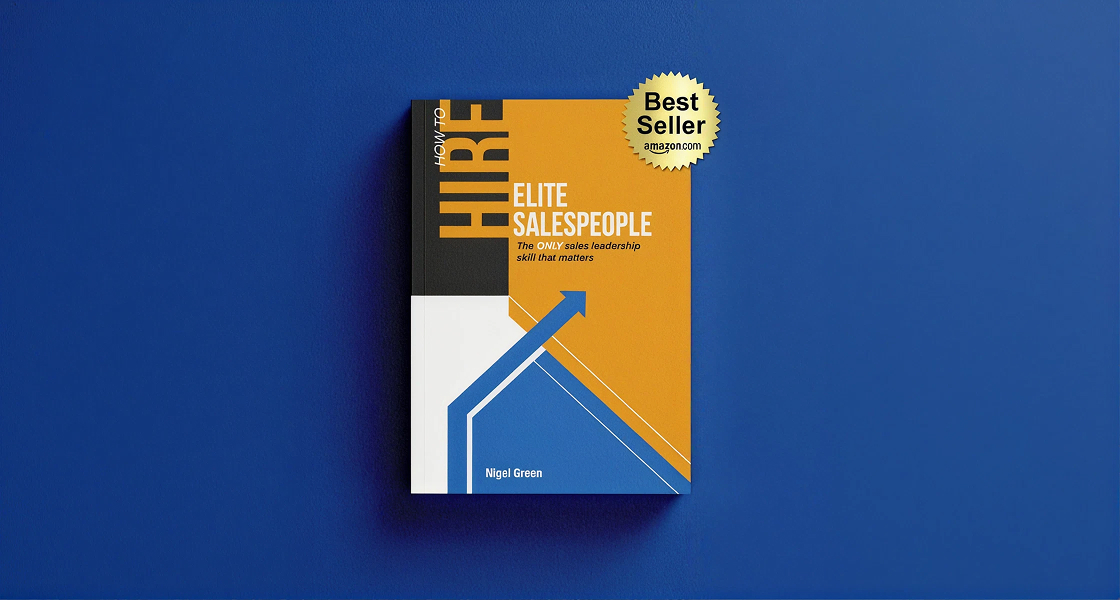
“In comparison to my first book, Revenue Harvest, the new book, How to Hire Elite Salespeople, sold as many copies in the first six weeks as the entire existence of Revenue Harvest. In the thousands.
I spent zero dollars on paid marketing for the book.
I did less than ten podcast appearances to promote the book.
I shipped every chapter, as I finished it, on my website and pointed people to it on LinkedIn.
It’s selling through word of mouth.
In the early months it was 500 copies per month. Now it’s around 100 without me doing a thing to promote it. People are sharing it and talking about it.”
On launch, the book went to #1 in two of Amazon's new release charts.

“I felt like writing this book was going to give me a more discreet uniqueness than the broad positioning I’d previously had of, ‘Let me help you build a better sales team.’
The idea was, let’s talk about a problem within that category that was upstream of all others. If you don’t have the right people in the team, nothing else matters. That was my perspective. My thinking was, if I can get this right, maybe that’s big enough to create something that scales without me.
And it has proven to be the thing.
I now have so much demand that I hired two recruiters working for me full time. That staffing retained search company will do hundreds of thousands of dollars in placement fee revenue and I don’t even have to touch it.
That’s come out since publishing the book as a result of the process of making and sharing this book.
I get other opportunities, too.
People hire me to come and speak, do training for their sales leaders on the book, to basically take the content of the book and make it unique to the context of their organisation. I get hired to design an interview process for a key revenue leadership role.
So, yeah, it’s led to lots of other ways in which I can monetize the insights.”

Find Nigel at nigelgreen.co, or connect with him on LinkedIn.
I comprehensively reviewed Nigel’s existing intellectual assets. This included his course on hiring elite salespeople, his first book, his articles, and all podcasts he’d guested on. This gave me the grounding to ask sharper questions, and material to reshape rather than build from scratch.
We mapped an outline of all topics to cover in the book, everything a reader would need to know and believe in order to successfully hire elite salespeople. It was Nigel's as yet undocumented approach to hiring. It was a fluid outline that acted as a starting point, not a fixed structure. These topics would become chapters.
We would tackle one topic every fortnight. We’d spar on each item: validating, questioning, and bridging knowledge gaps until Nigel’s ideas became concise and defendable. I would pull any interesting insight from the call that Nigel might build on and help him figure out how to connect each beat to the next.
I’d turn the call into a suggested structure for the chapter. Nigel wrote to it in his own voice. I reviewed, he revised, I reviewed again.
As he wrote them, Nigel published each piece as an article on his website and to his email list, looking for critiques from trusted members of his audience and signals of resonance.
When everything was complete, Nigel made any alterations from relevant reader feedback, then we put it together as one document, worked on the connective tissue, and reviewed it as one book.
Once everything was complete, Nigel handed over to his book editor, Bryn Mooth, and his book designer. I created the illustrations and visuals.
We all reviewed the final edition, then Nigel sent it to print.