


I’ve spoken about the concept of the focusing question, and in a previous essay, I shared a scoring criteria to stress test the validity of any question you’re considering building your authority around.
This article is about how you come up with those potential focusing questions that you can test through that scoring criteria.
To recap, I believe that every authority has a focusing question that frames the entire body of their work, implicitly or explicitly.
It’s a strategic, guiding principle for developing insight and intellectual capital.
A question that frames the heart of the frustration you solve.
Everything you publish moves you closer to answering that question or it doesn’t make the cut.
The question contrasts state A (where your client doesn’t want to be) with state B (where they want to be).
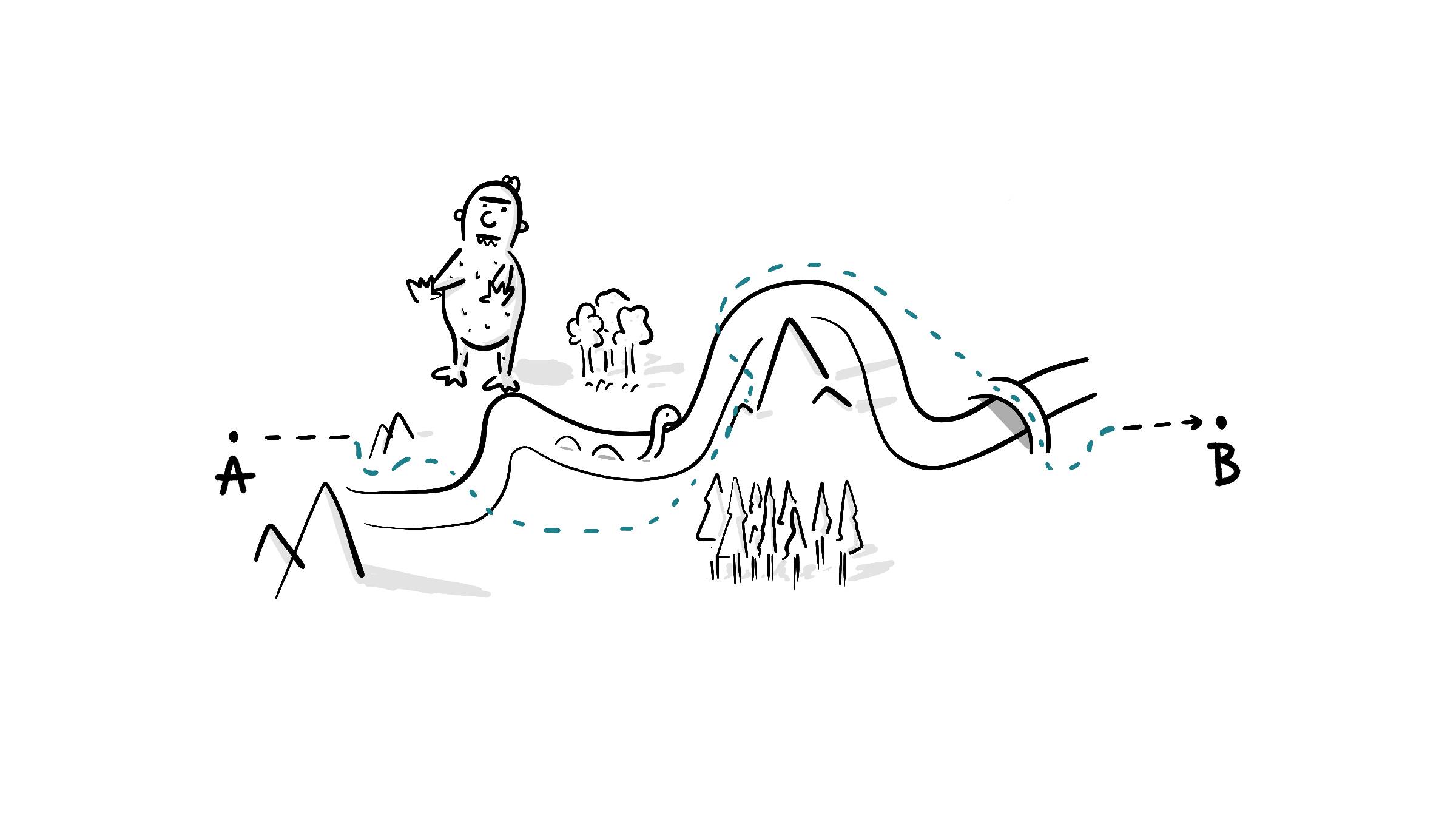
Usually it does that in one of three ways:
- By directly asking how do we go from state A to state B?
- By asking why a phenomenon occurs that keeps us in state A and stops us from arriving at state B.
- By asking how to do a task that’s critical for your client (often an employee who’s a decision maker) and one of several factors holding them back from reaching state B.
Examples in the visual below.
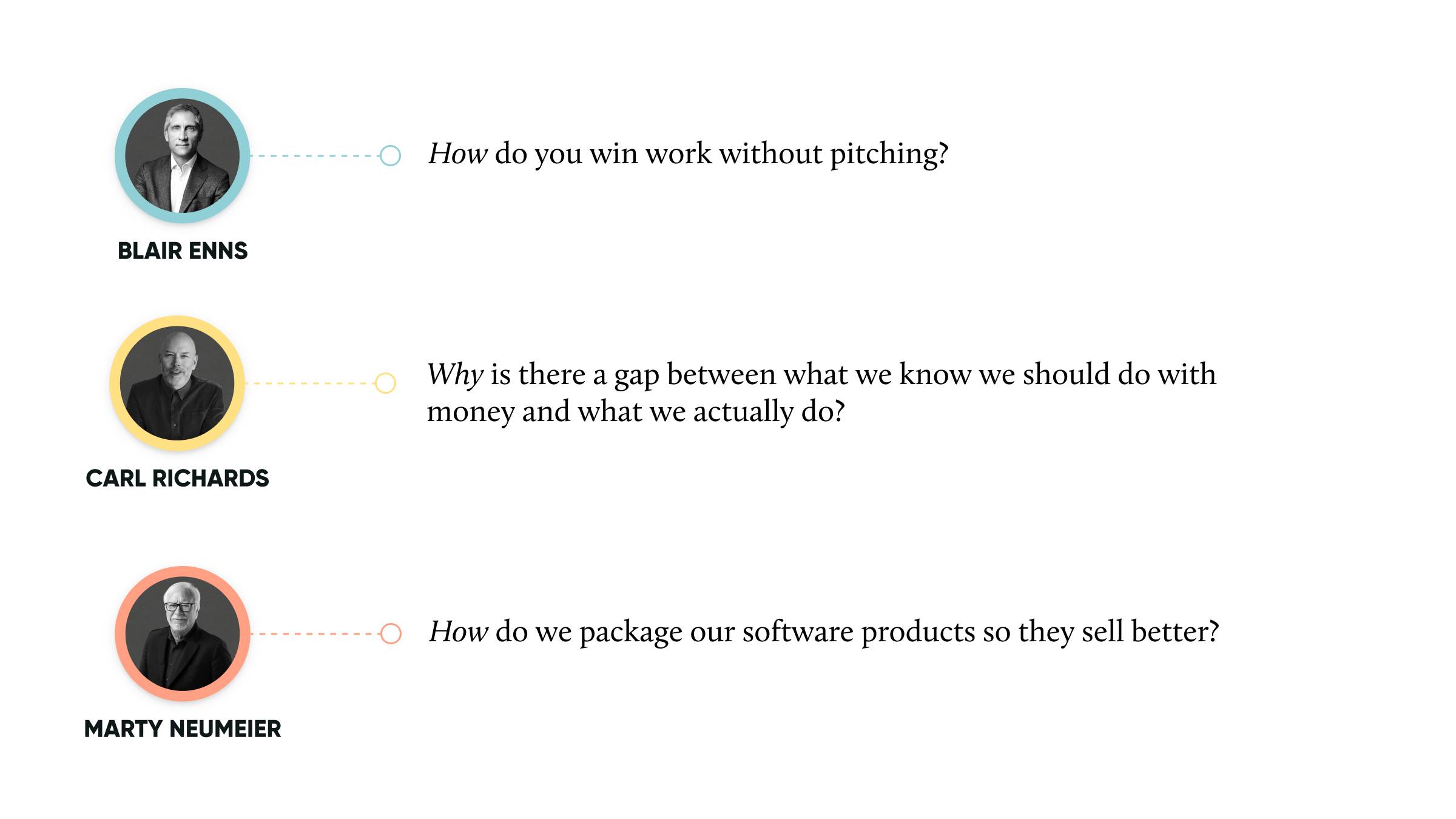
There are four routes to coming up with a focusing question
1/ Osmosis
You've been doing this for so long that you have a solid hunch for what your clients truly want. Carl Richards recognised the frustration sitting in the trading room when professionals were losing their minds during a market crash. He also noticed patterns in client behaviour over the years of working as a financial advisor. Through osmosis, a question formed.
2/ Personal Frustration
You’ve personally lived this frustration and desire yourself, and your clients look a lot like you. You figure, if you set about solving this problem, others like you will be interested in following.
3/ Task mapping
This one is particularly relevant if you’re selling to employees. Your client is responsible for a number of tasks, and many are deemed important to deliver the overall goal they want to achieve. The individual has personal stakes in making sure they do well at this, like status, bonuses, and promotions.
You map the tasks they’re responsible for in relation to the work you do for them.
Marty Neumeier is a perfect example of this. He ran a design agency for tech firms, but decided he wanted to specialise even further. He recognised that product managers are responsible for software packaging design. The frustration was, how do we package our products so that they sell better? He doubled down and became recognised as the authority on software packaging design in the 1990s.
If you want to figure out focusing questions in this category, you’re asking questions around the following:
- The Role Context
- Who is the person you’re selling to? What’s their job title?
- What are they ultimately responsible for?
- What are they measured on? What affects their status and perceived performance?
- The Task Context
- What are the tasks that fall under their remit that your work touches? List them all. You’re not picking yet, you’re mapping the territory.
- For each task, what does it involve? Why is it important? What happens when it’s done poorly? What happens when it’s done well? Can we measure impact?
- The Validation Context
- Does this task get their full attention? If so, why? If not, why?
- Is this the kind of thing they’d bring someone in from outside to help with?
- Can you point to evidence that people care about this, projects you’ve done, results you’ve delivered, demand you’ve seen?
- Is anyone else specialising in this? If not, why might the white space exist?
The tasks that survive validation are your hypotheses. Wrap them up in a focusing question and put them through the scoring criteria from the previous article.
4/ Client mapping
Though you’ve been working with clients for years, everything is muddled in your head because you’re so close to it. Even if you have a hunch through osmosis, this is worth doing. We go through the process of mapping individual clients against a set of questions to identify the frustrations, desires, and all sorts of important details in and around that, so you can then identify patterns and then identify the heart of the frustration.
- The Business Context
- How would they describe what their business does?
- What’s the size of their revenue and employee count?
- Who are the key decision makers in relation to the engagement you sell? What’s their job role, who is where in the chain and how does your engagement impact their status and perceived performance?
- The Frustration Context
- How would they describe the core frustration they experienced in relation to the engagement you delivered?
- How does that frustration show up?
- Where does that frustration show up?
- What’s their theory on the root cause of their frustration?
- What’s your theory on the root cause of their frustration?
- The Urgency Context
- What was at stake for solving or not solving this frustration for the client?
- What was the tipping point? Why did they ultimately decide to engage you when they did (not sooner or later)?
- How did they justify the decision internally to their team?
- Solution Context
- What do they call what you do?
- How do they describe your service?
- What did they expect you to deliver?
- What were the boundaries of adjacent engagements you could have delivered, but chose not to?
- How do they describe what makes you different?
From this, you’re finding patterns to ask the question, what’s state A and B?
The idea is to run through these context questions individually for each client, not amalgamated (you’ll create a Frankenstein client that doesn’t exist).
Whichever route you take, you should come away from this with a shortlist of potential focusing questions. You’re hypothesising.
Those hypotheses are what you put through the scoring criteria from the previous article. Don’t try and do two. Build authority around one.
In the future, you may move onto others, and other authorities have done exactly that. But first, they spent years becoming known for that one thing.