


“Goal: Get Famous, However You Can."
Marketing your firm is essentially nothing more than being well known by the right people for the right things. That’s all you need to keep dropping opportunity into the top of the funnel.”
That comes from an article David C. Baker wrote on making the case for email newsletters as a marketing tactic.
A friend, Eric White, emailed me that quote to chew on before an upcoming call together.
David's headline is a little misleading and doesn't actually reflect his core message. Becoming well known by the right people for the right things is not the same as getting famous however you can.
But the idea of getting famous with the right people for the right thing absolutely holds up.
Zipf's law teaches us that every marketplace dramatically rewards the brand widely recognised as the best.
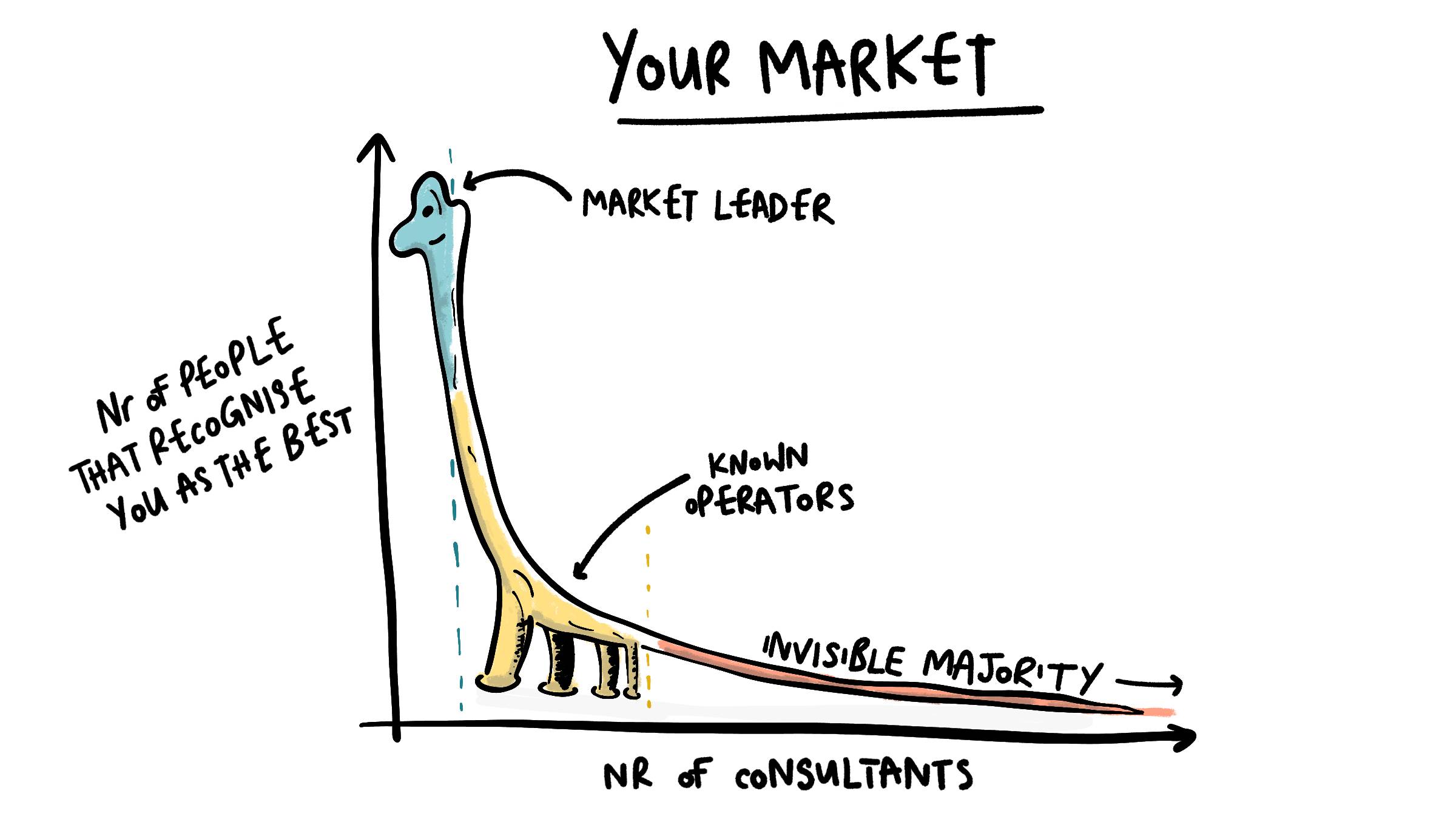
The person recognised as number one has twice as much demand as the person ranked number two, and for a consultant, excess demand means they can double their rates. Doubling their rates means they can halve the amount of time they spend 'doing' the work, which means they can invest all that extra time on activities that reinforce their position as number one, building a moat in the process.
That's exactly what happened with April Dunford:
- She becomes a bit famous in the process of writing and promoting Obviously Awesome
- Trebles the price of her workshop from $20k to $60k
- Subsequently becomes oversubscribed once Obviously Awesome takes off
- Has more time to speak and promote her expertise, which;
- Reinforces her place as the number one positioning consultant for Early Stage SaaS
But upstream of that, the real question is…
How do you get famous with the right people for the right thing?
Becoming the number one consultant in your niche is a rare and valuable achievement.
“Basic economic theory tells us that if you want something that’s both rare and valuable, you need something rare and valuable to offer in return.” Cal Newport, So Good They Can’t Ignore You
Cal Newport points to the famous quote from Steve Martin, "Be so good they can't ignore you," and frames this as the craftsman's mindset. The dedicated, deliberate practice of mastery. This approach leads you to become the best in your field, and when you're the best, at some point, the market will inevitably recognise and reward you.
If we look at what David C. Baker did to become niche famous, we uncover his own pursuit of mastery:
“I started consulting in 94 and I remember in 99 it just hit me that I was being asked similar questions repeatedly…I didn’t have a defendable point of view on certain topics… So I wrote down all the topics that I felt like I needed a point of view on and it came out 55 topics.” David C. Baker
For the next 4.5 years, he published a monthly long-form newsletter covering those 55 topics. Each issue was 3,400 words long, and he spent the whole month researching and thinking around the specific topic, addressing genuine paint points for his audience.
Things like:
- Your compensation and ownership agreement
- Constructing an appropriate retainer relationship
- Good and bad reasons for having a partner
- Surfacing warm leads through direct and indirect marketing
- Creating compelling new business presentations
Baker was, as David Foster Wallace puts it, "Paying far closer attention and at far more length" than his peers were."
And, because he's committed to writing and developing a defendable point of view each month, he starts noticing things he'd otherwise miss. He pays attention in his day-to-day. Whenever an interesting idea, perspective, question, or metaphor comes up, he collects it.
That act of mastery and study makes him so good you can’t ignore him
As he publishes his thinking and findings, more and more people start noticing him.
Austin Kleon talks about his online writing as "researching out in the open." You could piece together his books from everything published on his blog and socials, but that doesn't stop people from buying the book. There's something different about having a structured piece of work in one package, thought out and coherent.
He talks a little more about his approach to this:
“Find the little bits and pieces of your process that you think might be interesting or helpful to someone else and push out those little bits and pieces as you’re working on something. And then that way… people don’t forget about you, and then you’re able to keep your head down and do your work while you’re just sending out these little transmissions.” Austin Kleon
Every modern thought leader becomes famous by mastering their craft and refining their thinking in public
Regardless of channel or format, the route to becoming famous with the right people for the right thing is developing mastery in public. Leaders build a jigsaw puzzle one piece at a time. Some ideas are discarded later, others become a core pillar of a future book or talk.
If a larger piece of work becomes a hit, they become famous.
If it doesn't, they still become a master at what they do in the process of creating the work, and if they do that in public long enough, it's almost inevitable that they create a niche hit amongst their tribe (and then become famous).
There are outliers, but on the whole, the people that become "well known by the right people for the right things" take years of consistent publishing to get there.
David C. Baker wrote his hit, The Business of Expertise, in 2017. That's almost twenty years after he started on his 55 topics. April Dunford was blogging weekly into the void on Rocketwatcher, four years before releasing Obviously Awesome.
The route to becoming a famous consultant is a simple one. Mastery in public. It's been done by many before, and they all take more or less the same journey.
Simple, but not easy.