


How do you come up with your 55 topics?
Five years into consulting, the realisation hit David C. Baker that clients were asking the same questions for which he had no good answers. They were questions on topics that were critical to his work, but he found himself, as many of us do, regurgitating someone else’s opinion or lacking the language to support his recommendations.
So, he wrote down those topics, came up with 55, and spent one month researching, thinking, and writing on each and delivering them as a paid newsletter.
4.5 years later, he had a considered opinion for every query related to his subject-matter expertise.
I love this approach.
But, I’ve always wondered if there’s a more strategic way to come up with the appropriate topics.
Here’s the way I work with clients to identify their own “55 topics.”
I call it The Map of The Terrain.
Start with a Focusing Question, which I’ve spoken about in previous articles. Links below:
- What’s a Focusing Question?
- How do you come up with a Focusing Question?
- How do you select the right Focusing Question?
We fix the end points in the terrain
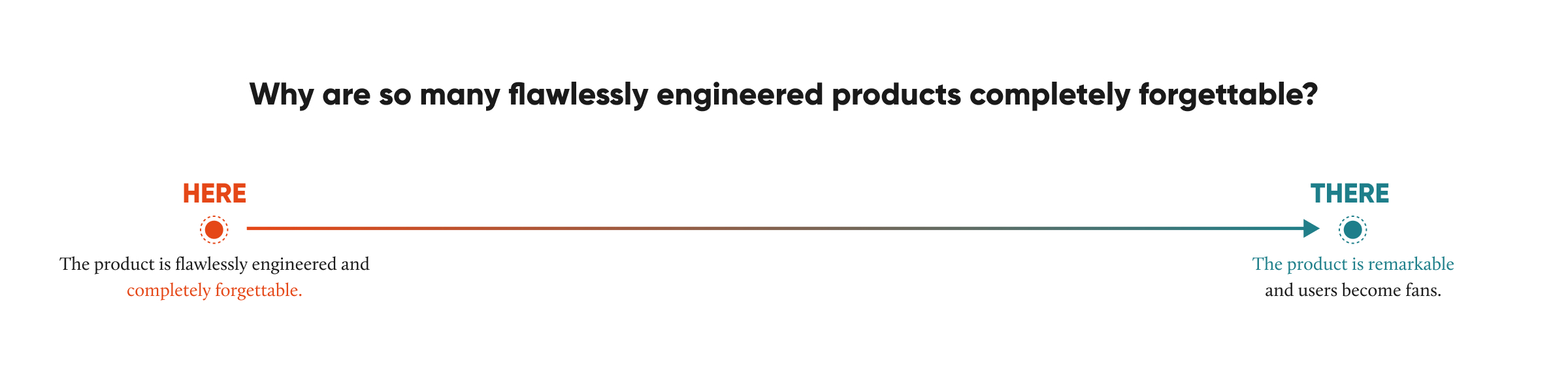
Once we have a focusing question, we identify the contrasting states of that question that capture where your people find themselves and where they want to go.
Example in the visual below:
Then, we open the gap
Once we have the end points, I’ll ask my client, “How do you help your people get from here to there?”
In the visual example above, I’d ask, “How do you take a product that’s flawlessly engineered, but completely forgettable, and make it remarkable?”
This is a deliberately broad question. From it, I’ll identify potential pillars, gaps in thinking, and unsubstantiated claims. We’re not filtering anything here, we’re just surfacing claims, opinions, and processes.
Now, challenge everything
I'll go through each claim and challenge them from different angles. Let’s say the claim is this:
“Delightful experiences are what make a product remarkable. But engineering teams don’t build them because engineering optimises what it can measure, and delight can’t be measured.”
I'll ask these kinds of questions:
What do the words actually mean to you?
- What does “delightful experience” actually mean?
- What does “remarkable” mean?
- Remarkable to whom?
- What does “measure” mean here? Measure how?
How do you know this to be true?
- How do you know delightful experiences are what make a product remarkable?
- How do you know engineering teams don’t build them?
- How do you know it’s the inability to measure that stops engineering from building them?
What else is at play?
- If a product has delightful experiences and average engineering, can it be remarkable? If so, give me an example?
- If a product has delightful experiences, is it categorically remarkable? If not, what else is required?
- If engineering could measure delight, would nothing else stop them building it?
So what?
- What does a forgettable product actually cost the company?
- Why does it matter if a product is respected but not loved?
- What outcomes does a remarkable product lead to that a forgettable one does not?
Why does this happen?
- Why does engineering optimise only what it can measure?
- Why exactly does “can’t measure it” lead to “don’t build it”?
- What conversations and decisions are happening inside the team when this occurs?
Are they not doing it, or unable to do it?
- Why aren’t engineering teams building delightful experiences?
- Do they know they need to and are choosing not to?
- Are they trying to build them and failing?
- Are they even aware of the concept of delightful experiences?
- Do they think the product is delightful but users do not?
Paint a picture
- Give me an example of a delightful experience.
- Give me an example of a flawlessly engineered product that’s forgettable.
- Show me a team that did build delight. What did they do differently?
- What does a forgettable product look like? What does a remarkable one look like?
Where is this not relevant?
- Give me an example of a product category where delightful experiences are not required.
- Give me an example of a product category full of products with delightful experiences.
Here’s what this process does
Firstly, it gets you thinking clearly about the claim itself.
Secondly, it helps us sharpen the claim and make it more accurate.
Thirdly, it helps us discard a claim with the realisation that, when challenged, it doesn’t hold up.
Most importantly, it surfaces other underlying principles you skipped over because they felt like common knowledge. That’s the curse of knowledge, unknowingly skipping steps.
We map out and sequence the pillars we’d need to develop insight and processes to comprehensively help your people go from here to there.
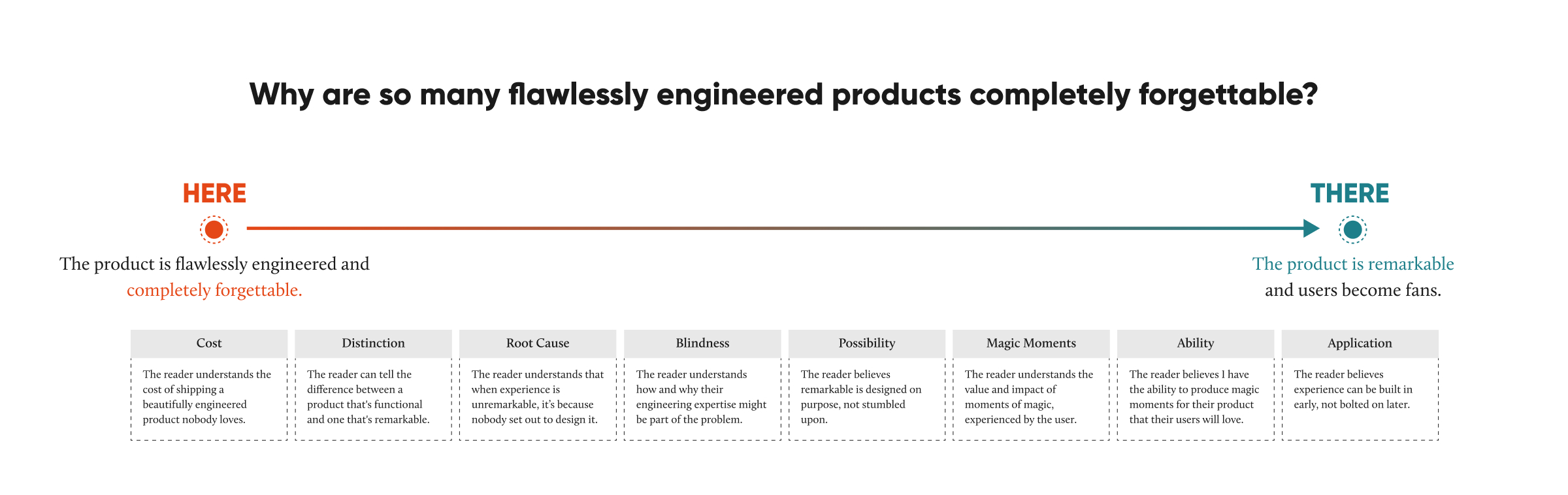
Then, for each pillar, we dig further to identify the sub-topics that make up that pillar.
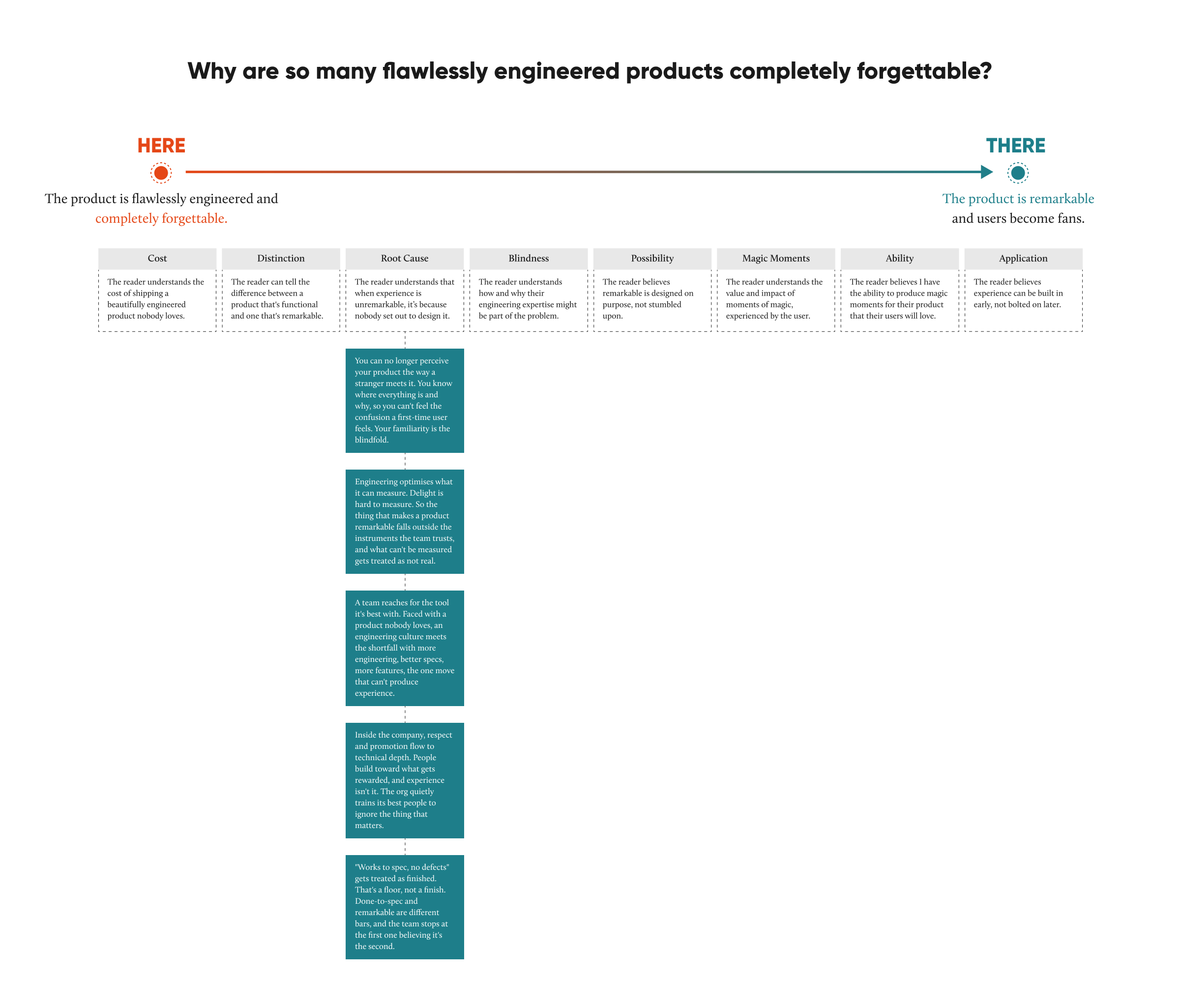
We’re not creating the material here, rather identifying what we need to make.
Use this Map of the Terrain to plan out all articles you need to write over the next 12 to 24 months. It’s not a static list. The act of making this material will surface new ideas, observations, and holes in your thinking. So, you alter it as you go.
And whilst David spent one month writing a 3,000 article each month, doesn’t mean you do.
Each sub-topic could be a 200 or 2,000 essay. Depends on the topic, your people, and your writing style.
The map then subsequently informs the outline for books, keynotes, or other intellectual assets you’ll build around your expertise.
Happy mapping!
P.S. If you want to develop the kind of insight that gets you recognised as an authority in your field, complete this form and we’ll have a conversation as to how I might help you do that.
P.P.S. The example above is mine, but the concept of Magic Moments comes from Iwan Hänggi of Notation Creative Consulting.