


“What we measure is often what’s simply numerically available, but what’s important to the human being may have absolutely nothing to do with this.” Rory Sutherland
Rory Sutherland, possibly the world’s most famous living ad man, shared a fascinating thought with me on the subject of opportunity costs.
He told me a sad story of a friend who was a very talented mathematician and an alcoholic. Let’s call his friend Mark.
Mark was forever frustrated that he could never get a job worthy of his mathematical talents, despite the fact that he was well connected.
Friends who were in banking would tell Rory, there’s a fundamental problem here:
“I could get [Mark] a job tomorrow based on his mathematical ability. He’s brilliant at that. But, because he has a drinking problem, if I recommend him for a job, and in 15 days’ time he turns up hungover at 11am or he vomits in the waste paper basket, I’m left looking like a total idiot. So, I can’t make that recommendation.”
Mark was completely unaware of these missed opportunities.
Because it’s much harder to measure opportunity costs than actual costs.
As Rory puts it, “Things that are really valuable may not be very quantifiable, and they may also be slow to grow or slow to reveal their value.”
In the context of building an authority-driven business, Rory identifies two assets that have the utmost value.
Fame and trust.
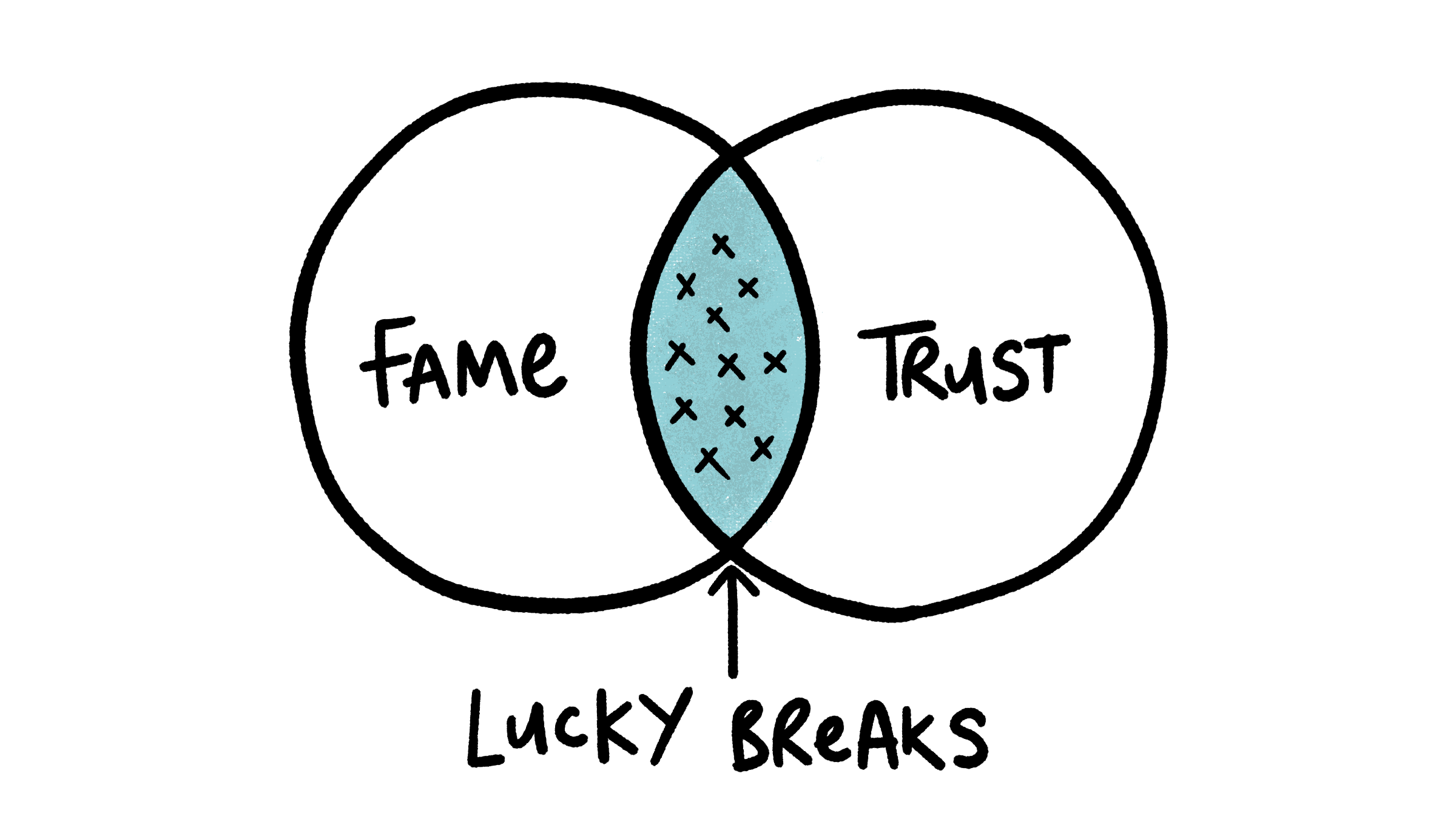
Fame is slow to grow, but if you have it, it exponentially increases your surface area of luck. You don't go looking for opportunities. Clients and partners you didn't know existed come looking for you.
I think that applies to niche fame, too, not just mainstream fame.
Trust is slow at revealing its value, largely because it's hard to recognise the role it plays in influencing the extent to which an opportunity comes our way.
Harder still, we do not see the opportunities we'd have been given had we been more trustworthy.
A deficit of fame and trust doesn't lead to bad luck. It leads to no luck.