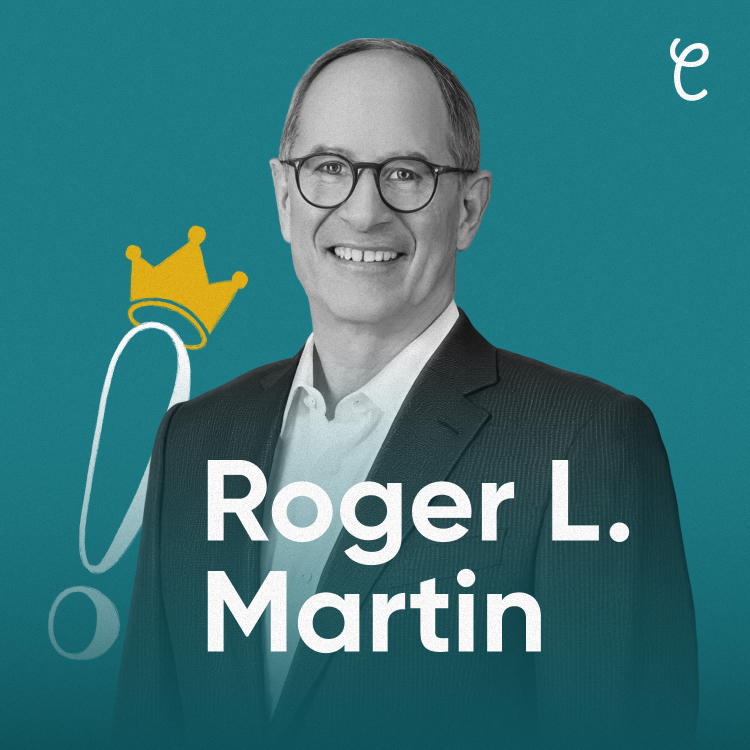
Roger L. Martin is one of the most influential thinkers on business strategy. He's advised CEOs of companies like Procter and Gamble, Lego and Ford. In 2017, Thinkers50 named Martin the number one management thinker in the world, and he has appeared in every one of their rankings since 2009. Aside from HBR editorial staff, he has written more articles for Harvard Business Review than anyone this century and co-wrote Playing to Win, a Wall Street Journal and Washington Post bestseller, which was one of his 13 books. By 1998, Roger had done a great deal of thinking and writing that would later make him renowned, but almost none of it was public. Before his 42nd birthday, he'd only published four articles. So how does someone get that far into the first half of their career, relatively unknown outside their network, and then in the second half become one of the highest profile figures in their field?
Chapter 1 — Monitor
Liam Curley: Roger grew up in a village of around 50 people in the middle of farming country in southwestern Ontario, Canada. He was the second of five children. His father started an animal feed manufacturing business when Roger was 2 years old and his mother taught at a school until Roger was born, then became a stay at home mum for about a decade before going to college and becoming a marriage and family therapist. Roger speaks often of the entrepreneurial lessons learned by asking his father questions at the kitchen table. He puts his business acumen down to his father and his interest in people down to his mother. He went to a rural elementary school learning from an English teacher who taught several students who would go on to become incredibly successful in their respective fields. So, Mr. William Exley. I think I got that name right.
Roger L. Martin: You do.
Liam Curley: What was the number one most valuable thing he taught you about writing?
Roger L. Martin: I think he taught me that it was about as much about precision as creativity. I think prior to that the English teachers I had in high school wanted flowery this and big words that and the like. And Mr. Exley was always about do you understand what you are trying to get across? Have you broken that down into a storyline? Do you have paragraphs that make sense? Do they flow one from the next? They were all things about precision. Now he was an incredibly creative guy. He played in an alternative rock band and Nihilist Spasm Band. So it wasn't that he wasn't into creativity, but, but he taught me that you had to be precise too. And he was relatively brutal on that. Right. Your essays would come back with all sorts of red marks on them, but for me it was magnificent because I could see what they were about. It wasn't just. This is my opinion here. It's like, no, there was no link between that paragraph and that paragraph. None. You're leaving it to the reader to try and figure that out. Not good enough. Right. So that's what he told me. Taught me.
Liam Curley: So it sounds to me my interpretation is that he taught you how to build a really cohesive, engaging argument.
Roger L. Martin: Yes. Yeah. Build and get it out on paper. It's an art form.
Liam Curley: I might be wrong here because I know that he's had some students that have gone on to being one incredible success as writers. Were they predominantly non fiction writers?
Roger L. Martin: Yes. Yes, they were. So, Malcolm Gladwell, nonfiction. My brother Terry, Harvard, Russian history professor, nonfiction. I would say Bruce Headlam, who by the end of his career was editorial page editor of the New York Times, probably would have dealt with a bunch of nonfiction in that he was more of an editor than a writer. Nonfiction editing in some of what he did at the New York Times. But interesting enough, yeah, now that you mention it, I would say it's much more nonfiction.
Liam Curley: Roger excelled at sport, but the trajectory of his studies and career would change as a result of a conversation with the school counsellor. When discussing which university to go to, the counsellor told Roger glibly, it doesn't really matter. They're all the same. Roger took his ambivalence to mean, you're a dumb jock. It doesn't really matter where you go. Here's Roger speaking with Guy Raz on Wisdom from the Top.
Roger L. Martin: And so I said to myself, I'll show Mr. Conlon I'm going to go to Harvard. And so I wrote away to Harvard to figure out what you had to do to go there and found out all these horrifying things, like you had to write something called the SAT, which I'd never heard of in my life, had to get reference letters, letters. Hadn't heard of those in my life, et cetera, et cetera. But I was so mad at being essentially dissed by Mr. Conlon that I went through that whole ritual and got in. And then when I got in, I sort of had to go to prove my point. And so it wasn't a big master plan. It was literally an adverse reaction to Mr. Conlon.
Liam Curley: Roger went on to study economics at Harvard, graduating in 1979. He went straight onto Harvard Business School for his MBA. He'd played on the volleyball team for four years, was the captain, and when the coach announced that he was leaving, Roger fancied the job. That, and he was also looking for a reason to hang around in Cambridge so that he could stay with his then girlfriend. Here he is speaking on The CEO Series with Karl Moore.
Roger L. Martin: And so my cover story was I'm going to go to Harvard Business School because you can't be accused of being a useless layabout if you're at Harvard Business School. So I applied to Harvard Business School and went. So it was my cover story.
Liam Curley: It's at Harvard Business School where Roger meets Michael Porter, a young Harvard Business School professor who would go on to become one of the highest profile thought leaders in the world. Can you tell me about your first meeting with Michael Porter?
Roger L. Martin: Yeah, it would have been at Harvard Business School because I had fallen in with a group of people who went on to found with Michael Porter Monitor Company. Two of them were in my section. I didn't have Mike as, so he taught a very big second year course at the time. The only strategy course at Harvard Business School in the 79 to 81 period was a course called Industry and Competitive Analysis which was based on his forthcoming book which came out in October of my second year. I took that second year course, but it was a very big course. So he taught a couple of the six or seven sections worth. And so I had somebody else as my professor but the guy in my section who was a good friend of Mike because his older brother, this was from Joe Fuller. His older brother Mark Fuller was a professorial colleague of Mike and also taught Industry and Competitive Analysis course. So they introduced me to Mike and that's when I met him.
Liam Curley: When Porter's book Competitive Strategy came out, it created a huge volume of requests for advice from executives who'd read the book, but not just execs. He was also appointed to President Reagan's Commission on Industrial Competitiveness. Michael couldn't fulfil the demand alone, so he started working with two consulting firms, Bain being one of them, to outsource some of the opportunity. But he discovered that although these firms would take the inbound work from Competitive Strategy, they weren't applying the principles from the book. They were applying their own consulting principles. Eventually, Porter came to the conclusion that in 1983 he should build a firm by bringing together a group of his MBA students. Roger was one of them. The firm was called Monitor. What do you think he sees in you or someone sees in you to bring you into this small group that's gonna launch Monitor?
Roger L. Martin: I mean, I guess it was probably, I mean, the biggest source of data they would have had on me would have been me in class at Harvard Business School. And I must have come across as a smart enough guy that they thought, well, he'd be good in this context. And I guess, I mean, I probably always have been kind of relatively kind of thoughtful and had opinions on things and was interested in strategy, which was a very new field still at the time. You'd probably have to ask them.
Liam Curley: Yeah, yeah, of course. Was it him that approached you first or was it.
Roger L. Martin: No, it was Joe Fuller. So Joe and Mark Fuller were a couple of the founders and Mark's the senior who had graduated, I think, 77, as opposed to 81 for Joe and I. And it was Joe Fuller, my section mate, classmate and actually Harvard undergrad classmate as well. We were both class of 79 undergrads and class of 81 MBAs, so he was for sure the conduit.
Liam Curley: Roger graduated from his MBA in 1981, but at this time, though he was aware of the Monitor opportunity, the firm wasn't yet ready to bring him in.
Roger L. Martin: So a number of us went off and worked for other firms. I went back to Canada, which as you know, I'm from, to work for a little McKinsey spinoff called Canada Consulting Group. And one of the senior partners gave me a report to read and it was a Royal Commission report on concentration in the newspaper industry. It's called the Kent Commission. And probably the first memo I remember writing which had a very strong point of view, was on the Kent Commission. And I thought it was horribly argued and a piece of relatively speaking, garbage. Now, I was young, foolish, naive. I would have been probably 24 something at the time, I guess 23, 24 at the time. And I just wrote what I thought. The truth was that this was a bad job by a guy who couldn't think his way out of a wet paper bag. I didn't kind of realise that the senior partner in my firm was a friend of his and liked him. And he came and threw it on my desk and said, we're going to have to teach you how to write. And so being young and extremely foolish, I sort of was basically screw you. And I sent it to our leading national newspaper, the Globe and Mail, which is kind of sort of like Wall Street Journal of Canada, the leading business newspaper. And one of the leading. There would be others who would say, oh, we're as much of a leading newspaper for non business. But anyway, the Globe and Mail, and they published it as an editorial and, you know, like, that's really kind of stupid thing to do because they probably should have fired me, but I guess they thought I was at least spunky and interesting enough not to. But that would be. That would probably be the first thing that I wrote that was designed to try and change people's minds. Now, it wasn't the more classic thing that I did, which is to write for a particular CEO, but that's the first that I can recall doing that. And that was probably 1982 or 1983.
Liam Curley: Asides from that internal, was there any other response outside?
Roger L. Martin: Oh, yeah. Lots of people liked it and lots of people hated it because they thought the Kent Commission was awesome. And so, yeah, it was. It was kind of fun. I realised it was. You know, I've done a bunch of those sort of things that just people would think are fearless, but I think of them as probably more naive than fearless.
Liam Curley: Well, might not be mutually exclusive.
Roger L. Martin: No, it's a good point. It's a good point. It's a good point.
Liam Curley: How did you feel when it came out?
Roger L. Martin: Well, it was a little bit of a, you know, screw you, buddy. You somehow think that I, quote, can't write. And Canada's national newspaper seems to think that I can. I'll take them over you, buddy.
Liam Curley: After three years of working at Canada Consulting Group, Roger gets a call from his friend at Harvard, Joe Fuller. That Monitor is up and running and it's time for him to come down and join the firm, as had been the plan. One of the key insights in Michael Porter's book was the Five Forces analysis. In the early years, most of the work consisted of clients hiring Monitor to perform or teach the Five Forces analysis in relation to the industry in which the client operated. Over the next 15 years, the firm would expand to the point that when Roger eventually left in 1998, they had 1200 employees. As Roger grows with the firm and starts leading teams, he becomes famous within the business for the memos he'd write to clients.
Roger L. Martin: And maybe it was Mr. Exley teaching about communicating with precision while everybody else was doing PowerPoint decks. I was always queasy about them. I mean, I was into PowerPoint decks just because that's how the strategy industry communicated. So I didn't not do them. But what I found is that they didn't feel as persuasive as the people putting them together thought they were. And also they were at their most persuasive when they were accompanied by a live person saying what these pages actually mean. And so I started to come to this conclusion that it wasn't an awesome vehicle and a better vehicle would be prose, where when a CEO asks me a question. I would write him or her a prose document saying, here's what I think. And occasionally it's interesting. I got, you know, this, this guy retired from, from Monitor six or nine months ago. Maybe it's almost. Oh, maybe it was almost a year ago. And he, he was like looking through his files and he sent me something from that. We worked together in 1985. And he said, here is your letter to this CEO of this giant company that persuaded him that he should hire this friend of mine. And I read it and I said, actually that was pretty good. And I made this counterintuitive argument to him because he had an argument in his head, even though he liked my colleague Jonathan, he liked my colleague Jonathan and had worked with him before, that he should go for a diversity of points of view and hire somebody else. This time I made a counter argument to him about kind of why he should hire Jonathan. And he did. And they had a long, kind of productive relationship thereafter. And so Jonathan sent it to me and said, this was good, Roger. And I read it and I said, yeah, it actually was persuasive. So it seemed to be a vehicle that helped me be able to frame up my point of view and be persuasive. And they all tended to be short. They tended to be 2,000 words or less, like 3 to 5 kind of typewritten pages or single spaced pages. And so that's not the only time people have sent me things and said, do you remember writing this? And I'm like, sometimes I was like, oh, right, that. If you'd have asked me, do I remember it, I would have never. But you sent it to me. And so 40 years ago, I remember, was it physical?
Liam Curley: Like, were you sending them off or was it emailed?
Roger L. Martin: Oh, early on, it for sure would have been physical. This was physical for sure, for sure. And I would say it was only in the probably late 80s where it became much more emailed. Though very little of my stuff from the email era is. Is the body of an email. It's generally an attachment. I would write something in a little more formal. This is a memo for you on this subject and have it nicely oriented or nicely formatted, I should say, so that the format wouldn't take away from the understanding. I want it to be nice and neat so that they can just absorb the thinking.
Liam Curley: Was that something you did more or less straight away when you were at Monitor or.
Roger L. Martin: Yeah, yeah, I did. Because there's a lot, it's a lot from that era. And I became known internally as the guy to email with the. Roger, have you ever written anything on this to one of your CEOs? And often I had. And they would then take it and modify it for their use. And I started calling it a file on my computer. I still have it called Greatest Hits, which sounds self promotional, but it was just ones that people have asked for multiple times. And so I'd rather not go back. Oh, what was this client? Let's go into the client file. Oh, where was it? Where was it? It would just be in the Greatest Hits file. And I remember having this experience where something happened in the outside world that caused me to say, I think an HBR article on this would be a fun topic. And so I took an article out of my Greatest Hits files and sent it to my editor at HBR, the senior editor, who kind of takes care of me, and he loved it and he published it. And then I fessed up. I said, you realise that that was HBR, likes to have brand new ideas. But that was 20 years. And he was like, what? And then he wanted to know more. And I said, well, it's for my Greatest Hits file. And he said, well, can I have it? And so I sent him my Greatest Hits file and we published at least one. Maybe there were two other things out of it where he just read it through and published it. So, yes. So the answer sort of is yes. I started becoming quite prolific and there was probably, I don't know, 30 or 40 pieces in the Greatest Hits file.
Liam Curley: The questions that are coming in, are they kind of somewhat informal, saying, Roger, can you give me your opinion on this or is it more? This was part of the structured engagement to deliver answers like this.
Roger L. Martin: I think almost none of the latter. Right. It is more like, hey, Roger. And in the conversation. And often I would give them, give them a few thoughts in real time. But I became, you know, these things build over time because they were so popular with the CEOs, they would thank me profusely. Wow, okay. Now I get why I should think about it this way. I would often just say, hey, I'll write you something. And I never. Honestly, I mean, I probably wasn't built for strategy consulting in the classic way, because you'd have a proposal that would have everything laid out and then you're only supposed to do those things. And I was like, I'd rather have something that's much more informal. And it's like, you got a problem, I'll help you with it and we'll figure out how much to pay for it. And I have no idea what we'll end up actually needing to do until we get deep into the problem. So I was always more informal, so this was just part of my if you add value to the client, if you help them understand something that vexes them, they'll like you. That's good enough.
Liam Curley: Do you now more so but maybe then have a method for capturing questions and ideas in conversations with CEOs that you will come back to later to answer in the form of content.
Roger L. Martin: Certainly. Since I've launched into this Playing to Win Practitioner Insights series on first Medium and now Substack now I pay attention with an eye to is that CEO asking me a question that I bet other CEOs would be interested in the answer too, and I'll just jot it down and put that on my list. I just sort of have a bit of a running list of things I'd like to write about, but I would say that only happened in the last five years or so or five and a half years since I since I started this idea that I would just write every week.
Liam Curley: I'm going to come back later in this episode to discuss further how Roger identifies and elaborates on ideas, but I want to pause here to reflect on something he did from the very beginning of his career. Whenever a question is posed or Roger notices something that's broken in the business environment, or a client encounters an obstacle, he spends time developing an opinion. He does that by writing, because the act of writing is a forcing mechanism to make sense of the world. Your own sense, not somebody else's sense. Writing is thinking, and he does this constantly, which means he gets better at it. He's concise, he's interesting and he's contrarian, though he's not necessarily intentionally contrarian. I don't think the best contrarians are intentionally contrarian. I think they're deeply thoughtful and observant. They notice things that others miss because they notice what others miss. What they share contrasts with what came before. He built the muscle for thought leadership, even though that thought leadership has barely left the walls of Monitor. Roger has spoken previously about the difference between a public and a private thought leader. A public thought leader is, of course, somebody who publishes their thinking in public and becomes recognised as an authority in their field on the back of their writing. Up to this point in his career, between 1983 and 1999, through his memos, Roger had become a private thought leader. Few people outside Monitor knew who he was, but hundreds of consultants and inside the business sought out his work. They knew what and how he thought, which was critical for leading clients and employees. Here is Roger speaking with Andrea Wojnicki on Talk About Talk.
Roger L. Martin: I think to be an effective leader you have to have thought leadership within your organisation. They need to know what you stand for, what do you care about and how do you think about what you think about and why.
Chapter 2 — Rotman Business School
Liam Curley: By his 13th year working at Monitor, Roger was now serving as co-head of the firm, having set up the Canadian branch of the business, Monitor Company Canada. Through the Canadian office, a company called Moore Corporation approached Monitor. Moore Corporation is a Canadian business that was the biggest in the world for making office forms. This is the 90s so every business needed printed documents like invoices, receipts and payslips. The firm needed help from Monitor, so Roger went to work with them and sat on the board and the strategy committee. Rob Prichard, the president of the University of Toronto, was also sitting on the Moore Corporation board and subsequently Roger and Rob worked together and got along really well. Rob held a dinner at the University of Toronto's President's house for the management team on board and invited Roger along. At the end of the dinner, when Roger was getting his coat, Rob said, I'm going to try and talk you into becoming the next dean of our business school. Roger had the idea of doing some sort of public service later in his career, but at this stage in his early 40s wasn't on the agenda. Rob though, was persuasive and Roger is a patriot. At the time, as Roger puts it, Canada didn't have a business school of any consequence in the global market. And if Canada wanted to make a habit of incubating significant global companies, Roger believed the country needed a business school that would attract the world's top talent, which it did not have. So Roger took a 94% pay cut in compensation and left Monitor to work as dean at the University of Toronto's business school, the Rotman School of Management, intent on turning the school into Canada's first globally consequential business school. Roger said, quote, when I became dean of Rotman School in 1998, we had very little going for us. We were poor, with a budget 1/4 that of our leading competitor and we were running a deficit on that tiny budget, end quote. Professors were leaving the school to go and work in the US because of a weak Canadian dollar. The school's alumni were disengaged and Rotman had very little in the way of a relationship with the Toronto business community. In Roger's words, they had to build advantage cheaply. Roger needed to turn the school into one that would attract world class professors. He needed to build the school's reputation as an authoritative leader in business design and he needed to fundraise more effectively. What he realised was that he'd need to offload many administrative responsibilities the previous dean had held in order to concentrate on the highest leverage activities he should focus on as dean, one of which was becoming a public thought leader. How and when do you come to realise that the most valuable and useful way to spend your time as the dean at Rotman Business School is to write and publish?
Roger L. Martin: So I would say it was one of the most useful things. I wouldn't want to put it over and above developing a personal relationship with all of my faculty members. So it was those two things. What I felt is that we paid faculty members a heck of a lot and we were counting on them for a lot. And the relationship that the university set up with them was essentially very cold and impersonal. And I said, I'm going to meet with them every year to go over what they'd done in the year, their aspirations for the future, and develop that personal tie to them. So I want to say that's important. But what I came to realise is that kind of universities are famous with other people in universities through their academic work, typically written in journals or in books that nobody reads. But the universities and schools they're in that are famous have public intellectuals, so people who write, professors who write for a broader public audience. And I realised that we had zero of that when I arrived there, zero. So it was no surprise that nobody kind of on the outside had any sense of what the Rotman School meant. And so I felt that that was something that I could kind of fill in the gap of. Though as I said, what I said, I'm wrong. We had one fellow, John Hull, who was a finance professor specialising in options and derivatives, had a very famous textbook that his students and then lots and lots of other people would have literally on their shelves to say, I'm doing this kind of weird kind of derivative. How does John Hull say I should be valuing it? So we did have that one person, I take back what I've previously said and I saw the impact that he had in the world of finance, where people on the outside would say, oh yeah, like John Hull, right, that's a yes. And so I said we need more of that outside that one narrow field. And it totally influenced me later to recruit Richard Florida. The Rise of the Creative Class guy, world's leading urban geographer who has a giant audience. He's a public intellectual with a giant audience outside. I recruited him to the school in part because on that front, more is better.
Liam Curley: As you were entering that role or just before you enter that role, was that a challenge that you were aware of, i.e. we don't have enough famous professors, we need to get more, or was that something that you come to realise?
Roger L. Martin: Certainly the latter. I knew precious little about my job when I took it. Honestly, I just had to learn as I went. But that was. That was an early learning of mine. And I also believed, like I believed a lot in leadership. And showing that it could be done would encourage others to do more of that. And others did take to that. And the school, I mean, I've been out of it for a while, but the school now has, you know, at least a good handful of public intellectuals, which is awesome for it.
Liam Curley: When Roger started as dean, the editor of the Rotman Management journal asked him to write an article for the spring issue, the first about him and a second by him. This is when Roger realises that it's his job to write for public consumption and become famous with a broader audience. So he starts writing an article in every issue, three per year for the next 14 years as dean. So you publish in your own journal. And this may be kind of a naive question, but when you decide, okay, I'm going to lead from the front, I need to start appearing elsewhere, how do you go about doing that?
Roger L. Martin: I had to make myself available. One of the earliest things I did in terms of writing publicly was for newspapers writing editorials and the like. And there, Ken McGuffin, our great media relations person, I always said, hey, if a newspaper or magazine is interested in some topic, offer for us to write something on it. Now, sometimes we would just get interviewed, but being quoted in an article was good for the school too. And we tracked that, you know, how much are we getting in the newspaper, how many hits and what's. Were they important hits or not? But then will Roger be willing to write an editorial on that subject? So that's what I did a lot of early on. And I committed to writing a lead article for our Rotman magazine, our school magazine, which also got the word out. Although in the early days it was a very, very small circulation. We had to build that. It became very big over time. And then I started to try to kind of submit things to Harvard Business Review. And sure enough, they seemed to really like me. And I ended up publishing more than anybody else in the 21st century in Harvard Business Review. So it sort of was a build. You had to start small where people were willing to accept this person who wasn't kind of a known figure yet and build slowly.
Liam Curley: I think you've said something along the lines of personally writing in a position of dean of the business school makes the school more worthy of donations. Might have got that slightly off. No, no, okay.
Roger L. Martin: That is correct.
Liam Curley: Why is that the case, do you think?
Roger L. Martin: I guess maybe I'm always a little bit contrarian. And when I got there and was told how you fundraised, which was make a list of rich people and go ask them for their money. I guess from my previous career, I had met a lot of rich people and it just struck me that that's sort of not how they work. They don't just accept invitations from fundraisers and then say, you want my money? Okay, no problem, no problem. And so I said, well, what do rich people care about when they have a philanthropic thought? And I think what they care about is worthiness. Is that institution worthy of my support? And so lots of people who are not MIT graduates but who are in technology just heave money at MIT. Why? Because they think MIT is worthy. Right. It's this fantastic technical university that also kind of reaches out and is part of the technology community. Hey, why don't I give money or a Harvard or a Stanford or the like? And so I said, we're not actually worthy now, right? We just aren't. We can't make a case of great excellence. We need to make ourselves worthy. And I worked really hard on being worthy and it ended up succeeding marvellously. We did by far better. And I think. I'm not absolutely sure, but I think during my time as dean, we raised more funding donations than all the other business schools in Canada combined.
Liam Curley: And though Roger was leading from the front, it wasn't just him. He was building a team of thought leaders.
Roger L. Martin: Anybody called up any reporter wanted to do a story, I said, I want them to call us first because they know our wonderful media relations guy, Ken McGuffin, one man band. Fantastic that he would find them someone and that person. Because lots of the professors didn't really appreciate how a newspaper especially runs. It's like if you say, yes, yes, I have a slot two weeks from now, right? The story's done, finished, gone, you're useless. And what I impressed on the professors and Ken was a media relations professional, was that when they call, you probably have to get back to them in a half an hour to fit into their story thing. And we developed that. And so they came to us first and that helped get the word out. And so there was a service that measured your share of voice. So there were, I think 33, 34 other business schools. And they would say of all the media, weighted by its reach, because they would know for every publication what its reach was. And you got a story kind of in that era. And you quoted a professor. Quote quoted. We went up from almost nothing to 60% share of Canadian business school share of voice. The other 34 got to share 40 share points. We had 60. That helps you be worthy. Because when these folks who might be philanthropically inclined are reading a story and it quotes in a good sort of way as kind of a source of insight, a Rotman professor, they say to themselves, well, you know, that's probably a good school, otherwise they wouldn't be being asked to opine on the issues of the day.
Liam Curley: Right. And I guess it's just that, you know, as with advertising or, you know, the volume is the constant. Okay, I keep seeing this name all the time. It must be a good school.
Roger L. Martin: But it's different than advertising, right? It's earned.
Liam Curley: Yes, of course. Yeah, right. You, you earned the. You didn't pay for it. You own.
Roger L. Martin: Right, right. And I think, I don't know about you, Liam, but I think in the modern world that there's an increasing gap between the value of earned versus unearned media. People want an opinion that wasn't purchased. Now, unearned media, it still matters. And if you have a good and genuine message, fine, fine, fine. But I think people are, are listening. I mean, the entire Internet world is headed in that direction. Although it's harder and harder to tell as a user whether it was earned or unearned message that you were getting from whatever Kim Kardashian or whatever or Kendall Jenner. They were paid a million dollars for.
Liam Curley: That tweet, which is probably why we want it more and more, because it's harder and harder to tell.
Roger L. Martin: Yes.
Liam Curley: Roger said that one way they made material that earns such organic media attention was to take their very expensive academic research that only other academics normally read and make it readable and interesting for a broader business audience, which they could do inexpensively through Rotman magazine. That's the kind of thing Roger's friend Malcolm Gladwell has built a career on as one of the biggest non fiction writers in the world. In Gladwell's case, take scientific research and tell engaging stories with it and around it. Here's Malcolm Gladwell speaking to that point on HBR IdeaCast with Adi Ignatius.
Malcolm Gladwell: I'm in the position of the journalist, not the researcher. The journalist is someone who stands between the academic or the original source and the public. And our job is quite different from that of the academic because our job is to translate for a wider audience and we are a necessary part of the kind of intellectual ecosystem. If social science were only done for other social scientists it would be pointless. I mean, not entirely pointless. The world would be, I suppose, moving forward in some positive way. But there is no point to having thousands of academics around America doing extraordinary work if no one is trying to bring some of that work to the public eye. But you're right, the set of kind of expectations and limitations on what we do are different from the academic. We have to simplify ideas, make sense of them, translate them, we have to attach them to stories, we have to help people put them in context.
Liam Curley: The Rotman magazine became internationally recognised having been when Roger started a run of the mill alumni magazine. You heard Roger say earlier, other schools didn't follow the approach because they were run by academics who didn't see the value in engaging business people with their research. The Rotman magazine was written, in the way Malcolm Gladwell puts it, like journalists rather than academics, translating source research for the wider audience in the intellectual ecosystem. As a result, Rotman developed a flywheel of growing media publicity organic and earned at a time when they had no budget for paid media. This was critical in the success of increasing donations, attracting world class professors and increasing student numbers. And there's a principle that explains why in 2001 two anthropologists, Joseph Henrich and Francisco Gil-White published a paper on how humans work out who to learn from. Their argument is that most of the time we can't judge expertise directly. We don't know enough to assess whether the expert is any good. So we use a shortcut. We watch who everyone else is paying attention to. Henrich and Gil-White call it prestige bias. Here is Harvard behavioural scientist Professor Joe Henrich speaking with Eric Singler and Suzanne Kirkendall on the BE GOOD! podcast.
Joe Henrich: Built around this idea that we have these cognitive adaptations for learning from others is that we're adaptive in who we pay attention to. So we learn from more successful people, more skilful individuals. We might copy individuals who match us on sex, all of this in order to get that adaptive repertoire from the minds of the other members of our social milieu. But I and others have made the case that we also have a kind of second order trick that we use to figure out who to learn from. And that is we pay attention to who other people are paying attention to because everyone's playing the same game. So if a whole bunch of people seem to want to be learning from one person, say, how to hunt or how to write, then that's probably a good signal that that person is worth paying attention to for those. So it's a way of kind of free riding or on the fact that everybody else is trying to figure this out and this leads us to attend to other individuals. And I've made the case that this leads to a separate kind of status called prestige. So in humans we have dominance, which we share with chickens and lots of other species, but also prestige, which is this kind of status that arises from competence or skill in which individuals vary in culturally valued domains.
Liam Curley: The people making seven figure donations to Rotman presumably aren't reading every journal or picking through the fine details of all their research to deem whether this school is worthy of their money. What they see is that this school, its magazine and its professors seem to get quoted and covered in the media a lot. And because of prestige bias, at least in part, they take that as a signal that this school is worth paying attention to. And perhaps in the case of a donor worthy of supporting this is the mechanism of authority. When an expert gets covered in high profile publications in their field, when they get referenced by other authorities, when they speak on famous stages, the prestige bias kicks in. I'm not saying that's all there is to becoming recognised as an authority. There needs to be substance in the material. It needs to be relevant to its intended audience. It needs to contrast with other similar material on the subject matter. But humans do take signals on who to pay attention to based on where others place their attention. By the time Roger stepped down from his position in 2013, the Rotman student population had increased by 300%. Since he'd started the role, they'd raised more than $250 million for the school. Eight of those donations were eight figure gifts, roughly a third of all the eight figure gifts the entire University of Toronto had received in its history. And the school's annual budget was $130 million, up from a little more than $13 million when he became dean. At the time of stepping down, it was considered a world class business school with a differentiated MBA programme. In BusinessWeek's intellectual capital ranking, it was the number one school outside the US. And the Financial Times ranked it 10th globally for academic research.
Chapter 3 — Playing to Win
Liam Curley: In 2007, Roger would move from articles to books. He published The Opposable Mind that year with Harvard Business Review Press, a book that would introduce his concept of integrative thinking. Followed by The Design of Business in 2009, again published by Harvard Business Review Press, which was a seminal book in the movement of design thinking. At the time of making this podcast, Roger has since published 13 books, so very much a public thought leader. But there's one book in particular that has had a disproportionate impact above all the other 12 on his standing as an authority. Playing to Win, which he co-authored with A.G. Lafley. It's a Wall Street Journal and Washington Post bestseller. Harvard Business Review referred to it as a contemporary business classic, and Roger has said it's one of the best selling books on strategy ever published. The origins of the book and how Roger developed the key findings and frameworks are worth exploring and reviewing. In the mid-80s, Monitor was hired by Procter and Gamble. You probably know Procter and Gamble, but just in case you don't, it's one of the biggest consumer goods companies in the world that owns brands like Gillette, Pampers, Febreze and Head and Shoulders.
Roger L. Martin: So we were the first ever strategy consulting firm hired by Procter and Gamble. It was 85 or 86, I'm not exactly sure. We studied shortening and oils, Crisco and Duncan Hines, their brand new cookie business, where they had figured out, well actually they found a recipe, a Mennonite recipe, as it turns out, for making cookies that stayed soft. And they were going after chocolate chip cookie that stayed soft rather than one that was Chips Ahoy that is hard out of the bag. But it wasn't doing as well as they wished. So we did the study. We came to the conclusion that they had made a tragic mistake in cookies that was largely unsolvable, which is that they're used to categories where if you have the best product, you get dominant market share tied to the best products. 50% market share, Head and Shoulders, 50% market share. So they thought that would happen for cookies, but it turns out that in cookies, moms rotate through cookies. So even if you have the best chocolate chip cookie, next week she's going to get them Oreos, a wafer cookie, and then she's going to get them a peanut butter cookie and then she's going to get them something else and rotate back to it. So your market share was never what you thought it was going to be. So the profit, the plant you built was too big, blah, blah, blah, blah, blah. And so we said you'd have to if you really want to win in the cookie business you got to come up with another three Duncan Hines style breakthroughs. And that's going to cost you a lot. We wouldn't recommend it. And John Smale, the great CEO at the time, who later became a good friend of mine who's long since passed, fired us and said, I didn't hire you to tell me to get out of the business, I hired you to tell me how to fix the business.
Liam Curley: So Procter and Gamble fired Monitor, but unfortunately for them, the cookie business performed exactly as Monitor had forecasted.
Roger L. Martin: And so he phoned us back, bless him, and basically said, you people are annoying. But you know something that we don't know because you saw something that we didn't know. We have to be able to see that ourselves. Come teach us.
Liam Curley: Monitor subsequently created the Applied Strategic Management Programme, ASM, for the category general management teams at Procter and Gamble and delivered that programme across their four regions. Between 1987 and 1989, Roger worked with Monitor's CEO Mark Fuller to create and deliver ASM. And then Roger took over leadership of the relationship with Procter and Gamble. During that time, he got to know two of the leading category general managers, A.G. Lafley and Wolfgang Berndt. Simultaneously with all this, something else was happening. If you remember, during the 80s, much of the work Monitor was doing was coming in through Michael Porter's book Competitive Strategy and of the inbound, most of it was related to requests for Monitor to conduct a Five Forces analysis of the industry in which the client was operating. But in time, clients started asking about other insights Monitor had around strategy as a whole. How could they develop a strategy to win through differentiation? The challenge was that Monitor didn't have a methodology to help a client develop a strategy that would move them from being one of the pack to a clearly differentiated leader. So in 1987, Roger took it upon himself to develop a methodology for creating a strategy. This was also when Roger opened the Canadian office for Monitor and he continued to work on the strategic process with Canadian clients, creating logic flows and early versions of the strategic choice structuring process. You open a Toronto office for Monitor, you continue to refine your strategy process. Looking back, is it possible to paint a picture for me of what your process was for developing those early versions of the strategic choice structuring process?
Roger L. Martin: Yeah, I mean it was trial and error. So the effort to do that started kind of simultaneously with the Applied Strategic Management Programme. And I looked at the Applied Strategic Management Programme and said that's still a bunch of strategy components. It doesn't teach you how to put them together. Here's how you understand customers, competitors, your cost structure, et cetera. Those are all things you do, not how do you put it together. It disturbed me that we didn't have that process that said you start here and then you do this, this, this, this, this. Even if you iterated a bunch, it wasn't necessarily completely linear. So I just started thinking about it and in 1987 also I drew the first strategic choice structuring process for Eaton, which was a Eaton Corporation, which was a Cleveland based conglomerate, mainly in auto parts. They did made truck brakes and axles and stuff like that. And I remember drawing the first one where I said, well, here's a flow of how you could think about strategy. And then I worked with them, they seemed to find that helpful. But I said, well, it's not, still not good enough. And then just over time between 87 and kind of 95, it kept modifying and modifying until such point as I sort of felt, well, this is now a strategy process where I can say to a client up front, this is the process I'll take you through and this is how it'll go. These are the kind of the steps we've got to go through. And that's the choice structuring process, is the process for strategy. I also was developing what became the content for strategy, the five box strategy choice cascade that's featured in, in the book. And that was drawn for the first time in 1995, I would say the strategic choice structuring process came into shape. Probably the first time it really was in good shape was I think 1992, working for Honeywell's HVAC business, heating, ventilating, air conditioning business out of Minneapolis. But I just kept at it. Every client. Avenor, a big Canadian forest products company. I remember honing it some more on that and some things would work better and other things would not work as well. And it was just a constant R&D effort for eight years and nobody had assigned me the job nor did anybody particularly reward me for it. I just did it whilst consulting. I was rewarded as a partner for how much business I sold and did. So this is one of the things people ask me. I'd just say, you gotta love this stuff or you ain't gonna do it. Because I had to love it because I got nothing, nothing for it, absolutely nothing for it, other than having it ripped off by other people in Monitor Company would say, oh, can I have your slide deck? And sort of like, yeah, you did zero, but okay, sure.
Liam Curley: Roger works on this strategic choice process between 1987 and 1995. In that time, he's fired by Procter and Gamble again in 1990. When a new CEO starts, that CEO decides that real executives don't use consultants, so they fire Monitor. Then in 1995, a new CEO replaces the previous one and Wolfgang Berndt became president of P&G North America. Remember, Wolfgang was one of the category general managers that went through the ASM programme. Roger was still angry at the way he was treated and fired by Procter and Gamble. But Wolfgang approached him because he wanted Roger to come back in with Monitor, update the ASM toolkit and deliver advice on how to improve the strategy process. Roger agrees. And then in 1995, they drew up a strategy choice cascade. Roger continues working with Procter and Gamble as an individual consultant when he leaves Monitor to become dean of Rotman School of Management. He stops working with Procter and Gamble in 1999 when a new CEO is hired and they don't get along. But then in 2000, A.G. Lafley is appointed CEO of Procter and Gamble. And remember, like Wolfgang, A.G. Lafley is another of the category general managers who went through and really appreciated the ASM programme. They get back to working together. Roger has said that A.G. made the strategy choice cascade the essential cornerstone of strategy at P&G. And in Roger's words, it was the best development lab anyone could hope for. In 2005, A.G. and Roger started discussing writing a book together on their strategy work. But A.G. didn't think it was appropriate to write a book on Procter and Gamble's strategy while still CEO at the company. But in 2009, when Lafley stepped down as CEO, they started planning the book and wrote it between 2011 and 2012. The book came out in 2013, co-authored by the two of them. It was a huge success and continues to sell in large numbers today. Shortly after publication that same year, Roger steps down as dean of Rotman. He had two years of sabbatical saved up, during which, instead of resting and relaxing, he ramped up his consulting. And by 2019, he decides to leave academic administration entirely and spend all of his time on the two things he loved most, writing and advising CEOs. I asked Roger when he went back to focus entirely on consulting, did he apply his own strategic thinking and process to his business strategy? A quote from you: a set of choices that enables you to invest in a given place to win. For Roger Martin Inc, did you sit down after, you know, you set up the business, you've left the university and decide what choices, you know, what was your winning aspiration? Where would you play, how would you win? Did you do that for yourself?
Roger L. Martin: Yeah, yeah, yeah. I mean, I eat the dog food.
Liam Curley: So what choices did you make around how you would win and where you would play?
Roger L. Martin: Well, I had a big choice to make because, as you probably know, long after I left, 15 years after I left, Monitor sold itself to Deloitte after sort of failing financially. And I didn't realise when I left that I was sort of an inspiration to many consultants. They loved the way I did it and I had a different view of how to consult and blah, blah, blah, blah. A whole bunch of people came to me and said, create the new Monitor Company fully in your image, not in the image of seven or eight directors or the global executive committee of four who ran it in the 90s until I left. So I had a choice to make as to whether I would. That was how I was going to win. I was going to rebuild Monitor Company. And I said, no, I don't want to do that. I didn't like when you build a big firm and have a pyramid, you get into the business of keeping all those hungry mouths fed by selling case teams. I said, been there, done that for 15 years or 17 years. I'm don't want to do that anymore. So I made a choice of being a sole practitioner. And that meant also the sort of the where to play was just at the very thin level of advising CEOs. So I personally would advise CEOs on strategy and I would continue to be kind of the thought leader that I had become, Playing to Win, and become very, very famous. And I had written a whole bunch of books I'd written and a couple more books by the time I left in 2019. And I said, I want to be. My aspiration was to be a voice who would be missed. Where to play, very high level senior advisory of CEOs, plus kind of writing. The how to win, it's to consult in a very different way where we need to use their people, not outside experts, and I would help them develop their strategy skills and I would bring kind of new insights from my writing to them. So, yep, that was the strategy choice. And lots of people were like, you're nuts. You're not getting the leverage of a giant firm. And I said, yeah, there's leverage and there's some negatives So I haven't questioned that. And I've delved probably even deeper into thought leadership with the Playing to Win Practitioner Insights series. I mean, I've written the equivalent in the last five and a half years of seven Playing to Wins in length, seven in five years. So I've written seven books worth in five years. Nobody, even Peter Drucker at his height ever wrote that much in that period of time.
Liam Curley: Whilst publishing books and publishing on HBR as well. On the subject of Peter Drucker, he was notoriously a prolific writer and it's clear that Roger is the same. I was curious where Roger stood on the question of quality versus quantity. Where does that sit with him?
Roger L. Martin: It is a bit strange because I think. I don't think that there are many people who like, are born and raised to think they're super special or something. So I just think of myself as just another regular guy. And so I just think about doing stuff that appears to have a customer, right? Like I don't want to do stuff where nobody cares. I want to do stuff that'll help other people. And so I sort of just think whatever feels interesting I will write on. So I don't worry so much about the quantity quality thing. It's got to be of interest. And in fact, I mean, my friend Malcolm, he and my youngest brother are best friends in life. We grew up five miles from each other. He's seven or eight years younger than me, Malcolm. But I'm a good friend of his and he would chide me, he would say, Roger, you'll write something. And if Harvard Business Review doesn't take it up immediately, you just put it in your drawer and go on to the next thing. And that's a better idea than most people have in their lifetime. And you just like, you know, kind of tossed it away as if it doesn't matter. There was a book I was going to write and I have a whole long book proposal on it that's so much. I mean, it's so much more accurate and relevant now than it was 20 years ago when I did it. I just pulled it out, alas. So he sort of accuses me of treating my ideas in a nice way with lack of respect. So it seems as though for one reason or another, I have a certain gift for figuring out topics that are of interest to people in my domain. And I thus far, and maybe, knock on wood, maybe it'll stop, but thus far have no shortage of ideas. I believe it's because I live in the world like professors would come to me and say, Roger, where do you get all your research ideas? Because they're searching for a research idea that would be of interest to their field and being able to publish in their field. And I'm like, I don't even think of that question. Like, I literally have never thought of how can I get a research idea? It's sort of like they just flood over the transom. But often those professors aren't out working in the world and seeing the kinds of problems and things that vex people and things that they don't understand. You know, this thing is happening, but I don't really understand why. And I can say, well, here's why it's happening and here's why more of it is likely to happen than it is now, or here's why it's happening now and it's probably going to go away. And so I just seem to be able to see those things and then write about them. And so, yeah, it's hard to figure out what it is. But these questions baffle me. How do you get your research ideas?
Liam Curley: This reminds me of Rory Sutherland and a previous episode of Undisputed Authority. In that episode, I said that Rory noticed what others only see. And I think the same is true for Roger, because he's living in the world and keeps consulting. While working as dean, he's frequently confronted with real life situations and challenges experienced by business executives, particularly around strategy. So he has real questions to answer. Plus, because he has a writing habit, his radar is permanently on alert for new ideas, new metaphors and new examples. It's like a comedian who tells jokes through observations of odd occurrences that we recognise in everyday life. We just hadn't stopped to notice them because we're not looking for them. Jerry Seinfeld is a master at this. Here is Seinfeld speaking about how he makes comedy with Jeffrey Brown on PBS NewsHour.
Jerry Seinfeld: It took me about two years after I started to realise this whole racket is writing. It's all writing. If you learn to write, to become a writer, you will survive in this business. If you don't, you will die.
Jeffrey Brown: But why is that? What is it about? The writing is what really brings you into the comedy.
Jerry Seinfeld: You need a lot of stuff. You need stuff. It's like, you know, it's like a bakery. You need fresh doughnuts. And it kind of takes you down the road of what you see and who you are. And you must always be able to look around. You have to be able to see it and go, there's something funny there I have to find it.
Liam Curley: Okay, back to Roger.
Roger L. Martin: I would say I tend to think that not much of life is completely random. And so I have a tendency to ask that thing that just happened, how could it be part of something that is a system that just isn't understood yet? And maybe if I could understand that, I could explain it and then people wouldn't have to view it as a mystery.
Liam Curley: Does any example come to mind on that?
Roger L. Martin: Well, you know, people would say we can never get that plant up to capacity. This other plant we can get up to capacity and that plant we can get up, but that one is always kind of lower capacity utilisation. And I would just say, well. And they would say, well, we've got to get a good salesperson for selling the stuff out of that plant or whatever. And I would just say, why don't we do a little bit of a study and see where each of those three plants appears on the industry delivered cash cost curve. And it turns out that if you look, the farther down you are with lower costs on the cost curve, the higher your capacity utilisation tends to be. You tend to be 100%. The ones at the top tend to be lower, like 50% or 20%. And then I just say, so actually the universe is unfolding exactly as it should. You can beat these guys running that plant with sticks as long as you want, but they aren't going to get high capacity utilisation because that's the way the world works.
Liam Curley: So it sounds like you don't blindly accept this can't be done, this can be done type of thing.
Roger L. Martin: Yes. Or this is totally random. This is just totally random. Weird, weird crap just happened. And. Well, maybe, but I doubt it. I guess my philosophy in life is something that is not understood or something where there isn't a good answer is sort of prima facie evidence you haven't thought hard enough yet. So if somebody says to me, Roger, we could do A or B, but boy, I really don't like either of them, My answer isn't to say, oh, poor you, you're going to have to make this tough decision. My immediate reaction is, let's put our thinking cap on and see if we can come up with a C that contains perhaps part of A and part of B and is better than both. Yeah. So I mean, that is philosophical for, for me.
Liam Curley: Before we move on then, how, how did Malcolm know that you had drawers full of ideas that you wrote and then put to one side?
Roger L. Martin: Oh, I probably was just talking to him about stuff I'm working on. And then he would never see anything, anything happen with them because he contrasts himself to me and he's a generous sort. He says, Roger, you are, you are an idea propagator, I am an idea describer. So I go read the Theory of Diffusion, an 800 page impenetrable book, and I write The Tipping Point. I didn't come up with the ideas, but I can storytell about them and have them reach a wider audience in a much more powerful way. I suspect the Theory of Diffusion has sold since its publication, I think in the 70s, or maybe even the 60s, maybe have sold 5,000 copies and The Tipping Point has sold, I don't know, what do you think? 25 million?
Liam Curley: I checked after speaking with Roger. When Malcolm Gladwell launched a follow-up book in 2024 to mark the 25 year anniversary, Revenge of the Tipping Point, the publisher declared that the book had sold over 23 million copies, much larger than the number of book sales of Theory of Diffusion, though the numbers are higher than Roger thought. According to the publisher, each edition has sold more than 30,000 copies. There have been five editions, which would imply 150,000 copies.
Roger L. Martin: So he just says we do two different things. Plus he reads like crazy. So he'll read something, he'll go to the footnotes and he'll read all the footnotes. I mean, he was a science writer at the Washington Post before he went to the New Yorker. And so he, in a non academic way is an incredible researcher. Like he wouldn't go and do a control test of two things, but he's a researcher in that he'll follow these strands of thinking through a whole bunch of footnotes and then footnotes of the footnote in the footnoted article, et cetera, and come up with, hey, people know this thing like it's science of shopping. There are people who know exactly why people buy and why they don't and why to make aisles. Gee, people ought to know this. And I will chronicle it and tell a marvellous story. I mean he's fabulous, he's just fabulous. But his reading is. You and I, Roger, have a completely different production process. He said, you just come up with new to the world ideas and you don't treat them with the respect I would if I'd come up with them. I don't know if he's right or not, but that's his critique of me, his very fair and reasonable, friendly, friendly critique.
Liam Curley: When I hear him speak, I actually wonder whether the way in which Roger and Malcolm discover ideas isn't that dissimilar. Malcolm gets his through being an avid reader, particularly of dry, scientific material that may not be written in the most compelling way. Gladwell's a masterful storyteller. He consumes other source material, makes sense of it, elaborates on it and makes it more engaging by telling stories and creating new connections with other material. Roger's source of inspiration doesn't necessarily come from books or not to the extent of Malcolm, but it comes from everything going on around him, including client questions and challenges. Roger then makes sense of the world in his own way. Remember, both Malcolm and Roger had the same English teacher who taught them how to tell a compelling argument, which I don't think is that different from telling a compelling story. I don't think anyone describes the components of a compelling story better than Ira Glass, creator and host of This American Life. Here is Glass explaining the two core building blocks of a story in an interview with Current.
Ira Glass: One is the anecdote. And an anecdote is literally just a sequence of actions. If you think of it as just like what is a story in its purest form? A story in its purest form is somebody saying, this happened and that led to this next thing and that led to this next thing and that led to this next thing, like one thing following another. And some of the things in the sequence can be. And that made me think of this, and then I said this, like, there could be thoughts and ideas as part of it, but like, one is leading to the next, leading to the next. The other thing that little anecdote has is that it's raising a question from the beginning. And that's the other thing that you want, is you want bait. You want to be constantly raising questions and answering them from the beginning of the story. And that the whole shape of a story is that you're throwing out questions to keep people watching or listening and then answering them along the way. Then the other big building block, your other tool, is that you have a moment of reflection. And by that I mean at some point somebody's got to say, here's why the hell are you listening to this story? Like, here's the point of the story.
Liam Curley: Malcolm Gladwell uses the building blocks that Ira Glass is talking about in this clip. So does Roger. One building block is the anecdote, the core piece of which is raising questions. Roger collects these questions from clients and other executives. They're real. Which means, as Ira Glass puts it, it's bait to pull in ideal readers. He's also paying attention to the world around him, to identify the questions he wants to answer, things that are misunderstood or unknown, which is more or less the same process Jerry Seinfeld described for creating comedy. Roger delivers his thoughts as an argument which is like a story. This leads to that, which makes me ask this, which leads to that, which leads to the moment of reflection. In Roger's case, particularly in those early Monitor memos, that moment of reflection is his recommendation to the client on how to solve the question they're asking. Roger was an unknown, aged 42, but he'd already developed the skills of a thought leader. It was when he became dean of Rotman Business School and there seemed to be a pressing need to become a public thought leader that he transitioned and consistently published his material in public. And it all ties back to those classes that Malcolm, Roger and his peers had with Mr. Exley about writing with precision, about how to get your ideas across, connecting one paragraph to the next and conveying a storyline. I don't think it's a coincidence that others, those who were successful from that class, have also been prominent nonfiction writers in their respective fields. It's that skill set that makes his writing engaging and compelling. He starts this process of storytelling or argument building as a private thought leader, then takes it to the Rotman School of Management as a public thought leader and beyond when he's building his own consulting business. And he adds to that the process of stepping back, not only making sense of the world around him, but rigorously building frameworks to reverse engineer and deliver the outcomes his clients and readers are looking for. That's how he became such a success at Monitor. It's how, in part, he turned Rotman into one of the leading business schools in the world and for his own consulting business and in his own right. It's how Roger L. Martin became the undisputed authority.
Liam Curley: Thank you for listening. This podcast was produced by Jamie Slevin, edited by Magnus Kramers, and researched, written and narrated by me, Liam Curley. I help experts develop the positioning frameworks and insights that differentiate them from everyone else in their field. And I've created a free email series called the Ten Patterns of Disruptive Wisdom. In my research of undisputed authorities, these are the consistent behavioural patterns I noticed among those who rise to the top. To get the email series, head to liamcurley.co.uk. Link is in the description.