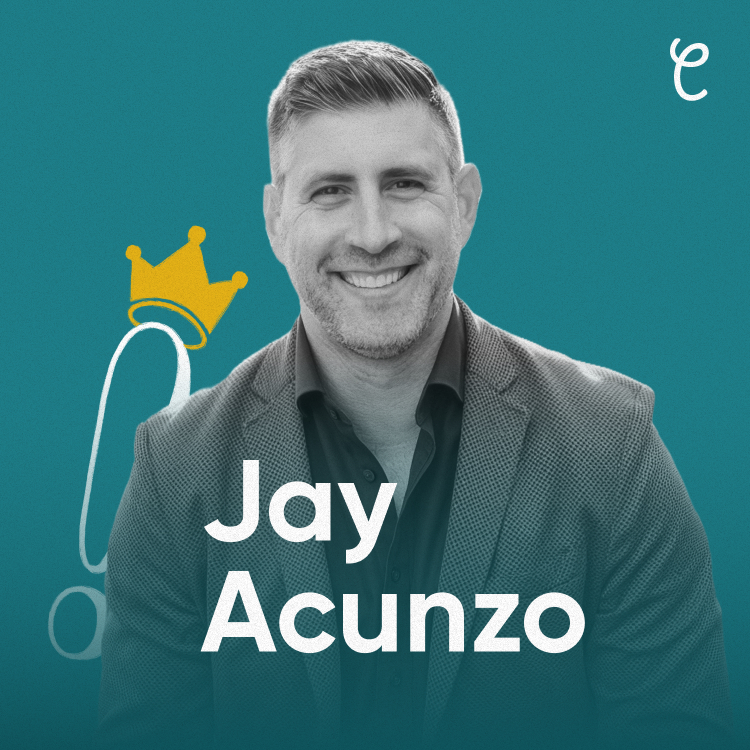
It took Jay Acunzo five years to build a successful business as a paid keynote speaker. At his peak, he did 25 gigs a year, opening the biggest event in his industry to 4,000 people. But when the pandemic hit, his business disappeared overnight. He pivoted, built a business model around advisory, and today earns more money than he did in his most lucrative years as a speaker. And he's done that in a way that few other advisors selling expertise ever attempt. He prioritises creative projects and blends them with commercial ones. He runs a one person business that pays musicians, videographers and illustrators instead of outsourcing to AI. He's gone all in on vinyl, where the market has moved on to mass streaming. This is a story of an advisory business built on craftsmanship.
Chapter 1 — Side Project
Liam Curley: Jay had always wanted to become a writer. He studied English literature at Trinity College in Hartford, Connecticut.
Jay Acunzo: I wanted to be a sports journalist. Eventually I realized that, but initially I just knew I liked to write and I had people around me before telling me I was good at it. So I liked the feeling of being told I was good at it and I also liked the feeling of writing. So English literature became the natural next step for me to kind of supplement everything else I was trying to do around my classes to find opportunities to write.
Liam Curley: On 24 March 2005, as a freshman, Jay published a first post on his blog, All Star Blog, covering a basketball match between the Celtics and the Knicks. He's a Knicks fan and watched a match at Madison Square Garden. Why do you write a blog post? What is happening where you think I'm gonna start a blog and I'm gonna write a post about this match.
Jay Acunzo: My kids are 7 and 4 and for the duration of their lives they pretend to be animals. They build a fort. They do this. Why? Because it looks like fun. I grew up reading emotional storytelling from sports journalists. So I think of picking up the print edition of the magazine Sports Illustrated and going to the back page and reading the column there from Rick Reilly or. Or I think of the rise of more colloquial bloggers like Bill Simmons back in the day when he was wasn't yet founding his own company, The Ringer, but was writing for Page 2, a subsection of ESPN.com and he had a very voicey style to his writing. And all of those writers that I sort of grew up with in and out of sports, it just looked like fun. And so I think as a creator, like most normal people look at something they love and admire from others and they go, that's great. I could never. A creator, an entrepreneur, a builder looks at that same thing and goes, that's great. And I'm going to make something like that. And so I think there's a little bit of a delusion, what author A.J. Jacobs calls a useful self delusion. Very good tool for an entrepreneur or creative. And there's also just this sense of play, the sense of fun, this intrinsic motor to make that. I was like, I want to be a sports journalist someday. And so I should just start. Why? Because I would like to write stories. I like to write and how I feel touching the keys and hearing my voice in my head and cackling to myself when something goes out and how others might receive it. It just looked like fun. So I did it.
Liam Curley: Jay continued with his blog through college and also started writing for the student newspaper. He interned at the Hartford Courant, the largest daily paper in Connecticut. Then in 2007, he interviewed for an internship at ESPN. While his English literature major at Trinity was critical for getting the interview, the people at ESPN were mostly interested in his All Star Blog. It got him the internship.
Jay Acunzo: So I had applied for and won a national sports journalism scholarship in 2000, I think 6 it was 2007 rolls around, I enter senior year of college, eventually graduating in 08, and I meet all these fancy people in the world of sports media. Accepting the scholarship out in California and when I'm home, I was able to parlay those relationships into internships, including in PR at ESPN. And I thought, okay, this, this is the mothership. This is the worldwide leader in sports was their tagline for many years. This is where you want to be. And it's in my home state and it's 30 minutes from the campus where I'm a student. This is perfect. The internship becomes the full time job. That's my career forever and ever. Amen. Because that was kind of the bill of goods you were sold, especially back then, of like, go work for the fanciest company you can work for. You're a success. And my manager at the internship was like, we want to bring you on full time when you graduate. Just make sure you keep in touch after your internship as you graduate.
Liam Curley: But when Jay graduates, he keeps in touch with his manager and he doesn't hear back.
Jay Acunzo: And I couldn't reach him, couldn't reach him, couldn't reach him. Finally he gets back to me and apologizes because in 2008 the economy was terrible, they were laying off, not hiring people. And he apologized profusely said, we're not bringing on anybody entry level for our time. And I went home completely lost and miserable. I had not prepared myself to surround that one opportunity with other leads. I didn't know what to do. All I knew was, where else? It's not like today. There wasn't really a. A wealth of digital media companies where you could maybe find a way to work for them or do the creator thing independently. It was, you work for print papers and there's a couple of larger media organizations in sports. So I had been what I thought was the cusp of me getting into the place to be. I'd been at the gates and I was turned away. And I didn't have other ideas for what to do. So I moved home for three months that summer. I was totally miserable. And I was just applying to PR firms, some print publications, but I didn't want to move to a town that nobody'd heard of and cover a sport that nobody cared about. I wanted to live in a big city. I was a young professional. I wanted to be, you know, in a, in a cool town. And I remember I just, I applied through an online forum for a digital media strategist job at Google on their AdWords team in Boston, which is essentially an account manager job, a sales position to grow the accounts of AdWords, search, banner ads, YouTube ads run by advertisers, and, and that. That became my first job out of college.
Liam Curley: Jay has written that the All Star Blog also helped him get the job at Google. One of his colleagues at Google told him the blog had stood out. It showed a willingness to try things out and put his own name and energy into a creative endeavour, which is what Google were looking for. But after three years working in sales for AdWords, now in 2011, a moment of realisation hits that this isn't the right job for someone who likes to make things. Despite the very fact that his nature of making things was what got him the job.
Jay Acunzo: I had this crystallizing moment at Google where I tried to show a YouTube video to some friends at home. And I recognized the pre roll ad as being like my colleague's client. And I hated the pre roll ad. And then I was like, wait a sec, my colleague convinced this advertiser to run this campaign. I'm now getting the fruits of his labor. Oh my gosh. I do the same thing that my colleague does. So, like, at great scale, millions of people are having slightly worse moments all the time because I sold adverti like, nope, that. Sorry, not for me. I want it to be the video, not the ad. I don't want to make people like stuff. I want to make stuff people like. And so I quit Google and ended up at this tiny little startup. I was person number 12 at this company, first in sales, and then they laid off all the sales team because they overstaffed as they raised venture. But I was the last one standing because they saw me writing for the company's blog when I had time and they were like, this is really good stuff. Would you want to be our director of content? And I was like, I don't know what content means. I knew what editorial meant for my days in journalism. I knew what creative was from my days in advertising. Like, what's content? I don't know. Content marketing was not a thing, but it was becoming a thing.
Liam Curley: The startup is called Dailybreak Media. Content starts as a one person department. Over time, they hire a small team of writers and designers, which Jay leads. He gets frustrated though by what he encounters in the market's low expectations for content quality, as he puts it. His journalist heart was breaking inside. He starts a new blog, writing about his perspectives on this emerging field of content marketing and how he feels it should be approached. And he also begins searching for others with a similar job title in the Boston area.
Jay Acunzo: And I found this wonderful human being that was, that is Arestia Rosenberg, who was director of content at an agency in town serving big brands in a slightly different way. My background was pretty print journalism. Her background was actually from Hollywood doing documentaries and trailers and things like that. I'm like, we have very different backgrounds, but the same title. Let's get a drink. And so drinks turned into a group getting drinks and that group turned into hosting a single event and that single event turned into this organization we built on the side completely for free and for fun, called Boston Content, which sought to help steward the careers of people in this emerging field of, of content marketing. And honestly, that's the story of my career above all else is side projects. Not side hustles, not side businesses, side projects to express, to hone my skill, to learn and to just create larger surface areas for serendipity.
Liam Curley: After a year of participating in and leading community meetups and panel discussions during 2012, Jay started getting invites around Boston to speak at other organisations, nonprofits, and in house marketing teams, all for free. At this stage, there's no thought that this could become something he'd make money from. But he discovered that he loved speaking and the act of doing it encouraged him to sharpen his thinking. He also began expanding his network, building a presence in the tech and VC communities. The following year, he gets the opportunity to work at, as Jay puts it, a second fancy company after Google. He gets hired as head of content at HubSpot.
Jay Acunzo: I'd taken a few big swings creatively at HubSpot, but I felt pretty handcuffed by the nature of that company monthly goals. Very focused on what I'd call direct response style marketing. Trying to basically justify every move with some kind of proof of a lead being created for the business. And couple that with the fact that I was a manager and not a very good one, especially back then. And this is a reason I'm a soloist now and don't want to manage teams ever again. But I had emerged feeling pretty jaded about the marketing industry and pretty hell bent on proving to people that creative excellence was also good for marketing. It was also good for your business if you were. If you were really genuinely good and differentiated, if you could be high value and highly original at the same time, that good things would happen. But you do need a little bit of faith because there's not like, an analytics chart that immediately shows, like, look how great this is.
Liam Curley: Jay left HubSpot after a couple of years as head of content, which we'll come back to later, to join a venture capital firm called NextView Ventures in 2014, where he spent the next three years as vice president of content and community. What he enjoyed, in contrast to his time at HubSpot, was that there was very little requirement for direct response marketing.
Jay Acunzo: So I was privileged to work for that firm where they said, okay, you've built up enough trust. And now I was kind of like cashing it in to pitch them on something creatively different. And what some organizations might have seen as risky, maybe the partners did too, I don't know. But for me, it was like, oh, this is a total slam dunk, because look at the gift other firms have given us. And this is not just in VC, this is every sector. But they've created such a wall of gray behind us that if we just know how to shine a specific color, our color, that's a gift. It's so much easier to stand out when you're surrounded by sameness. People are like, the sea of sameness. Oh, it's such a struggle to see if I'm like, bring it on. People are like, Jay, why do you post to LinkedIn so much? LinkedIn is so full of beige content. And I'm like, precisely because it's so much easier for me there than if everybody on LinkedIn was sharing wonderful and deep and nuanced and original thinking.
Liam Curley: That same year, when he started working for the VC firm, Jay had a friend at a Boston nonprofit who connected the nonprofit world with the tech sector.
Jay Acunzo: I was having drinks with this nonprofit director and he was talking about content strategy and picking my brain. And I said, hey, you know, I think at this moment in time, you should be hosting a podcast. And this was 20, probably 2014 or so. And he goes, oh, interesting. Tell me more about it. And I've been a huge fan of Radiolab and This American Life and the Bill Simmons podcast and, you know, just my favorite shows were not business related shows. And I always learned about running shows, especially from Radiolab, and wanted to try my hand at it for many years and had just hesitated or I was looking for an excuse. And so I shared my thinking on him running a podcast for this nonprofit and. And he goes, oh, that's interesting. And I was like, yeah, you should host one or you should have one, and here's the thing, I should host it for you. And he's like, oh, have you hosted podcasts before? And I was like, here's the thing again, no, but I'd love to host yours. And so I created, given their brand's message, their nonprofit's mission. It was called, it was a really clunky name. It was called Tech It Forward, like Pay It Forward. And I would have one big question or theme of an episode and I would talk to a nonprofit leader about it, and I would talk to a for profit tech founder about it, because it was about connecting both sides. And I kind of stitched it together with some narration, a little bit of music. And I had a couple of cracks at that. I think I hosted three or four episodes and people liked it in the community. But then my friend left the nonprofit and they killed the project. But by then I had a head of steam and I. So I went to my. The three partners of the firm NextView and I said, I pitched them on the idea of doing a show for the firm. And at that point, even back then, there were infinite numbers of. I mean, it was insane how many podcasts existed run by VC firms and why would the world need another one? Well, in generic senses, no, you don't need another generic interview show. But we had a distinct premise. It was called Traction. Creative and clever ways that startups start. And it was all about those initial inklings turning it into initial traction. That's it, that we just wanted to live there because that's where we invested. So the firm had a lens on the world. The show needed a lens on the world, needs a premise and something to explore and defend. And then I used some of those old tricks that I was learning from other narrative shows that I'd tried a couple of times with Tech It Forward to create a narrative immersive style show called Traction. And a few episodes in, I think it was like 12 or 13 episodes in Fortune wrote about us. We were in all these roundups of the best shows in VC or tech back then. It was a very different landscape where it was a little easier to stand out, but we were compared to shows that had hundreds of episodes from major, major brands throwing major resources on it at it. And here I am in a tiny little conference room with a mic I bought for whatever it was, 50 bucks, and just stitching together what I had learned by observing others. And all of a sudden it was like this massive runaway success.
Liam Curley: Was it Fortune who you said picked it up?
Jay Acunzo: Yeah.
Liam Curley: Do you know how, how they discovered it?
Jay Acunzo: My suspicion is like many publications, they had a beat writer focused on venture because a lot of the moves of venture capitalists are covered. And so at least one of the partners probably posted about it and they caught it. That was always an engine that we could rely on, was the three partners had some sense of an audience built up on social media. You know, we had a newsletter and I imagine either the writer was following them on social or was on our newsletter or both.
Liam Curley: The piece in Fortune led to, as you can imagine, a lot more press and Jay ended up producing around 50 episodes of the show. We'll come back to this experience of hosting and producing a successful narrative driven podcast for NextView Ventures. But before we do, let's go back to Boston Content. That community that Jay launched with Arestia Rosenberg in that capacity, leading that community, he reaches out to Andrew Davis.
Jay Acunzo: So Drew to me is the single smartest human being in the business of speaking and one of the best speakers, if not the best business speakers on the planet. He's not mainstream famous. He is not celebrity level. Even in his industry. There are others you'd point to that his industry being marketing. There's others you'd point to that have a stronger like air game. And I thought, oh, Drew is this awesome guy in Boston I've yet to meet. He's in the marketing world. What if I could get a beer with him and convince him to be a guest speaker to my group? And in our meeting we just hit it off, just talking shop about marketing, about Boston, about tech, about storytelling and speaking. And he, his pitch to me at the end of that wasn't, I'd love to come and speak to your group. It ended up being he was building a management company for aspiring business speakers and authors and he needed a guinea pig. And before he could finish his sentence, I was like, me, I'll do it, I'll do it. Like, VC is very drawn out. I had a lot of extra time compared to my days in software, and I was like, I am in. I am all the way in.
Liam Curley: What did it involve being the guinea pig?
Jay Acunzo: Drew had systems and processes that had worked for him. And what, what breaks people's brains about keynote speaking, paid keynote speaking is it works on an inverted commercial model to everything else that you've sold that has brought you this success, where you start thinking, I should monetize my spe speaking. Everything else you sell. First comes marketing, then selling. Then there's a moment of conversion. And after the contract is signed, you deliver the full service. Speaking is the opposite, or at least it starts at the end of that chain where you put your signature talk in front of the right people. And yes, it's the product, your speech, but it's also the best sales tool. It's also the revenue engine, because the people sitting in the room are actually your best leads. They're what Drew calls stage side leads. And they rush up to you with the most opportunities at the highest dollars, the most intros to the best. That is the lifeblood. That is how you make keynote speaking sustainable and growable. If you're not celebrity level famous, because otherwise you have no pipeline, you're just restarting a pipeline with each gig. We use today's gig to win tomorrows and multiple tomorrows. And so Drew had systems and processes that he'd been using since selling his marketing agency to run that playbook to understand like, this is where it happens, which I love because it rewards craft, right? It rewards my idea has an impact in the room and in the market. My premise and IP are well developed and I'm pressing that into the talk, into a well structured argument, which is what a speech is, an argument for one idea or change. And I can perform it all really, really well. And I surround that with a good process before, during and after the gig and a little bit of marketing prowess online, but not so much that it's a distraction or I'm pursuing fame for random reasons, like I have the right systems around me. And Drew had wanted to see do this. Does this scale to other people. And so he walked me through this phased approach of developing the talk and the material, of getting myself to gigs and booking further follow on opportunities and, you know, revising his systems based on what we were learning together. And so I got this amazing gift which was working with one of the world's best, most accomplished speakers, showing me how to do it in a way that aligns with my values, where I could actually be craft driven, service minded, help the event organizers get where they were trying to go, help the attendees get where they were trying to go. And it was good for business at the same time.
Liam Curley: So from all these free talks he'd given at community meetups and panel discussions and in house teams, Jay would take that momentum and those skills he developed and build a business around them. When you first meet Drew, had you already done your first paid speaking gig?
Jay Acunzo: That is a really good question. I know what my first gig was and how it happened. I don't know if it was while I was working with Drew or not. I suspect not. So I was running Boston Content, and there was someone who approached me and said, my organization has a closing keynote spot open for our conference in New York. And they apologized to me. They were like, we only have $2,500 to pay for the closing keynote spot. Like, are you available? Would you do it for that fee? They were like, so apologetic. And outwardly, I said to them, thank you so much. Like, I'm honored. I'd love to connect. You have a card? Do you have, you know, can I connect with you over email? Like, I want to check my dates and, you know, make sure everything lines up and maybe we can have a call to, to talk about it. That was like very, like, front facing. Like, I am a professional at this. Even though this was my first time getting paid to speak, in my head, I was like, da, da, da, da. Getting paid to speak. Didn't know that was a thing before. So I got paid to speak there and then that showed me the power right away of stage side leads. Because right away people came up to me and they were like, that was amazing. Do you do this a lot? Like, can you speak to my group? It was like, oh my gosh. Like, this could become a thing. And I can't remember if that was while working with Drew or not.
Liam Curley: I'm presuming that when you have the meeting with him, you're thinking, I would like to do speak. I would like to get paid for speaking.
Jay Acunzo: No, that's the thing, actually. I'm glad you said that. When Drew approached me, it was much more of this holistic management company he wanted to build. I was much more interested in the podcast thing because I had been running a narrative style show for the venture firm where I was working as a VP and it was getting a lot of press and, and it was listed up alongside like a16z and all these massive organizations that had hundreds of episodes. It was getting written about in the same breath as those shows after like 12 to 15 episodes because I produced and hosted it as a narrative style show which was, which was new and different and refreshing and it had a distinct premise to it as well. And so I thought, okay, this is my ticket to give speeches and write books and do other things, get sponsors for revenue, but to be a show host and storyteller professionally.
Liam Curley: Everything Jay has achieved in his career up to this point, really, you can put down to his instinct for launching side projects. First, the All Star Blog played a major role in helping him secure opportunities at ESPN and Google. Then when he was working in a sales role at Dailybreak Media and they started laying off the sales team, they kept Jay on and moved him into the director of content position because he'd been writing for the company blog in his spare time. What you might call a side project. Boston Content was a side project that gave Jay the opportunity to speak and grow his network and ultimately meet Andrew Davis and then the podcast he created for the nonprofit. All three episodes helped him get buy in to make Traction, which would lead to another side project that we'll come to shortly. And whether we call them side projects or not, that's a pattern I see with experts who become authorities. A project outside of their day job creates opportunities that propel them to authority. Carl Richards' newsletter was essentially a side project outside his client engagements until the New York Times picked it up and asked him if he'd like a weekly column. Marty Neumeier launched a magazine, Critique, which was unrelated to his agency work designing software packaging. The making of Critique led him to develop his unique insights on branding, speak on stages, and earn a book deal for The Brand Gap. And as with Jay's case, it's not just a question of launching side projects, it's persisting with them, honing the craft when making the thing is no longer a novelty and nobody seems to be paying attention until suddenly they do.
Chapter 2 — Best Practices
Liam Curley: Jay had experience in telling stories, but he hadn't built a business around doing that. Andrew Davis had.
Jay Acunzo: Several of the first interactions I had with Drew was basically ranting about the space I was in back then, narrowly marketing, or even content marketing, more narrowly. Just trying to get frustration out onto the page. What conventional wisdom do you see everywhere that drives you up a wall? What are you constantly being told yourself that you bat away and can't stand? But then sometimes you're like, should I pursue that? No, there's something going off in my chest that makes me hate that advice or whatever, like, what problems make you angry? And he would chip away and chip away and chip away until finally I'd be like, okay, Drew, you really want to know what I think about this space? And I would just rant and he'd go, good, great. Okay, now let's do something with that material. Like, he. He was good at extracting from me in the way I'm now doing for clients, good raw thinking and mostly frustration. And a lot of people do that to some degree. That's what, like, a lot of social media posts turn into is like people lighting a match, and then that's their frustration, and they go to social media and just hold the match until it burns their fingers. But then what Drew showed me is you need to switch from just ranting and raving or even just being an expert in things that predate that rant or rave. Switch from trying to be an expert to trying to be an explorer. Be an investigator, he told me. And ask questions. This is his line now. Ask questions Google can't answer. Ask questions that deserve a quest. That you have to go and figure this out. And then as you figure it out, you're going to codify that. You're going to turn frustration into curiosity. And that curiosity is like kindling. You use the match to light the kindling. You light the kindling. That's your curiosity. And then all of a sudden, you have this raging fire of creativity that emerges as you go and investigate something and explore it and then eventually codify that into a distinct signature idea. What I call a premise surrounding IP frameworks and stories and signature bits, et cetera, maybe branded terminology you come up with, and then your signature talk. That's the engine. It all comes from those things. And. And then we layer on top of that, what marketing and selling mechanisms do you need? But people start there. They start with that latter category, and they don't really have anything that's not just yet another generic speech. They. They're commodified experts trying to push harder on a commodity or push their commodity at someone else, and it just falls apart. And so that one switch was instrumental in everything for me, which is you need to go be an investigator. Everything emerges when you start asking better questions and pursuing that in public versus trying to show up and saying, I have all the answers and I'm here to gift that from the mountain peak.
Liam Curley: What Jay is referring to here is looking for a personal frustration or a premise. In my language, I call that focusing question. It's a tool I use to help clients hone in on the one question that will frame their entire body of work. Everything they publish moves them a step closer to answering that question, and it's a question their target market would love to know the answer to, so they follow along. Many authorities I study have a focusing question that frames their work even if they don't specify it as such. And often if they're around long enough, they spend a few years answering one question, then move on to another. Brené Brown launched her authority position with the focusing question why is vulnerability the first thing I look for in you and the last thing I want you to see in me? Carl Richards had why is there a gap between what we know we should do with money and what we actually do? Marty Neumeier had how do we package software products so they sell better? With Jay and his question on best practices to pursue as an investigator, the plan with Drew was to create a new narrative style podcast to follow that path, a podcast called Unthinkable. It'd be similar in style to Traction, the one he was currently making for NextView Ventures, where he's still VP of content and community.
Jay Acunzo: Unthinkable was a product of working with Drew during his management company when they were starting. The model was we're going to make speaking your first revenue engine. We're also going to think about brand deals and we need a signature pillar content brand. And so for me, after ranting and raving and doing some investigating through my writing and figuring out an emerging possible premise for myself, what was clear was the marketing industry at the time was really suffering from the proliferation of supposed best practices and I hated how that showed up in content marketing. But it happened way beyond just creating. Content marketers were now on the receiving end of too much advice from too many self proclaimed experts for how to do their jobs. And I also felt indebted to attack. I felt like I needed to attack that problem in part because I was the head of content at HubSpot and had always clashed with their philosophy of just giving away advice like it was gospel based on very little data and lots of high volume content with, you know, the goal being put a name in the database like there was a lot of problems with this celebrated playbook that HubSpot ran at the time. Oh, lo and behold, their cold calling team was actually the revenue engine when I was there, not their inbound marketing team that was so celebrated. So I struggled and failed to shift their philosophy to something deeper, stickier, better, I thought, better for business and the audience. And so I had this blog called Sorry for Marketing, yet another side project of mine. I was sorry for the way marketing interpreted how to write, how to create content. I was sorry for my own role in marketing. And so as I was writing my way to clarity, trying to figure out what am I about, this idea of questioning best practices and thinking for yourself and actually trusting your intuition started to emerge. And in a world of advice overload, you know, finding best practices isn't the goal, finding the best approach for you is. And there's all these variables about your own context that a generic bit of advice has not considered. And I saw those things being thrown out in favor of something generic and worse. And so we had that messy description of my premise and so Unthinkable became the podcast, the first content brand that I built alongside my speaking business, where my goal was to tell stories of people who question best practices, hone their intuition, and did their best work as a result.
Liam Curley: So Jay starts working with Drew, gets his first speaking gig around that time, starts getting more, then launches a new podcast. Pretty soon he tells the VC firm he's working for it, he's leaving to start his own thing. They offer him a day off each week if he stays.
Jay Acunzo: So I had Fridays to myself to build my own business and I was earning real revenue. Not enough revenue to support my life, but enough revenue that there was monetary signal, not just audience signal, that I could make it the speaking world.
Liam Curley: I'm presuming, and correct me if I'm wrong, that your revenue for you is purely coming from speaking at this stage.
Jay Acunzo: Year one, full time independent, 100% of my revenue was public speaking fees. It was not enough to replace my in house salary, far from it. I think it was about a third, maybe a quarter of what I was earning before. But I said to myself, you know, I'm going to give it a good try. I didn't have kids at the time. We were renting, my wife and I. And so I was like, I'm going to give it my all to see if I can make this viable. And so I again, another source of privilege here, a story that's not well told enough in the entrepreneurial space, is I was able to stomach a year of earning far less than I thought, you know, my ego wanted and my life needed and so I could stomach that year.
Liam Curley: Around the end of that first year, 2015, two inflection points marked the path to meaningful revenue and a business. Jay could go all in on becoming fully independent in 2016. One on the podcast front, one on the speaking front.
Jay Acunzo: So I was running Unthinkable. And I was, I was interviewing the CEO of a startup and my process was, I thought, pretty decent, well honed. The end product was certainly above and beyond what that CEO had ever experienced as the CEO of a scaling startup. He was the former chief product officer at HubSpot who had started a company called Drift. His name is David Cancel. And so he very visible guy at the time especially. And he'd been on a lot of podcasts, none like Unthinkable. And both the process I ran and the episode itself impressed him and he asked if I would make a show like that for his company. And I thought, interesting. Like never thought of making that a service. And so I ended up doing a 20 part docu series style, like multiple voices, narration, voiceover or music. 20 part docu style series for Drift. That was my first sort of paid standalone series I built. I turned that into a real income stream in year two of being independent, where I would make shows and host shows for brands. I wasn't smart about it. I didn't know where leads came from. I didn't have enough production support, I was doing all the parts. I was probably losing money in some spaces, but I was able to bank clients that looked and were impressive, that did pay me in enough money to like now buttress my income in addition to speaking. And it was very like an attractive almost vanity service because I could say I was doing this, I could share real examples, I could line up the logos and that would open doors for me. So I wouldn't say it was the most strategic, proactive business unit in the world, but it was happening. It was a little too reactive and too all consuming. But that's where the show stuff originated, was I had one in house. I moved out independent with my own show and that show started getting inquiries from brands to pay me to create shows like that for them.
Liam Curley: Along with pitching himself as a speaker, Jay started pitching himself as a showrunner. When you produce or work with him to produce the podcast, are you on air? What exactly are you doing?
Jay Acunzo: So my role for those shows was coming up with the premise and you can see now why that's helped me so well because working with clients as speakers and authors and experts, developing their signature premise, such a huge value driver. It's a huge reason people hire me. And so I learned about how to develop a premise for a show, how to develop the format and the show bible, put together that treatment. So it's the North Star document that can help the show run. So I would do that show development inclusive of the premise. I would often plan out the episodes and host them myself. And this is where it wasn't really a strategic business. I would also do all the other things. I would often edit the episodes, I would often create promotional assets, none of which were monetized as well as they could have been, none of which had any support staff around me. Eventually I think I work with a couple of producers, maybe on a part time basis for some of those projects. But for the most part I was being very strategic in how to run a sustainable speaking business. And this over here with showrunning felt like vanity revenue and opportunistic, but arguably just as important for both my livelihood and like the front facing platform that I was building.
Liam Curley: Why was it important? Just as important for the front facing platform?
Jay Acunzo: Skill wise, it helped me continue to tell stories, collect material, show up on the mic, be front facing, invisible. And then I think marketing wise, sales wise, being associated with those brands, especially as they had a lot of heat around them because no company that's not doing exceptionally well would be hiring someone like me to create a 20 part docu series. Right? So these were companies that were on the rise, doing well, had a lot of heat in the market, had a lot of notoriety. A lot of people both at the company and elsewhere in the industry saw what I was doing. And either the folks who left the company to start their own would hire me or the folks elsewhere would hire me. And having those two options of like, I can come in and give a training, give a workshop, give a keynote at an event of yours and. Or we could develop a show together. Somehow made sense back in that moment for a lot of different clients. So. But it all really started by saying here are these well known, very creative leaning brands that your space admires that I am now responsible for a very visible project in their portfolio of content. That was a really important piece of my business. It just, I never really focused on it enough to turn it into something repeatable and. And I'm actually glad I did because a lot of the budgets dried up as podcasts sort of the wave crashed a little bit. The heat was lost a little bit from that space. And I could also then refocus that time on the speaking business.
Liam Curley: If you recall, I said Jay's business had two inflection points. The first was interviewing David Cancel of Drift. The second was on the speaking side of the business, an opportunity to speak at Content Marketing World, the biggest event in the industry. It was run by the Content Marketing Institute, a group founded by Joe Pulizzi, the person who by all accounts coined the term content marketing.
Jay Acunzo: And when I was at HubSpot, I was speaking at a conference, filling in for a teammate who couldn't make it. And after I gave my talk, I saw this, like, flash of bright orange in the periphery of, you know, of the event venue. And it was Joe Pulizzi. He always wore an orange suit, full on orange suit. And he had headed to the back of the venue and was like checking email on his phone. And I thought, well, we shared a stage, me and this, like, marketing influencer, this giant name in the space. He doesn't know me from anyone, right? But I'm going to go up to him because he saw me speak. You know, that's, that's a justification enough. And we hit it off and he invited me to write some guest blogs for their site to contribute however I could. They had Twitter chats, I'd be a guest on that Twitter chat. And then eventually what rolled around was the opportunity to pitch them to speak. And they would always do something really clever where if you were new, like I was at the time, they'd put you in a really small room because you were new there. They didn't know if you were going to deliver or not. And based on your audience ratings, they would give you a progressively bigger stage each year. And then the number one rated speaker at the whole event would be the opening keynote speaker the next year to all 4,000 people. And so in 2016, I was on the biggest possible breakout track after speaking there several years. First, when I was working in house, I would speak there because I was a practitioner of content marketing. And then a year or two as an independent, or I guess a year as an independent. And so I was on the biggest stage, but still a track, the Big Idea track. All these other professional keynote speakers would speak there. And along comes me in the sidecar like, I'm here too, guys. And based on that 2016 talk in the Big Idea breakout track, I became the number one rated speaker of 150 speakers that year. And so I got to open the whole event the next year to 4,000 people. And that was a massive inflection point, as you can imagine, for my paid speaking business. And what's funny here is this validates my premise of resonance over reach, because you might be thinking, okay, Jay, but 4,000 people, you reached a lot of folks, both in the room and beyond. And while that's true, I think resonance does lead to reach, or resonance means you don't need to think about reach as much. It's not a focal point. I'm not saying reach is bad. Put resonance over reach. Because the only reason I was on that stage, yes, I was the number one rated speaker, and that was a sign that I resonated with the audience. But what I've never said publicly, so maybe consider this a scoop, is that I was actually tied for the number one rating. And the reason I got the opening slot was that although my numbers were the same as the other speaker, the comments they said were so passionate about my speech in 2016, where people were, like, demanding that I open the event the next year, talking about how they felt this way or that way, or they cried or they, you know, can't wait to apply these ideas back in their business or whatever, that it was actually the qualitative comment section that got me that role. So it was a metric about resonance. But even more so, it was the sentiment of resonance that got me that. That position, in addition to tons of hard work and. And a very, very, I think, delusional attitude that I can do something like that.
Liam Curley: You said it was a massive inflection point.
Jay Acunzo: Yeah.
Liam Curley: What did it do for you?
Jay Acunzo: In the world of speaking, famous events are not better events. Like, if you want a flywheel of paid speaking, it makes sense to show up for free, strategically. Like, that event won't pay me, but in the room are leads to invite me to speak. But typically, a lot of the mainstream, biggest events in an industry or overall, the room is a little hit or miss. You're not sure who's sitting there. And the event is so chaotic and sprawling that it's hard to coalesce a group, a community. It's hard to bump into people who saw you speak. It's hard for that speech to have a rolling effect to other rooms where a speaker who saw you then gives a talk and is like, oh, it's like Jay said, it's just harder to have an impact. And I have questions about the caliber of the attendee. In other words, they can't hire me as a speaker. So if you're looking to generate pipeline as a paid speaker, you should be speaking for free at what I would call a pipeline gig, which means you waive your fee and you show up to the right attendees. The caliber, the quality. Can they hire me to speak matters more than the fame of the event or the size of that crowd. And so Content Marketing World for me represented the largest and highest quality at the same time. And the key, the linchpin, is you put your signature talk in front of possible leads and then you get hired to speak because those are called stage side leads. So Content Marketing World had such an impact on me, not only because I learned from other speakers and oh my gosh, that's such a value in and of itself, but because it combined like the right combination of industry presences and organizations and leaders, folks who have events or team retreats or kickoff meetings or what have you, or where they need speakers elsewhere.
Liam Curley: A side note here, one thing I hear from many experts who specialise in a horizontal like internal communications and not a vertical like SaaS is a frustration that they can't get in front of the C-suite who make the buying decisions. Their insights land with the more junior people in the thick of doing the work. But the people in the C-suite aren't picking up what they put down. Jay's method here is the antidote to that. Identifying events that attract a broader range of people from different markets. Then develop a keynote around your expertise that resonates with people who want stories and strategy, not tactics, because sitting in those audiences are the people who programme the niche industry events the C-suite attends. And that's where the stage side leads Jay talks about come from. For example, Jay opened Content Marketing World in 2017. The next year, he was on stage at an automotive industry summit. Automotive leaders probably aren't at Content Marketing World, but they are at the industry summit. Jay would eventually go all in on the speaker side of the business rather than the showrunner side.
Jay Acunzo: Corporate clients can be, in some cases, he says, carefully couching his words, really difficult to work with. Being a speaker felt at once more creatively energizing and also less logistically complex. So it made sense from a business standpoint because it was always earning me more money than showrunning, even from the start. But then it became a sense of like, well, this is more joyful. There's less back and forth and negotiation. I am carrying the banner of the event I'm speaking at. Absolutely. I'm here to serve the event client and the attendees, but I am ultimately on stage to represent my ideas that I bring to you. Today, not necessarily the message of a third party organization. And I'm the representative of that group. Now you fast forward to today, and I look back and I can, I can very much make this a strategic story. But the fact remains, I just liked speaking better and I felt like there were fewer people around me telling me what to do. And as a, as an entrepreneur, I define my success by how I control my time. I very much value control over certainty, which I think are two inversely proportional things. The more control you have, the less certainty you tend to have, and vice versa. In a career and working with great big corporations, the budgets are very certain. The fact that you're going to get paid, very certain. I would have to sacrifice too much of my control for some of those projects. And so that helped me run very, very quickly towards the speaking side of it all.
Liam Curley: So as Jay's building his business, he's still producing his own podcast, Unthinkable, which, as he mentioned earlier, helps him hone his craft. Telling stories and for building his network, it's also a creative outlet. But he's not just producing a podcast, he's writing a newsletter as well. And the two inform one another. When something resonates in a newsletter, he expands on the idea and turns it into a podcast episode. And he pulls fragments of an idea from a podcast episode and turns them into newsletter pieces. And this loops back to his approach as an investigator. Here he is speaking with Ryan Hawk on The Learning Leader Show.
Jay Acunzo: Making stuff for me has always been about finding the answers, not sharing the answers. And yes, sometimes if you read something from me, it's like, this guy has this one question answered. Thank you. But I assure you it's because what you didn't see was 5, 6, 7, 8, 9 different times, however many thousands of times. If you want to go that far. Back in my career, like I was trying to figure this out right, or I was writing.
Liam Curley: Everything up to now has been a process of expansion, of landing on a premise or in my language, a focusing question. So the product, newsletter, and the speaking are all forms of expanding on the question and as an investigator trying to figure out the answer in public. But then as he proceeds down the journey and gets tens of thousands, if not hundreds of thousands of words under his belt, the task becomes one of reduction and refinement, capturing the essence of his answer to the focusing question and packaging it in a discrete artefact. His book Break the Wheel, which he published in October 2018. His process for making a book, as described by other authorities of research, is one of curation, poring through the concepts he'd already articulated, figuring out how the fundamental ideas hang together, fleshing out any areas that need to be fleshed out, and verifying anything he'd written for the newsletter on a gut instinct. He also interviewed podcast listeners. Here he is speaking about the process with Ryan Hawk on The Learning Leader Show.
Jay Acunzo: I wrote articles on my personal blog. I wrote a newsletter once a week, every Friday. I published my podcast episodes first weekly, then I went to seasons because I needed time to like sleep, eat and not publish content all the time. But my podcast Unthinkable. And then public speaking. So you have four pillars of content, blogging, newsletter, podcasts, and public speaking. And public speaking was kind of the best of the first three rolled into a speech. And I spent two years aerating all these stories and all these insights and basically trying to pressure test them so that the book was kind of the culmination of this journey to understand everything that I was trying to explore.
Liam Curley: Jay calls himself a good selling author rather than a best selling one. The book boosted the speaking side of the business and the act of making the book informed refinements to his keynote. The two connected to one another. He watched the talk, he read the book, and business continues to grow. At his peak, Jay is doing around 25 keynotes per year, working at some of the biggest events in his industry, collaborating with major brands, and then overnight it all disappeared.
Chapter 3 — Built in Five Years, Lost in Five Days
Liam Curley: Jay had successfully designed and built a paid keynote speaker business.
Jay Acunzo: After doing that for about five or six years and building a sustainable growing speaker business, along comes the pandemic. And when your business is predicated on travel and big groups, there are few business models worse set up to endure a pandemic. Maybe if you're in somehow like the face licking business, it's a little bit harder, but for me it was. Everything evaporated in an instant. And unlike a lot of my peers who were scrambling to catch whatever virtual fees they could as speakers and then rebuild their in person gigs once the world opened up again, I knew at the time, arriving to that moment, I was already starting to think about scaling down the road. Heavy travel or the road heavy speaking. Because my wife and I were thinking of growing our family, I was thinking I'll wean off the road, build up a services arm and then those two revenue streams will cross as keynotes come down and public and paid services or paid products or something, I didn't know, rose. And so I was like it's to me. I was in this mode of like, trying to wean off the road. And the world was like, there will be no weaning to be had. It will crash around you in an instant. So I built it over five years. I lost it all in five days. And I kind of lurched around trying to sell different things. I tried to start a niche media company helping people who are in marketing build better podcasts and video series. I sold courses. I cobbled together some random advisory deals and sponsorship deals with brands from my background in content marketing and running editorial teams, it was a lot of. A lot. It was a mess. And I tried to activate my network several times in that period to go back in house and stop being an entrepreneur. And about two and a half, three years ago, at this point, I had a couple clarifying moments which showed me what I should be doing, who I should be selling to, what I should be selling them around this idea of being a stronger speaker, being an expert who needs greater resonance in the world.
Liam Curley: What were the. If you don't mind sharing, what were the clarifying moments?
Jay Acunzo: I can kind of crystallize them retroactively. Looking back into, like, two questions, I'll share how I came up with these, but the first question is, if I was in a room full of 100 professionals that I wanted to serve, what would I be the best at doing? And for many years, I didn't think I could sell services around public speaking because my peer set and mentors were building these large speaking businesses and selling keynotes and giving keynotes to crowds that I wanted to be in front of and stages. I want to be on selling other things, like books, appearing on all these fancy podcasts, like being in that business of thought leadership and paid speaking. You meet some people who you don't really love meeting behind the scenes, despite them having a big public platform. But then I was surrounded by so many good people and I was like, I am learning from you. You are either a better speaker than me or have a better business than me, or both. And so this prospect of selling speaking services of any kind, I kind of kept it at arm's length. I think I can admit now, I kept it at arm's length because I thought to myself, well, I'm not the best speaker in the world, so how could I sell a service to somebody? So the question again is, if you're in a room full of 100, what would you be the best at doing? And that helped me realize, well, I'm not the best speaker in the world, but I am almost always the best speaker in the room. And I am also well trained and have good mentors and have looked hard at this and have created a lot of IP around developing your premise and giving speeches and telling stories. Like, I have a lot of stuff like things that feel like expertise but codified into IP and I can bring with me both halves of that to be the best teacher and coach and strategist in the room on these ideas. So that first question was really useful and it helped me get over myself in some sense.
Liam Curley: This idea of what are you the best at in a room of 100 people speaks to something I noticed with Michael Zipursky in a previous episode. An idea of relative expertise. Michael went to Japan as a college student and started working on branding and communications for major Japanese ad agencies that were targeting English speaking markets. He got the work not because he was a major expert in branding and comms, but because in the Japanese market he was working in, he, he was the expert relative to the people in the room and he had knowledge to offer that they valued. It's exactly the same here with Jay, though Jay was further along in his journey of expertise than Michael was at the time.
Jay Acunzo: And then the second question is, what are the most impressive people in your network most impressed by coming from you? Because that's a good market and that also sells, sells services and that's how you build a referral network or even just catch your first few booked clients. And so I remember I was giving a speech in Boston and this was well after the pandemic and I was still kind of finding myself and rebuilding and I gave a speech at a friend's event in town because I live here, so that's easy. I'm not leaving my kids for multiple nights in a row. And a friend who is a CMO who's also like very front facing, he's built a personal brand even though he's building other corporations' brands at the same time. He's always out on the road giving talks, appearing on podcasts, et cetera. So he's no stranger to the stage. He comes running up to me and he's like, holy shit, I haven't seen you speak in years. Jay, can you give my talk later today? And it was like, right, here's this person who is to me very impressive in lots of ways. And the thing he's most impressed by is all things speaking, relating to my work. So why in the world am I not offering that? Crystallizing it, selling it, building around it, teaching it for free and for a fee. What am I doing like, it was just so hard to see the label because I was stuck in the jar.
Liam Curley: Coming out of the pandemic, Jay mentioned that he had tried a few different things around paid services and paid products. A podcast called 3 Clips which he'd later sell, and a membership based programme called Creator Kitchen that he co created with a fellow speaker in space, Melanie Deziel.
Jay Acunzo: It was for people who have a lot of competence and again, what they seek is resonance. And we always talked about like what is the super suit that we could stitch around these people so that they are better communicators and more trusted voices in their spaces. Like what do they need? Well, they need a premise, they need speaking skills, they need storytelling skills, X, Y or Z. And so it was an attempt at a membership group. I think the people who were in it really liked it. But what we found was there were too many things to get done all at once. In designing it, delivering it, customer support, servicing it, growing it, marketing, selling all at once, that caused me to feel more drained than energized. So it helped me get out of the hole. The pandemic and about a year and a half in two years in, Melanie and I decided to kind of let our main things be the main thing as she has pursued more paid speaking again. I had clients one on one and I was like, I need to build a full on advisory business for the one on one stuff because that's what's working and it's what's filling my cup.
Liam Curley: So that's what Jay did. Built a business advising entrepreneurs, experts and executives on how to develop their own speaking businesses or how to grow their existing business through speaking, developing their own premise, telling stories and turning all of that into signature talks.
Jay Acunzo: And so that's been running now for about three years and I've, my advisory business today is now larger than my speaking business was before, which is sort of hard for me to believe because I didn't think I'd be here. And for many, many years I thought this is it, my entrepreneurial journey has run its course. I have to go be an executive or a practitioner back in house and clock in, clock out and wish, I wish I wasn't doing that. So I'm thankful to be talking to you on this side of the journey because it was a, it was, it was, it was a terrible time. To be frank.
Liam Curley: Approximately 60% of revenue comes from one on one engagements, 25% from group mastermind style programmes, and the remainder comes from brand deals and paid keynotes. Most of the opportunities come because of the relationship Jay has nurtured with his audience as an authority, not an influencer.
Jay Acunzo: There's this weird gospel of like, there's a whole generation of marketers and entrepreneurs and creators who think the only way to build an audience, the only way to increase your influence is social media followers. And it's like, that's not the same thing. In fact, it's becoming increasingly separate. Like there. It's never been further apart. These two ideas have never drifted further apart than this moment. Followers and influence or impact. I know a lot of people who have hundreds of thousands of followers on LinkedIn and they speak to, you know, B2B themes and not a single executive thinks highly of them. There's not much influence there. You know, you have if you have a hundred thousand interns, you need to sell something that interns can buy. You can't then sell, turn around and sell strategic services for, you know, 50k. And so for me, a lot of people get into this danger zone where they sell high ticket services, they sell premium services meant for premium people, but then they act like creators. And I think having a big audience is a nice way for one way and a nice way, maybe a really loud way for a premium client to vet you and decide they'll go with you. Possibly not the final decision, but it contributes. Having a big audience but building a big audience on the way up. Given the way these platforms work, you have to do things and say things and become things that actually actively turns away very discerning clientele.
Liam Curley: Right.
Jay Acunzo: And it's also a bad use of your time. You know, if I work with people who have legitimate businesses and they're looking for that next wave of growth and fulfillment to embody and own their ideas in the market, they're like an interchangeable trusted voice and expert and they're trying to like really shape how their field thinks and be on the main stage and all that stuff. A better use of my time than blasting out more content on social media and growing my following is showing up among densities of my audience, contributing to trade associations, showing up on podcasts, giving webinars, among mastermind groups or community groups, keynoting conferences. There's myriad ways for me to build an audience, increase my impact and grow pipeline that feels more efficient and effective and than casting this wide net online and hoping that people come my way.
Liam Curley: I've called this borrowing audiences in previous episodes. And it's what most authorities do to get their ideas in front of their market. Social media isn't designed to amplify nuanced, interesting ideas on niche topics relevant to the people you need to reach to sell a five or six figure engagement. David C. Baker, Blair Enns, Nancy Duarte, Dorie Clark. Listen to pretty much every episode today on this podcast and you'll find an authority who borrowed audiences from organisations and authorities who already had the trust and attention of that audience. And you borrow audiences from these types of places by focusing on making something they consider worth sharing with their audience, which goes back to everything I've already mentioned on focusing questions, investigations and storytelling.
Jay Acunzo: And so there's a lot of people who are not seeing clearly the fact that they're acting like they have a creator business model where they sell low ticket things or sponsorship. They're acting like that, but then they're trying to sell something that's more relationship style than traffic style. And so as, as my friend and business sensei Michelle Warner likes to say, you need alignment. You need if you sell something traffic based, you need traffic marketing throughput. You need lots of leads that makes sense for you. I don't need a thousand leads or even a hundred to have an exceptional year. A year beyond any target I would reasonably set for myself. So therefore I don't need a hundred thousand followers. My ego might scream for it. People selling courses and ideas on how to grow an audience might tell me I need it. But actually, not only is it more fulfilling for me, I also feel safer that if my LinkedIn went away today, I'd still know how to build an audience and drive business results. And and a lot of people don't. A lot of people conflate marketing and influence and all these things that are sturdy and sustainable ideas with something very flimsy and fleeting, which is building on rented land, building an audience on a channel. And that again is one vote in your favor if you have a big audience. But just be careful because the things you need to do to fly on those channels are often built for low level, entry level type people. Sensationalism 101 level tips the way I sum this up is social networks want you to host or run 101 level classes, but you might need to run executive forums. And that's not going to fly on social media. So be careful where you show up because the places that reward our ego aren't really the places that reward our business.
Liam Curley: Yeah, I kind of say. I'm not sure if this is a perfect language, but I say there are in our space there are two types of business. There are businesses that sell little value to many which I would class as an influencer style business and there are businesses that sell high value to few, which I would say is an authority business. Both are viable business options. Where people go wrong typically is they have an authority business and they act like an influencer business of little value to many, right?
Jay Acunzo: Because they see the folks who have a big audience already reaping rewards and having an easier time of it. Because A, they figured out all the authority stuff and now they get the luxury of acting like an influencer or a creator or B, they have the big audience, which is a vote in towards their authority and hiring them for some kind of consulting engagement. But they already have the audience. They're not doing all the gimmicks that the platforms currently reward in this time, in this moment, right? They're, they, they've been able to do something, or frankly they've done something away from social that got them followers on social, which is, I think, how it should always have worked, right? It's like you should have a following because of something you did. Building a following in and of itself. I'm sorry I didn't get out of bed in the morning to be my niche's version of a Kardashian.
Liam Curley: Throughout his journey, Jay has obsessed over his craft, developing the skills to tell stories in writing, on stage and in audio. Check out any of his work and you'll see he's masterful at each. But before we wrap up, there's something really important to acknowledge about any individual who got to their position of authority through publishing insights.
Jay Acunzo: A credit is owed to a person. It's a version of myself that I need to think about more and more as I move further from that moment in time. It's a guy who would wake up super early before he had kids, go to a coffee shop a block behind his tiny apartment, open his laptop, get a way too expensive cup of coffee, sit on a way too uncomfortable bench in the coffee shop and just write for fun. Because it felt like this is interesting. I'm learning about myself, I'm expressing to the world. I'm pursuing the what ifs of it all. What if someone sees this? What if I do get readers? I think a lot of people that we might look to and say their work is really great and we start to put them up almost on a pedestal. We don't see 95% or more of what they created. Certainly that one project, you don't get every version of it, you just get the final version that they felt was okay to ship. So you don't get all the journey to that one piece or project, and you don't get their whole career or life journey, which was all leading to that one moment. So the people we admire creatively, if we put them up on a pedestal, that's fine. Learn from your heroes, point to people and say, I want to do stuff like that. Get inspiration. But when you put them up on a pedestal, remember, the pedestal is made of crap. It's made of a lot of bad work. And I do feel like that's one kill filter among several that you find with creatives, with experts, with anybody expressing to the world, whether it's thought leadership or entertainment, you know, much of which has a mode of thought leadership because you're imparting a message through that entertainment. If you're creating something, the first kill filter is you have to be willing to put out a lot of bad work. You have to be willing to go through the reps and learn about yourself and make a mess and clean it up and trial and error. That's. That's all. That's most of what this is. And honestly, that's what fueled my first book, is trying to help people just get more acquainted with themselves and decisions they would make versus the generic advice or what people push on them as best practices. That first kill filter is, are you willing to put out a lot of bad work, by the way, en route to the good? That's the nuance here. We want to be great. We want the work to be awesome and to do the work that we're trying to do in the world, but we are not letting the fact that it's not yet hold us back. We're like, the only way to get there is to continue. The only way to be fit is to put in the reps that nobody sees. The only way to be a great writer is to be a bad writer for a while, then a mediocre writer for a while. You know, the only way to figure out that big idea is to have, like, a bad idea that you're exploring. And then it becomes a little better, and it gets a little better. All of a sudden, people are like, that's a great breakthrough idea. And you look back, you're like, really? I've had no singular breakthrough moment. I've just had this gradation of exploration from messy to clear to clear and differentiated, right? Like, there's not this singular moment that it's. We're sold this incorrect story from a lot of these podcasts and books and speeches from people who want to put themselves on a pedestal because they point back and they're like. And then I had this sudden breakthrough moment. And that's bullshit. That's not how it works.
Liam Curley: It reminds me two things. Number one, it reminds me of the Ira Glass quote.
Jay Acunzo: That's exactly what I was thinking about.
Liam Curley: And then also I remember, like, relatively recently, someone was saying to me, it seems like you've been everywhere recently. Like, they had. They didn't know me, right? And they do the kind of stuff we do. It's like, oh, you've just kind of broken through. You've been everywhere. This person made you. This person meant you. Like, you come out of nowhere. I don't feel like I come out of nowhere. I've been here for a while now. It's just no one's noticed, you know? They didn't notice because everything you said, right? You've got to take time to make anything worth sharing. Here is that clip Jay and I referenced of Ira Glass speaking with Current TV.
Ira Glass: All of us who do creative work, like, you know, we get into it and we get into it because we have good taste. Do you know what I mean? Like, you want to make TV because you love TV. You know what I mean? Because there's stuff that you just, like, love, okay? And you get into this thing that I don't even know how to describe, but it's like there's a gap that for the first couple years that you're making stuff, what you're making isn't so good, okay? It's not that great. It's really not that great. It's trying to be good. It has ambition to be good, but it's not quite that good. But your taste, the thing that got you into the game, your taste is still killer. And your taste is good enough that you can tell that what you're making is kind of a disappointment to you. You know what I mean? Like, you can tell that it's still sort of crappy. A lot of people never get past that phase. A lot of people at that point, they quit. And the thing I would just like say to you with all my heart is that most everybody I know who does interesting creative work, they went through a phase of years where they had really good taste. They could tell what they were making wasn't as good as they wanted it to be. And the most important possible thing you could do is do a lot of work, do a huge volume of work, because it's only by actually going through a volume of work that you're actually going to catch up. And close that gap and the work you're making will be as good as your ambitions.
Liam Curley: Early in his career, Jay developed a craft for telling stories through his own side project. Opportunities to work with famous brands came because of the personal projects he undertook that demonstrated his skill and enthusiasm as a writer. He took the initiative to co create the Boston Content community, another side project to build his network and develop a new skill, speaking, which led to early business opportunities and a critical relationship with Andrew Davis. He's constantly making things, bridging the gap that Ira Glass talks about between taste and execution, and he does it in public, increasing his chances of getting recognised and attracting opportunities. That's how he gets the opportunity to collaborate with Content Marketing Institute, and the ongoing honing of his craft for telling stories on stage is what gets him the highest speaker score that earns him the opening slot at Content Marketing World. He didn't waste time creating content to try to build followers. He focused on honing his craft of telling stories, acting as an investigator, all in pursuit of answering the questions of why marketers were being drawn into copying average and following best practices, making something of value to him and his clients. And he took the same approach when he was forced to rebuild the business with an advisory model, a business built on the craft of telling and delivering stories. That is how Jay Acunzo became the undisputed authority.
Liam Curley: Thank you for listening. This podcast was produced by Jamie Slevin, edited by Magnus Kramers, and researched, written and narrated by me, Liam Curley. I help experts develop the positioning frameworks and insights that differentiate them from everyone else in their field, and I've created a free email series called the Ten Patterns of Disruptive Wisdom. In my research of undisputed authorities, these are the consistent behavioural patterns I noticed among those who rise to the top. To get the email series, head to liamcurley.co.uk. Link is in the description.